

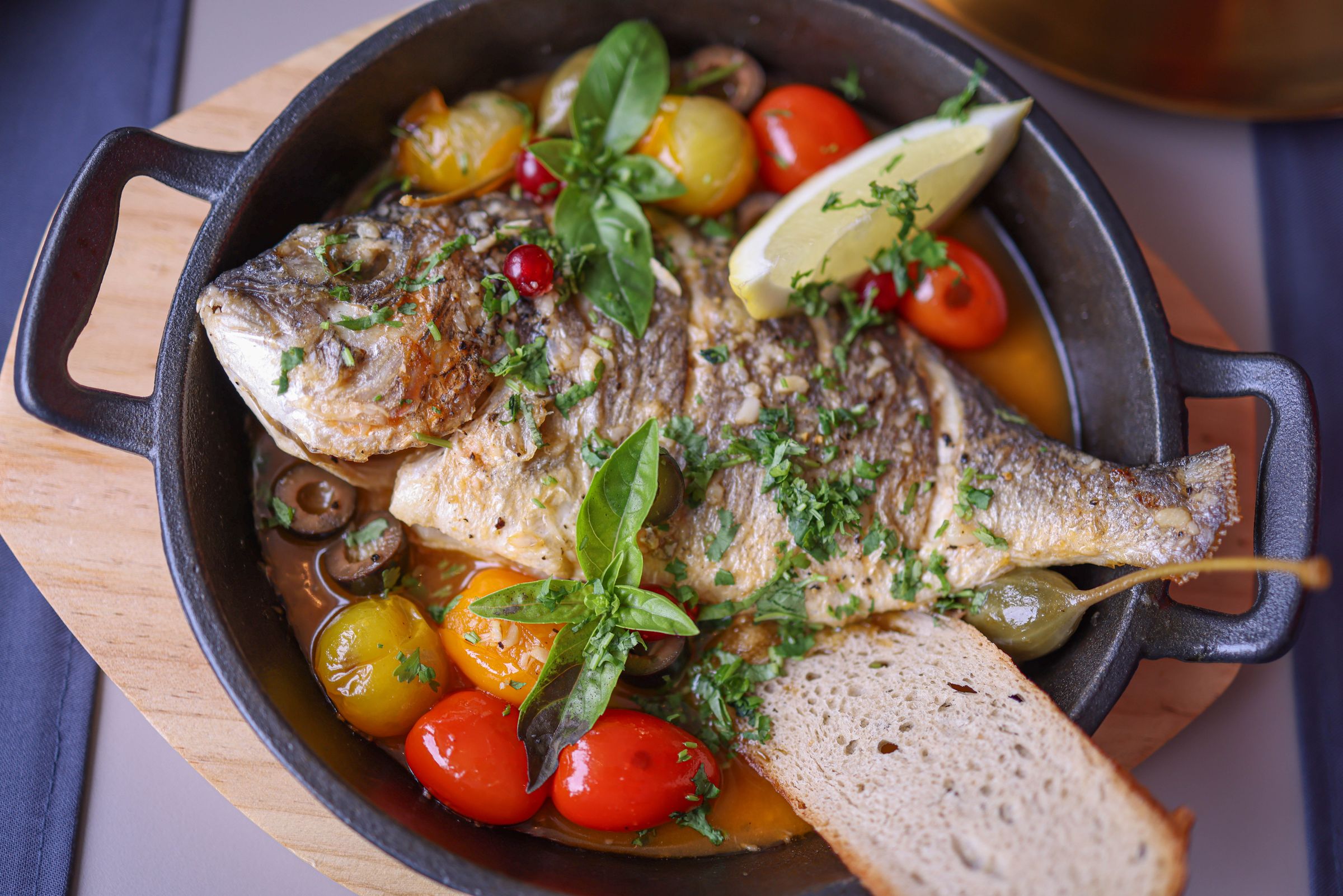
Cetara is the smallest of the Amalfi Coast towns you have probably not heard of. A fishing village of 2,200 souls pressed into a ravine between Vietri and Maiori, it has no cliff hotel and no English menus printed on laminated cards. What it has is the best anchovy in the Mediterranean, an 800-year tradition of salting it, and a dish the boats cooked on their decks because there was nothing else to do with an unsold scorpion fish at 11 a.m. in July. The dish is acqua pazza. Crazy water.
Raffaele De Martino, 61, skipper of the Stella Maris out of the Porto di Cetara, will tell you acqua pazza is not a recipe. It is, he says, a solution. The morning catch goes first to the buyers on the quay, then to the small market under the arcade, then (if there is anything left, which in summer there often is) to the boat's own galley. A scorfano (scorpion fish) with a torn fin, a branzino too small to sell, a few mazzancolle (red prawns) the restaurants did not ask for. With these, a pescatore and a two-burner stove, you invent a way to eat lunch.
The formula holds roughly across the Campanian coast, with variations from Procida to Palinuro. Olive oil, good, not the one you cook pasta in. Four cloves of garlic, crushed, skin on. A handful of pomodorini del piennolo, the small cherry tomatoes hung on strings from the rafters of kitchens on the slopes of Vesuvius. A splash of colatura di alici, Cetara's own aged anchovy liquor (in which all the salt of the dish lives). The fish, whole, gutted and scaled. Enough water (the pazza part) to come halfway up the flank. Ten minutes covered, five uncovered, a handful of parsley, a slice of stale pane cafone (country bread) for the bottom of the bowl. Nobody measures. Raffaele measures with the ladle and his thumb.
Pazza does not mean crazy. It means you used what you had.
Raffaele De Martino
The word itself is the clue. Pazza, in this context, does not translate to crazy in the sense of unhinged. It translates closer to improvised, or on the fly, the adjective a Neapolitan grandmother would use for a decision made at speed with incomplete information. The water is crazy because it is not stock. No bones were roasted, no aromatics simmered for hours. The tomato does the work of umami, the colatura does the work of salt, the fish does the work of the fish. The whole thing takes less than twenty minutes from the flame going on to the parsley going in.
Restaurant acqua pazza and boat acqua pazza are not the same thing. In the elegant dining rooms above Amalfi, a chef plates the fish on a drift of confit tomato, spoons the broth around it with intention, finishes with a slick of raw oil and three basil leaves set as if by tweezers. It is, on its day, excellent. It is not what Raffaele eats for lunch. What Raffaele eats, on the Stella Maris, is the fish in its broth, the pane cafone at the bottom of the bowl gone to the texture of the sea, a second piece of bread in his hand for the mopping. The plating is the bowl. The tweezers are his fingers.
Summer is the dish's season for three reasons and they are all about arrival time. The pomodorini of Vesuvius come in from late June to mid-September, and they are what makes the broth taste like the coast and not like a jar. The colatura di alici produced at Nettuno, at Delfino Battista, and at the Cooperativa dei Pescatori di Cetara finishes a three-year cure around May and June, and the bottles with the summer draw are the ones the fishermen buy for themselves. The catch, in July, is shallow and fast. Scorpion fish come up in the morning and reach the deck still hot from the surface water. The whole dish is an argument for doing nothing to the ingredient except giving it a pan.
If you eat it where it belongs (Al Convento, at the end of Corso Garibaldi, or San Pietro in the Piazza San Francesco, or the small unnamed trattoria attached to the cooperative dock where the tables are sometimes plastic and the bread is always free) you will notice what the restaurants uphill cannot quite reproduce: the oil is already on the fish when it hits the pan. The garlic goes in first in the cold oil, colours slowly, and before it tips toward brown the tomatoes split, the colatura goes in with a small hiss, the fish lies down on top, the water follows. A kitchen up the coast will do these steps in the right order. What it will not have is the oil, which in Cetara is from a grove above the town that presses in November and has been sitting in the pantry, unfiltered, under the stairs. When it hits the hot pan it throws a smell like a beach at the end of August. That, more than anything else, is the dish.
Raffaele, asked what he would tell a visitor who wanted to cook acqua pazza at home, shrugs. He recommends the ingredients, in order of non-negotiability: the colatura first (bottle, not substitute), the tomato second (piennolo if you can find it, datterino if not), the oil third (Campanian or Ligurian, not refined), the fish fourth. A branzino will do. A bream will do. A scorpion fish is better. It is August. The pan is hot. The oil is in. He is putting the garlic down. You smell it already.


