

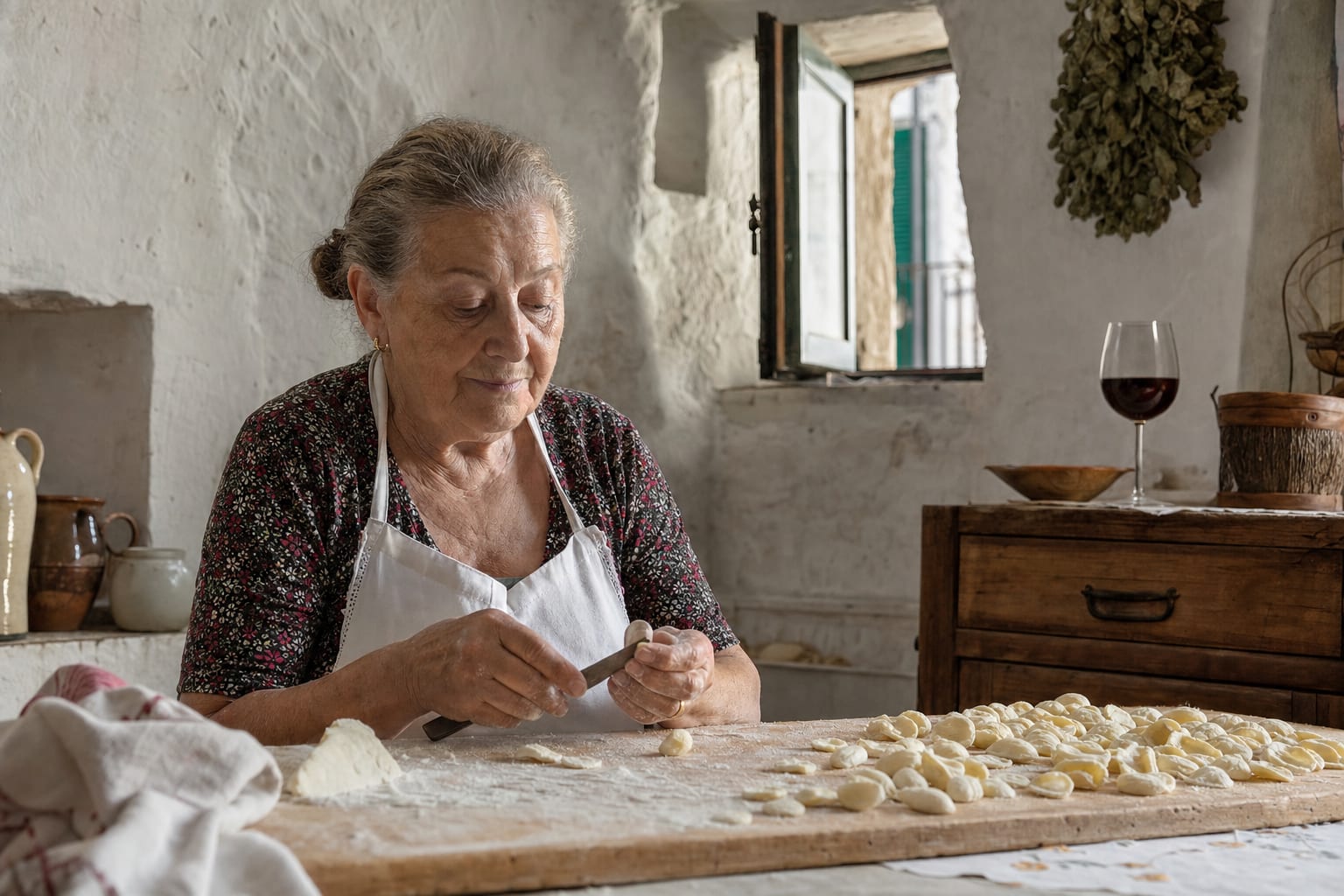
Tuesday is orecchiette day on Via San Quirico in Cisternino, a town of 11,000 on a limestone ridge in the Valle d'Itria, equidistant from Alberobello and the coast at Savelletri. Sig.ra Filomena Lippolis is 72. She makes orecchiette every Tuesday because on Tuesday the kitchen is cool and the butcher on Via Regina Elena has the right pork sausage, and because Saturday has always been for other things. The wooden board on her table is 90 cm wide, sanded smooth in the middle by sixty years of the same motion, and tipped down a quarter of a centimetre on the side closest to her hip, so the flour falls toward her and not onto the floor.
The flour is semola di grano duro rimacinata, twice-milled hard-wheat semolina, from a mill at Altamura forty kilometres north. The rimacinata is the whole point. A single milling leaves the semola too coarse; a second pass reduces the particle to a fine warm yellow that hydrates evenly and holds the thumb-print sharply, which coarser semola will not. Filomena has used the same brand, Molini De Vita, since 1987. She buys a five-kilo sack every three weeks and keeps it in a lidded ceramic jar on the top shelf, out of the humidity that rises off the valley in summer. Her proportion, by hand, is roughly 500 grams of semola to 240 millilitres of tepid water and a pinch of fine salt. She does not weigh. The dough is ready when a ball pressed on the board springs back at the count of two.
She kneads twelve minutes, covers the dough with an overturned terracotta bowl, rests it for twenty, and cuts off a piece the size of a fist. Under her palms she rolls a rope the thickness of her little finger, a movement she learned at six and does without looking at her hands (she is looking, in fact, at the geraniums on the balcony opposite, where the Di Cagno family's cat sleeps in the sun). A short knife, round-tipped, 8 cm, olive-wood handle, sits to her right. With a pulling cut she slices a disc about 7 mm thick from the end of the rope, drags it toward her with the flat of the blade so it curls into a concave shell, catches the shell on the tip of her left thumb, and turns it inside out so the rough, thumb-printed inside becomes the outside. The whole motion takes a second and a half. She will make roughly 600 this afternoon.
Il pollice ha già imparato. Io lo guardo solamente lavorare.
Sig.ra Filomena Lippolis
The partner, on Pugliese tables from late winter through early May, is cima di rapa, the flowering tops of a broccoli relative that grows in the red earth between Ostuni and Martina Franca. By June the leaves turn bitter and the Pugliesi switch to other greens. Filomena picks over a kilo at the sink, keeping the tender crowns and the first two sets of leaves. She boils them briefly in the orecchiette water, lifts them out with a spider, and sautés them three minutes in a wide pan with four tablespoons of olive oil from her cousin's trees at Fasano, two cloves of garlic, and a dried peperoncino broken in half. The orecchiette follow, drained but dripping; the starch catches the oil and the bitter water of the greens. Anchovy, one fillet, optional, melted into the oil if a husband is eating. She grates no cheese. The pasta is dressed and done.
The glass of Primitivo on the sideboard is from a small producer at Gioia del Colle, 14 per cent, opened yesterday. Filomena will pour herself half a glass when the second tray is finished, about four, and sit for six minutes at the open window before starting the cime. A younger neighbour is hanging sheets in the courtyard. The Di Cagno cat has moved to the second balcony. The orecchiette on the tray, rough sides up, have the pale yellow of a late-September afternoon and the small even shadow of sixty years of a thumb that has, as Filomena puts it, already learned. She is only watching it work.


