

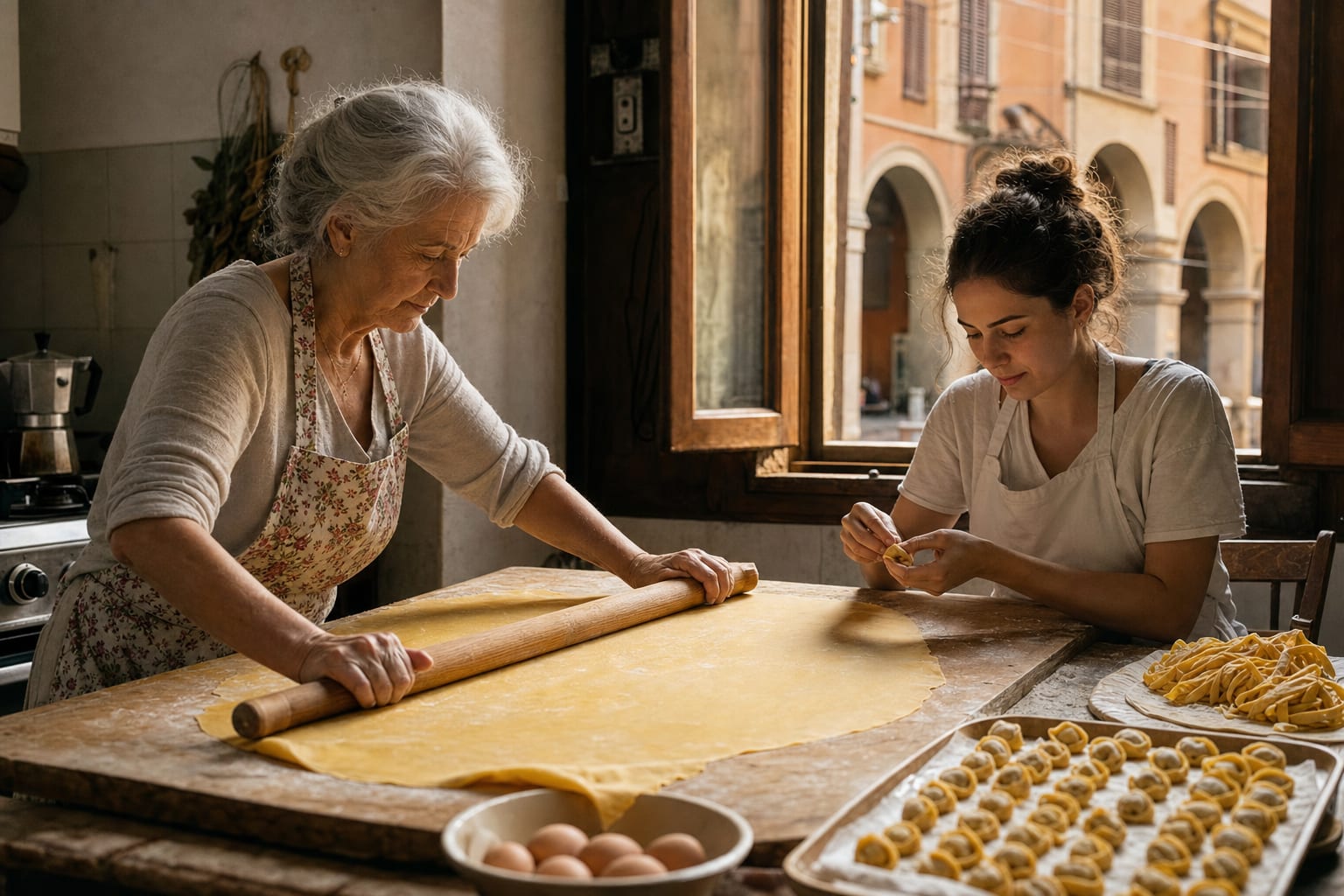
At six in the morning, the kitchen at Trattoria da Vittorio, on Strada Maggiore, smells of flour and espresso and a wood stove that has not gone cold since Tuesday. Sig.ra Lucia Ferrari leans into the mattarello, a rolling pin of maple nearly a metre long, and turns a pale yellow disk of dough under her forearms. The disk thins, widens, loses its edges. In eleven minutes it will be a sfoglia. Soon after that it will be tagliatelle, then tortellini, then whatever the lunch service asks of it. Lucia is 82. She has done this, roughly, since she was nine.
Her hands, as she works, seem to warm the table itself. Bolognesi sfogline (the women who make the sheet) will tell you that a pastry marble is wrong for egg pasta: the cold stops the dough, which needs the slight give of wood under a warm palm. Lucia's table has the shallow bowl that forty years of rolling have ground into its surface. She does not use scales. The proportion, she says, is one egg to 100 grams of flour, soft 00, with a pinch of semola if the kitchen is humid. The eggs come from a farm outside Imola. The flour is a mill she has used since 1984. The semola is for her mother's hand, she says, not hers, but old habits.
Across the table is Giulia Marchi, 28, in a cotton apron still stiff from the packet. Three months ago she was finishing a master's in cultural heritage at the university. Today she is apprenticed four mornings a week at Lucia's elbow, learning the things that cannot be written down: how a sfoglia sounds when it is thin enough (a dry whisper when lifted), how a tortellino is closed so the filling never breaks out in the pot, how to read a dough by smell before you press it. The Bolognese word for the sheet, sfoglia, and for the woman who makes it, sfoglina, share a root with the verb sfogliare: to leaf through, to turn a page.
If you rush the sheet, you lose it. The pasta tells you when it is ready; the hand only listens.
Sig.ra Lucia Ferrari
The thickness is the quiet heart of it. A good sfoglia for tagliatelle in Bologna finishes at roughly eight tenths of a millimetre (0.8 mm), pale enough that a newspaper headline beneath shows through. Tagliatelle, by a 1972 measure kept at the Camera di Commercio in the Palazzo della Mercanzia, must end up 8 mm wide when cooked. Tortellini are cut from squares of 3 cm, filled with a mortadella-prosciutto-loin mix seasoned with Parmigiano and nutmeg, then folded around a fingertip. Each shape has a sauce it belongs with: tagliatelle with ragù (never, Lucia sighs, with anything called alla bolognese abroad), tortellini served in brodo di cappone (capon broth), tortelloni in butter and sage, garganelli (the ridged quill shape rolled on a comb) with cream and prosciutto. She rattles off the grammar of her city's table the way someone else might recite a rosary.
It is easy to sentimentalise this work. The sfogline of Bologna themselves are not especially interested in being sentimentalised. What they want to talk about, if you sit long enough, is the problem of counting. In 1990, according to an internal census taken by the Ordine delle Sfogline (the informal guild that has since become a school), there were roughly 400 women rolling pasta professionally in the city and its immediate comune. By 2015 the figure had halved. By 2023, in a survey run jointly with the Confcommercio Ascom trattoria association, the number of full-time sfogline working in restaurant kitchens inside the centro storico was 58. In the neighbouring towns of Castel Maggiore, Budrio and San Lazzaro it was another 31. The total held steady only because a handful of older women had returned part-time.
The reasons are not mysterious. Restaurants added pasta machines through the 1980s and 1990s, first the hand-cranked Imperia, later the extruders that produce a kilo of orecchiette in four minutes. A sfoglina, working at pace, makes a kilo of tagliatelle in about forty. The wage did not keep up with the city. The daughters of the sfogline went to university. The grand-daughters went to Milan. Bologna's centro storico became dense with tourists looking for a plate they had read about in English, and many kitchens, pragmatically, served them a close-enough approximation. Hand-rolled pasta became, without anyone quite deciding, a boutique.
The pay, to be candid, is part of it. A sfoglina working four mornings a week in a good trattoria, on the 2024 collective agreement for the sector, earns between 1,300 and 1,700 euro net per month depending on seniority. That is less than a line cook at a mid-range hotel on Via Marconi, and considerably less than a pasta-machine operator at a supermarket producer in Anzola dell'Emilia. The difference between the two jobs, the sfogline will tell you, is mostly dignity, which does not pay rent. The Scuola in Via Galliera has been lobbying the comune since 2021 for a small professional stipend tied to a city register of accredited sfogline, modelled on the one Venice uses for gondola builders. As of this writing, the register exists; the stipend does not.
And then, as sometimes happens in Italy, the decline made the thing legible. In 2014 a cooperative of eleven women founded La Vecchia Scuola Bolognese on Via Galliera, a school where the sfogline themselves teach. In the years since, the Scuola delle Sfogline at Palazzo Poggi (run under the university's food studies programme) and a second laboratory at the Alce Nero cooperative kitchen outside Monterenzio have joined them. By 2024 the three schools together had trained nearly 900 students, about 40 per cent of them Italian, the rest from Japan, France, Germany, the United States, Brazil. A small but pointed proportion were Bolognesi under 35 who had decided, specifically, that they wanted to do this.
I did not come back because it was disappearing. I came back because it was still here.
Giulia Marchi, apprentice
Giulia is one of the Bolognesi. She grew up in Bolognina, a tram ride north of the porticoes, in a flat where her grandmother rolled tortellini on Sundays on a marble pastry board (the wrong surface, Lucia will tell you later, with a small fond smile; her grandmother, Giulia reports, was stubborn). She spent her twenties reading heritage policy. She wrote a thesis on intangible cultural heritage under the 2003 UNESCO convention. Somewhere in the middle of it, she says, she realised the thing she was writing about was being held together, in her own city, by perhaps sixty pairs of hands. She wrote to the Scuola. Lucia answered.
The apprenticeship is unglamorous. Giulia arrives at 5.45, puts the first flour down, learns to read the room's humidity off the windows. She does not touch tortellini in her first month; the form takes more wrist than shoulder, and until the wrist is trained, the tortellini come out lopsided and open at the seam in the pot. (Lucia scoops these out, cheerfully, and feeds them to the cook's dog, who loves them.) She learns tagliatelle first because the cut is forgiving. She practises, on days off, on a second-hand table her cousin helped her carry up three flights in Bolognina. Her forearms, she reports, ache in places she did not know had places.
What catches in the throat, watching them at the table, is how little of the work is visible. A tourist who eats tortellini in brodo at Trattoria da Vittorio on a Thursday sees a small bowl of broth and twelve pieces of pasta the size of a thumbnail. They do not see that the broth was made yesterday from a capon Lucia chose at the Mercato delle Erbe herself (she has opinions about birds), that the filling was mixed at four in the morning, that the pasta was rolled at six, that Giulia will roll her first passable tortellino sometime in 2026, perhaps, and that Lucia will still check each one before it goes into the pot.
Bologna, unlike many Italian cities, has not turned its craft into a museum. The sfogline still work in kitchens, not behind glass. You can find them at Trattoria di Via Serra in the Bolognina, at Trattoria Anna Maria near Piazza Aldrovandi, at Sfoglia Rina on Via Castiglione (the closest thing the craft has to a public stage, with a long window onto the work), at da Cesari in San Vitale. Most of them will not mind if you watch, provided you do not loom. They will mind if you ask them to pose.
The other thing they mind is the word tradition, used loosely. The sfogline are not, as a group, sentimentalists. The mattarello they use, a cylinder of hard maple about 85 cm long and 3 cm in diameter, only became standard in Bologna in the 1920s; before that many women used a shorter pin and pieced the sfoglia in sections. The ratio of eggs to flour has shifted twice in living memory with the shift in egg size. The ragù itself, now inseparable from tagliatelle in the Bolognese imagination, was codified by the Accademia Italiana della Cucina only in 1982. When the sfogline say they do things as they have always done them, what they mean, more precisely, is that they do things as they were taught by the woman who taught them, which in Lucia's case was her aunt Immacolata in the Quadrilatero in 1953, and whose methods, given the pace at which anything changes in a kitchen, track roughly back to Bologna between the wars. The chain is short enough to count and long enough to matter.
At 11.40 on a Thursday in late May, Lucia pauses. She wipes her hands on the corner of her apron, looks at the sfoglia, and nods once. Giulia lifts the sheet with the mattarello, a movement that still surprises her a little, and lays it onto the board to cut. The knife is a Sanelli from 1979, rewelded once at the heel. The cuts come: tagliatelle, fanned out in nests the size of a child's palm. Lucia watches for three nests and then walks to the stove to check her broth. She does not, in seventy years of rolling, think of this as heroic. She thinks of it as lunch.
What the sfogline of Bologna are doing, it turns out, is neither preservation nor revival. It is just the thing itself, continuing, on enough tables to still be a living craft instead of a rehearsed one. The number 58 is not large. It is not a crisis either, yet. Giulia will, in a decade, probably roll pasta at her own table in her own kitchen in a trattoria that does not yet have a name. The dough will be soft 00, with a pinch of semola when the kitchen is humid. The eggs, perhaps, from the same farm. The sheet, in eleven minutes, will be a sfoglia. A newspaper headline beneath will show through. A different tourist, on a different Thursday, will not see what it took. That, Lucia would say, is the point.


