

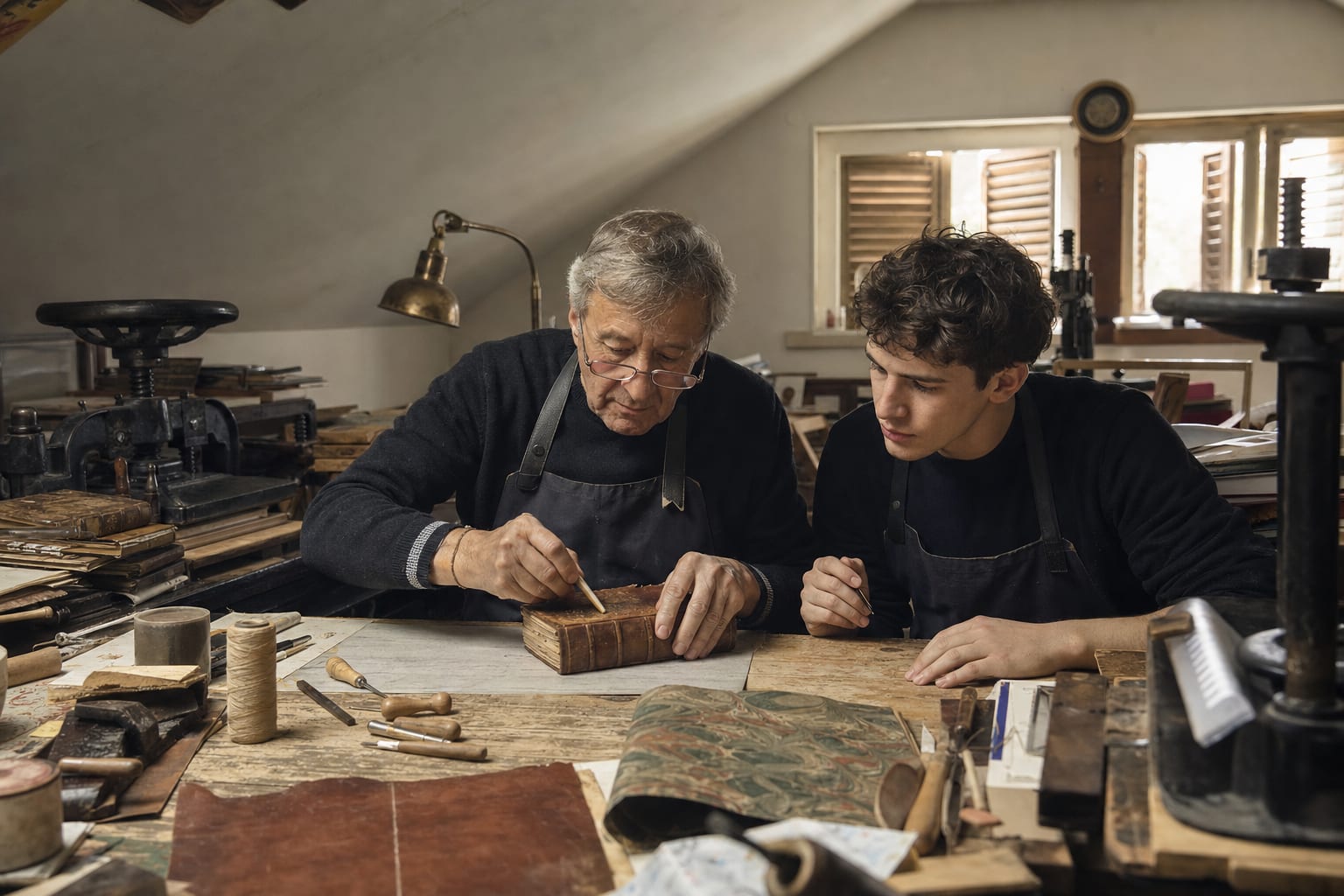
Via dei Fossi runs behind Santa Maria Novella, narrow enough that a delivery van has to fold its mirrors to pass. At number 47, behind a door the colour of old ox-blood, Matteo Baldassari has been rebinding books since 1981. The workshop is one long room: chestnut benches, a cast-iron standing press from 1904, a wall of wooden-handled tools ranged by length, and the particular smell of a legatoria (beeswax, hide glue warm on a low flame, vegetable-tanned calfskin, paper dust that catches the afternoon sun when the shutters are opened at four). Baldassari is 67. His hands, spatulate and stained from gold leaf and the iron of a burnisher, cut a sheet of handmade Amalfi paper to tenth-of-a-millimetre tolerance without a ruler.
At the bench opposite him, in a cotton apron the same blue as the Arno in November, works Caterina Falorni, 24. She is his first female apprentice in thirty years. The last, Fiorella, went to Bologna in 1996 to run a private collection; in between, four young men passed through, two finished, two did not. Caterina is two years and four months in, roughly a third of the way through a legatoria apprenticeship as Baldassari counts it. The full course, he will tell you without sentiment, is seven to eight years. Less than that and the hand has not been in every part of the process often enough for the process to live in it.
The book on the bench this month is a 1622 first edition of Galileo's Il Saggiatore, the polemic that argued mathematics was the language in which the universe is written. It arrived three months ago from the Biblioteca Riccardiana on Via de' Ginori, in a plastic conservation sleeve, with a spine parted cleanly down the middle, the front board detached but intact, and signatures needing resewing on five double cords. Baldassari quoted eleven weeks of labour and a materials budget of 340 euro. The library accepted, as libraries always do here, with a small sigh at the estimate and a small gratitude at the price.
The craft is called legatura a mano. It divides, roughly, into ten operations, each with its own vocabulary: collazionare (checking the signatures), smontare, pulire, consolidare (repairing tears with colletta, a cooked wheat-starch paste), risarcire (filling losses with matched paper), ricucire (sewing on five hemp cords the thickness of string), indorsare (rounding the spine with a hammer called a martelletto), coprire (paring the calfskin to 0.4 mm at the edges), and decorare (the gold tooling, stamped hot with brass fillets the workshop has used since Baldassari's father's time). Caterina, at two years in, has done all but the last unassisted. The tooling is the last thing you are given.
The book teaches you. If you listen, it does. If you do not, you ruin it, once.
Matteo Baldassari
The economics are not generous. Baldassari pays his apprentice 900 euro a month in the first year, 1,150 in the second, 1,400 in the third, on a contratto di apprendistato professionalizzante the Regione Toscana partly subsidises. Caterina lives in a shared flat in Rifredi and buys her tools from Baldassari's back cupboard at the prices he paid in the 1980s (he writes the old lire on the tags, then converts, with a pencil). A boxwood folder, 9 euro. A Mamoli burnisher, 28. The standing press, when Baldassari retires, is promised to whichever apprentice is finishing. He told her this in March, after she had rebuilt the corners of a 19th-century Divina Commedia without correction. She did not mention it to her parents until May.
By the count of the Associazione Italiana Rilegatori e Restauratori, 146 hand-binders are still active in Italy, 31 of them in Florence. In 1975 the Florentine figure was 218. The drop is not even: the masters in their sixties and seventies are holding; the cohort born roughly between 1975 and 1990 largely did not enter the trade. The people now in apprenticeship are in their twenties. The Istituto per l'Arte e il Restauro di Palazzo Spinelli, in the Oltrarno, enrolled 38 students in its three-year bookbinding course in 2024 to 2025; 29 were women. Baldassari describes it as a return to the 1880s, when a third of Florentine binders were women working on devotional texts and private libraries.
Why does the craft survive. Three reasons, in order of size. First, the libraries: the Laurenziana, the Riccardiana, the Marucelliana, the Nazionale Centrale, the diocesan archive at the Curia, a dozen private family libraries in villas above Fiesole and in Chianti, all holding books that need rebinding every generation or two. Second, the private collectors in Milan, Geneva, London and New York, for whom Baldassari has rebound an eighteenth-century atlas of Persia, a family set of Manzoni, and a music manuscript believed to be a working copy from the court of Lorenzo the Magnificent. Third, the university conservation programmes, which send books and students in roughly equal numbers.
At 3.40 on a Thursday in late May, Baldassari lifts the Saggiatore, newly sewn, onto the standing press. The cords are laced through the boards, a method called in-quadro, unchanged since the fifteenth century. Caterina is paring the calfskin, a piece of light fawn vitello from a tannery in Santa Croce sull'Arno, with a lifting knife called a scalpello a mezzaluna. She works from the flesh side, angling the blade almost flat, removing hair-thin curls that fall onto the stone like paper shavings. Baldassari watches for thirty seconds, nods once, and says nothing. The cut, when she finishes, is even to under half a millimetre. In eight weeks he will let her tool the first blind fillet. A month after that, she will tool the gold.
The Saggiatore, when the Riccardiana takes it back in mid-August, will look as if nothing has happened to it. That is the point. The work of a legatore, well done, is invisible: the book opens as it opened in 1622, the signatures lie flat, the new calf is almost indistinguishable from the old. No one will know that a 24-year-old in a blue apron spent a week paring a single piece of leather, or that a 67-year-old checked the sewing tension on five cords with the back of his thumbnail and adjusted it twice. The book will simply be readable again. Caterina, in five and a half years, will be a legatrice in her own right. Baldassari will still be at the bench opposite hers. The book will be another book.


