

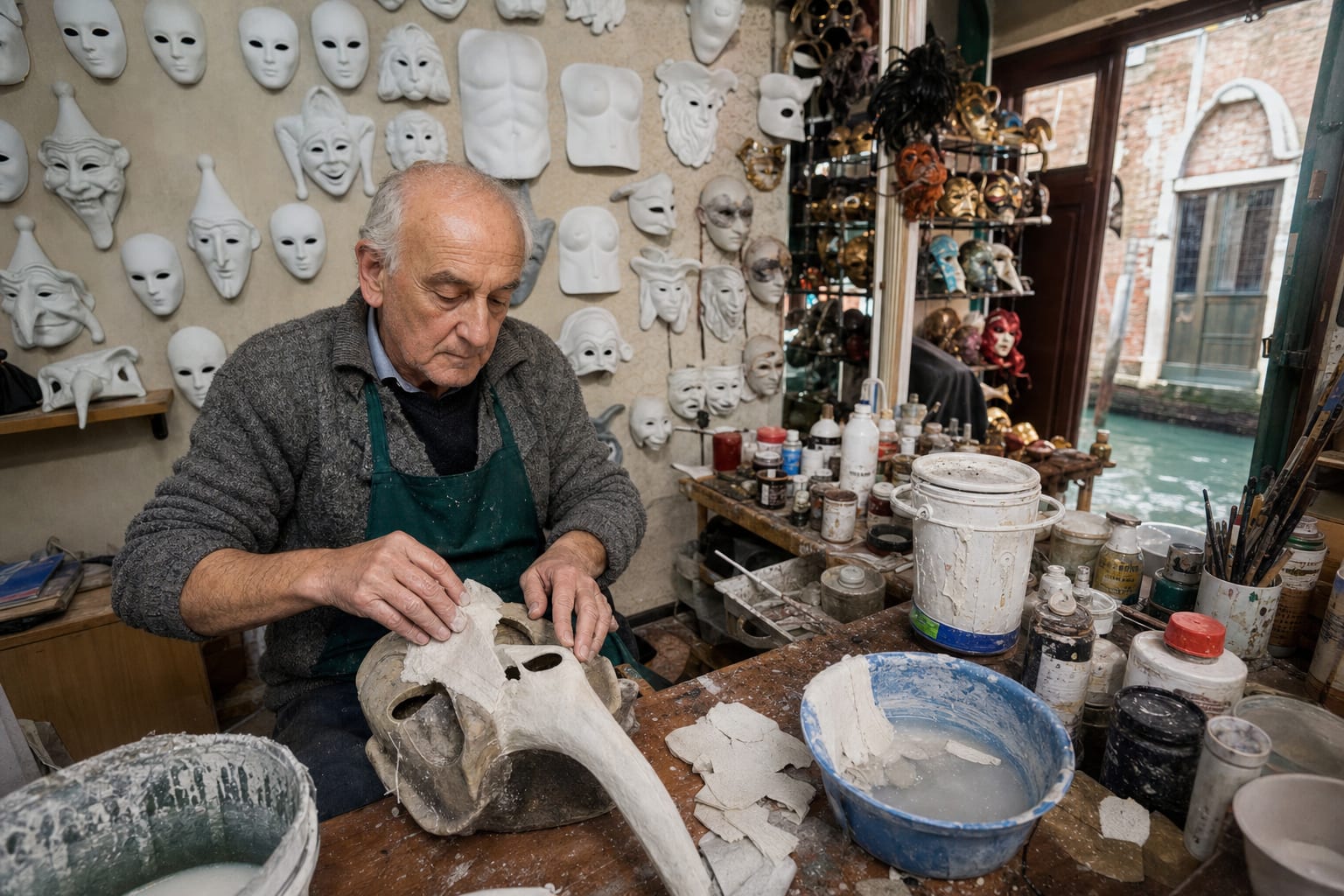
The workshop of Alvise Rigon sits two canals north of the Strada Nova, on the Fondamenta degli Ormesini, in the quieter half of Cannaregio. The door is painted the dark green of an old Venetian shutter, and the sign reads Bottega Rigon, mascherero, 1962. Through the window you can see a man of 58 in a leather apron, leaning on an oak bench, pressing strips of torn brown paper into a plaster mould. When the door opens the smell is of wheat paste, linseed oil, and the sawdust of planed poplar.
Alvise is one of roughly fourteen mascherai still working in Venice to the traditional papier-mâché technique. His grandfather, Leonardo Rigon, opened the bottega in 1962, when the craft was being revived by the city's theatrical community. His father, Bruno, ran it through the years the comune re-founded the Carnevale in 1979. Alvise took the bench over in 2008. He learned, as his father did, by cleaning brushes for a decade before being allowed to touch plaster.
The technique is four centuries older than the workshop. The mascherer carves a positive in clay, takes a negative in plaster, sets the mould mouth-up on the bench. Strips of brown kraft paper, four centimetres wide, are torn (never cut; the torn edge blends under the next layer), dipped in flour-and-water paste thickened with hide glue, pressed into the mould. Seven layers for a face mask, nine for a heavier Capitano or Dottore, each crossing the previous at right angles. The stack dries 48 hours at 18 to 20 C. It comes out a light rigid shell the weight of a pear.
In Cannaregio nobody watches you work. That is why I make masks here. If I tried to do this in Calle del Mezzo, I would finish nothing.
Alvise Rigon
On the bench this afternoon is a Capitano, the boastful Spanish soldier of the commedia dell'arte: long pointed nose, painted moustaches. The nose is the difficult piece, eleven centimetres forward of the face plane, too much to build in paper alone. Alvise cuts a light cone of cartoncino, fixes it into the wet shell with paste, and overlays four further layers across the join. A heavy nose on stage tips the mask forward, and the actor's sightline with it.
He paints under a work-lamp whose bulb has been in the socket since 2017. Acrylic for the base, oil for the final glaze, gold leaf only for a few pieces a year. The Capitano is commissioned by a small Padua theatre company that performs commedia in Italian eight times a year in a converted cinema. The actor's photograph came with the commission; the nose is shaped to miss his line of sight by one centimetre at the cheekbones. Alvise measures with wooden calipers that belonged to his grandfather.
He works in Cannaregio deliberately. In San Marco the rents are four times what he pays on the Ormesini, and to cover them he would have to sell the printed plastic masks that arrive by the case from factories outside Venice. He will not. In Cannaregio the foot traffic is Venetian, the ground-floor shops are mostly craftspeople or small groceries, and the people who come in mostly know what a papier-mâché mask is. He sells perhaps forty from the workshop a year and thirty more on commission. He has never kept a website.
The fondamenta was lined with rope-making sheds (ormesini, from the Persian hormuz cloth once traded here) when his grandfather rented the shop. The rope makers are gone; a cocktail bar opened on the corner in 2022. Cannaregio does what Venice has always done: it changes slowly enough that the people who live in it can change at the same rate. What he minds is the shops that pretend, selling masks they did not make, in premises labelled atelier, without a plaster mould on site.
At the end of the afternoon the Capitano sits on the bench beside two others in progress. Alvise turns it on its armature, checks the eye holes, covers it with a cotton cloth. In three weeks, if the weather behaves, it will travel in a wooden crate to Padua. Tomorrow, at 08.30, he starts the Pantalone.


