

The unruly, magnificent capital of the south, where Spaccanapoli cuts dead-straight through a Greek street grid and Caravaggio shares the city with the Veiled Christ in the Sansevero Chapel.
The Archaeological Museum guards Pompeii's treasures, and the world's first pizza was born in these alleys.
When to visit Naples
Average highs and lows across the year.
Month by month
- Jan
- Cold winter weather with occasional rain. Layer up and bring a warm coat.
- Feb
- Still winter-like with cold temperatures. Expect some rainy days.
- Mar
- Spring begins with mild temperatures. Weather can be changeable.
- Apr
- Pleasant spring weather with blooming flowers. Light jacket recommended.
- May
- Warm late spring days. Perfect for outdoor activities.
- Jun
- Summer arrives with warm, sunny days. Stay hydrated.
- Jul
- Peak summer heat. Best enjoyed with coastal breezes or air conditioning.
- Aug
- Hot summer continues. Many locals take vacations.
- Sep
- Pleasant early autumn. Still warm enough for light clothing.
- Oct
- Autumn weather sets in. Bring layers for cool evenings.
- Nov
- Cool autumn weather with increasing rain. Light jacket essential.
- Dec
- Winter conditions return. Cold and occasionally rainy.
What to see first
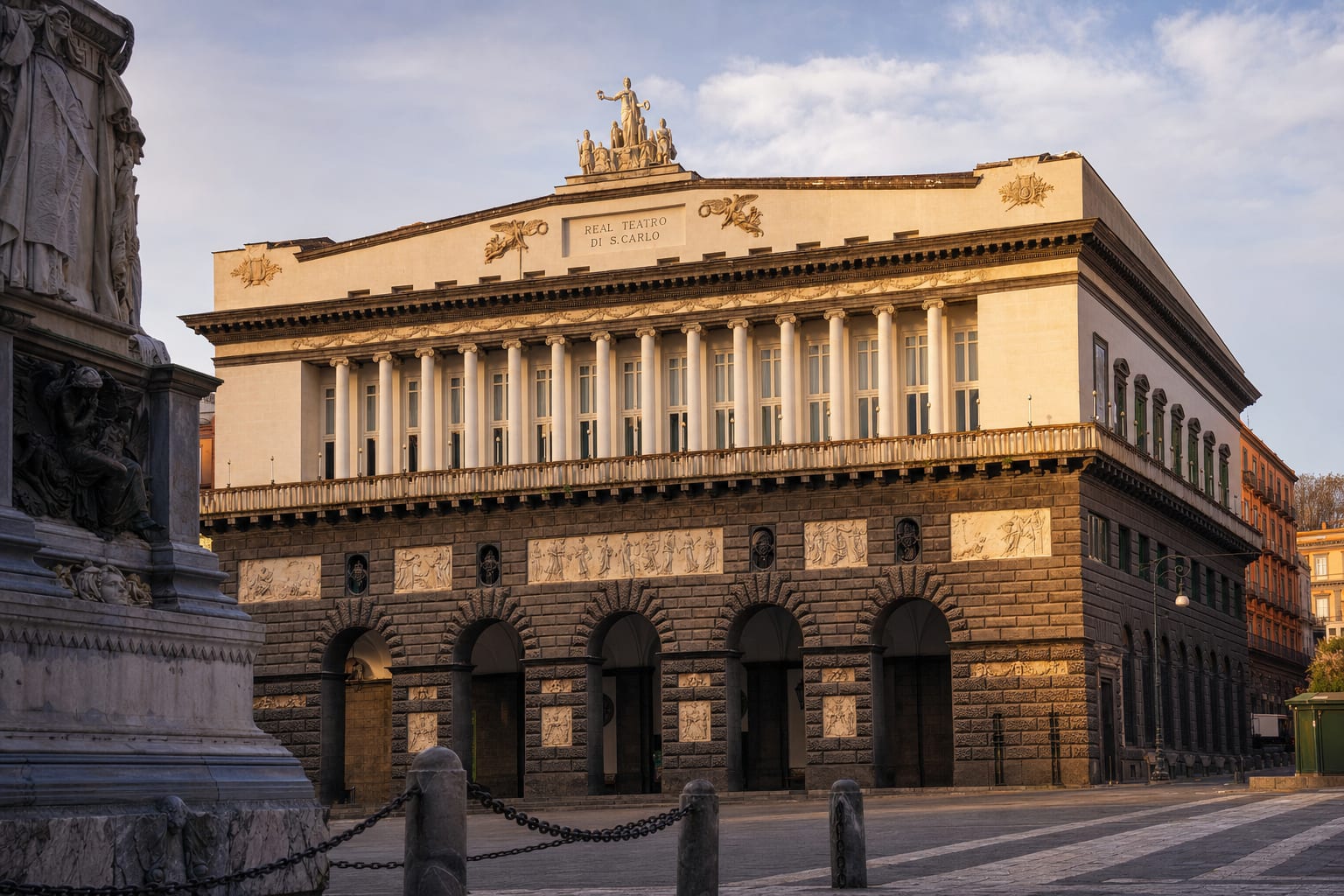
Teatro di San Carlo
The world's oldest continuously active opera house, opened for a Bourbon king in 1737.
Read the guide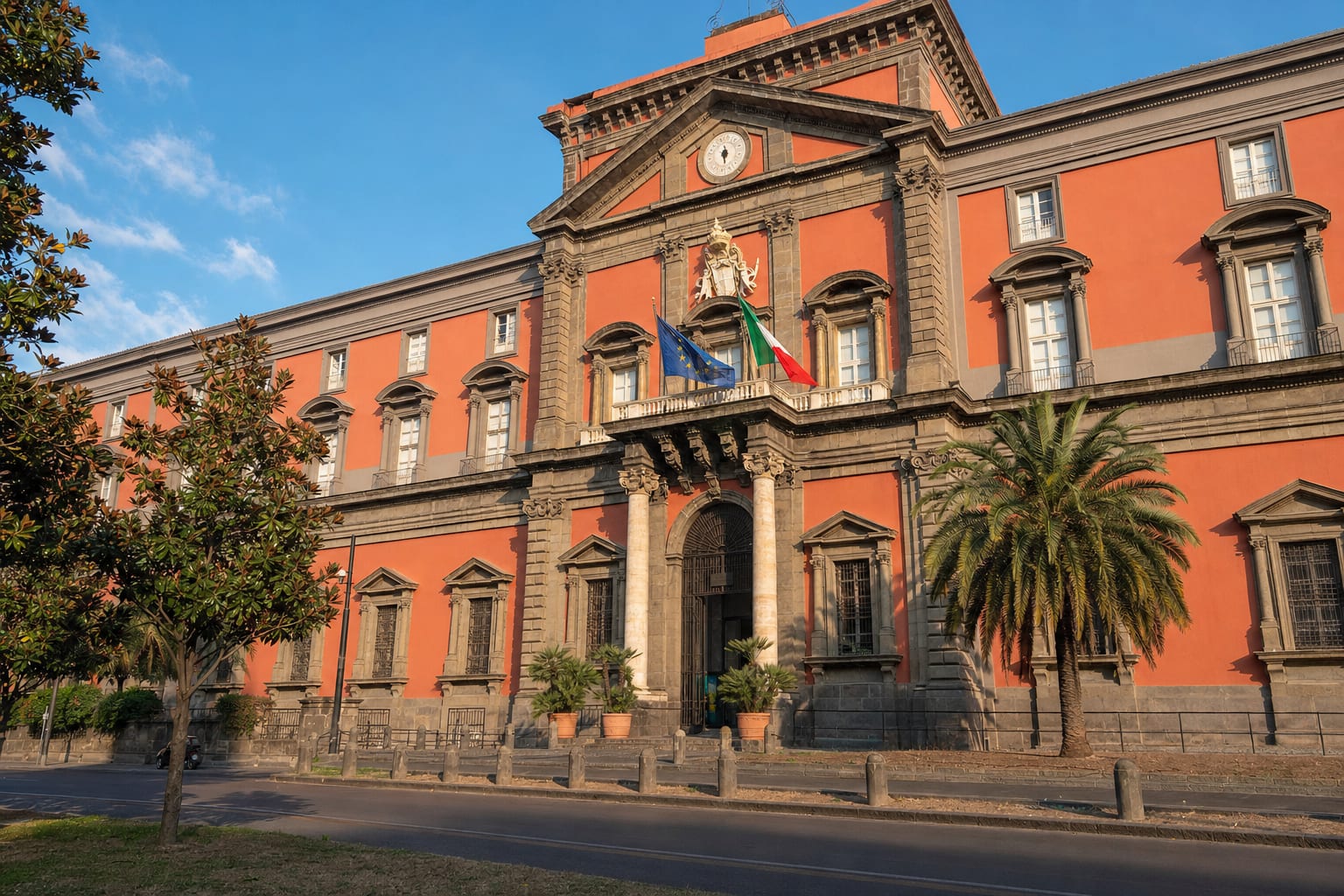
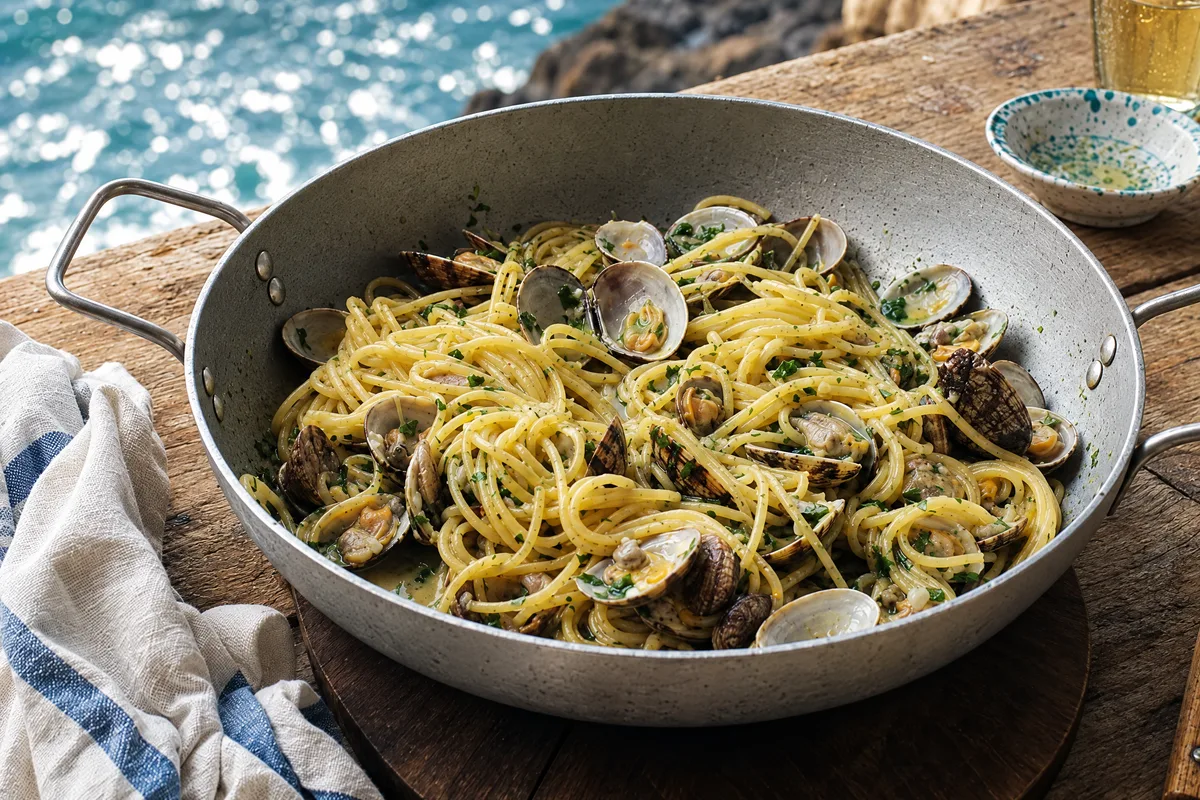


Eating and drinking in Naples
Well-loved everyday tables and Michelin stars, each checked open.
- La Locanda del MonaconeOsteria
- Osteria Gentile NapoliOsteria
- Antonio SorbilloPizzeria
- La Locanda Gesù VecchioTrattoria
- 'A Puteca d' 'a PizzaPizzeria
- Osteria da Ciccio e MeryOsteria
Michelin-starred
- George Restaurant ★★
- Taverna Estia ★★
- ARIA ★
- Il Ristorante Alain Ducasse Napoli ★
- Veritas ★
Sleeping in Naples
Well-reviewed places to stay, each checked open, by town.
- Neocore
- Grand Hotel Parker's
- Grand Hotel Vesuvio
- Grand Hotel Saint Lucia
- The Bellini House
- AuRoom Luxury Accommodation
The year in Naples
The rituals, races, and processions the city still keeps.
Tours worth booking in Naples
Compared by our editors, across providers.
Booking through these links may earn Italia Magnifica a commission, at no cost to you.
- Viator
- 4h 30m
- 5.0★ · 36 reviews
from €50Book this tour- Viator
- 8h
- 5.0★ · 28 reviews
from €179Book this tour- Viator
- 3h
- 5.0★ · 21 reviews
from €44Book this tour- Viator
- 2h
- 5.0★ · 21 reviews
from €290Book this tour


Naples in a nutshell
Naples is Napoli to Italians, and for a first visit the useful answer is not a list of everything around the bay. It is a choice among several dense urban systems inside the city: the Greek and Roman street grid of the ancient centre, the sacred and museum corridor around Via Duomo, the civic and royal city around Municipio and Piazza del Plebiscito, the waterfront from Santa Lucia towards Chiaia and Mergellina, the heights of Vomero, and the tuff landscape of Sanità and Capodimonte. Each can fill half a day.
Naples contains the UNESCO World Heritage property called the Historic Centre of Naples, inscribed in 1995, covering 1,021 hectares with a 1,350-hectare buffer zone. It is a defined area, not a blanket badge: not every part of the city is World Heritage, and not every building inside the mapped property has its own UNESCO status.
The fastest way to understand Naples is to preserve its vertical and horizontal layers. At street level, the Greek plan still disciplines movement through long east-west axes and narrow north-south links. Below them are quarries, water systems, burial chambers, archaeology, and wartime shelters that belong to different periods and operators. To the south, royal and maritime spaces open towards the bay. To the north and west, hills alter distance: two points that seem close on a map may be separated by steep streets or a large change of level. Plan by connected zones, reserve timed interiors, and leave room for churches whose access changes with worship.
The ancient plan is still the best map
UNESCO and the Italian Ministry of Culture distinguish the earlier Parthenope, or Palaepolis, from the later Greek foundation of Neapolis, and identify its rectangular grid as a structure still discernible in the historic centre. The grid is best read as an urban system rather than a match between any one present street and the whole ancient plan.
The Sansevero Chapel, the Cathedral complex, and Pio Monte della Misericordia are separate institutions, each with its own custody, functions, tickets, and access conditions. Treat them as three distinct visits rather than one circuit.
The plan also explains why Naples can feel compressed. Churches occupy or replace earlier structures, palaces turn narrow fronts into deep courtyards, and archaeology appears below current buildings. UNESCO describes a continuous urban and social stratification from Greek foundation through Roman, Byzantine, ducal, Norman, Swabian, Angevin, Aragonese, Spanish, Bourbon, and modern phases. That sequence should not be read as a parade of foreign rulers. It is visible in street widths, fortifications, religious complexes, royal projects, craft streets, housing, public institutions, and continuing daily use.
Greek, Roman, and underground Naples
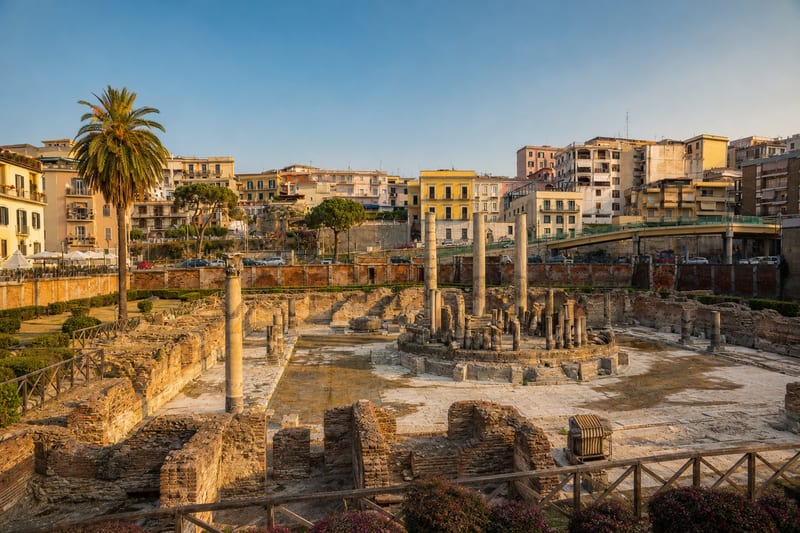
Ancient Naples is not Pompeii transplanted into a modern city. Its evidence is fragmented through the living centre. The remains under San Lorenzo Maggiore, the Roman theatre areas, Greek walls, burial landscapes, the Crypta Neapolitana, catacombs, aqueduct passages, quarries, and later shelters represent different sites and histories. Each is a different site with its own operator. The phrase Napoli Sotterranea is also used for a specific authorized route entered from Piazza San Gaetano, not for every cavity under the municipality. Its operator describes Greek quarrying, Roman water infrastructure, cisterns, and Second World War shelter use on that route.
Visitors should choose underground experiences by content and physical conditions. The San Lorenzo archaeological route is an urban archaeology experience. The Piazza San Gaetano circuit focuses on cavities and water infrastructure, with confined sections and stairs. The Bourbon Gallery tells a much later story of a nineteenth-century military passage and wartime adaptation. Catacombs are burial and devotional systems, not tunnels in the same category. Depth, stairs, confined sections, and footwear differ from route to route, so choose by what you can comfortably do.
The Catacombs of San Gennaro sit within the municipality in the Sanità and Capodimonte system. The complex distinguishes upper and lower complexes, early Christian paintings, the underground Basilica of Sant'Agrippino, tomb forms, and the history of San Gennaro's burial.
From duchy to European capital
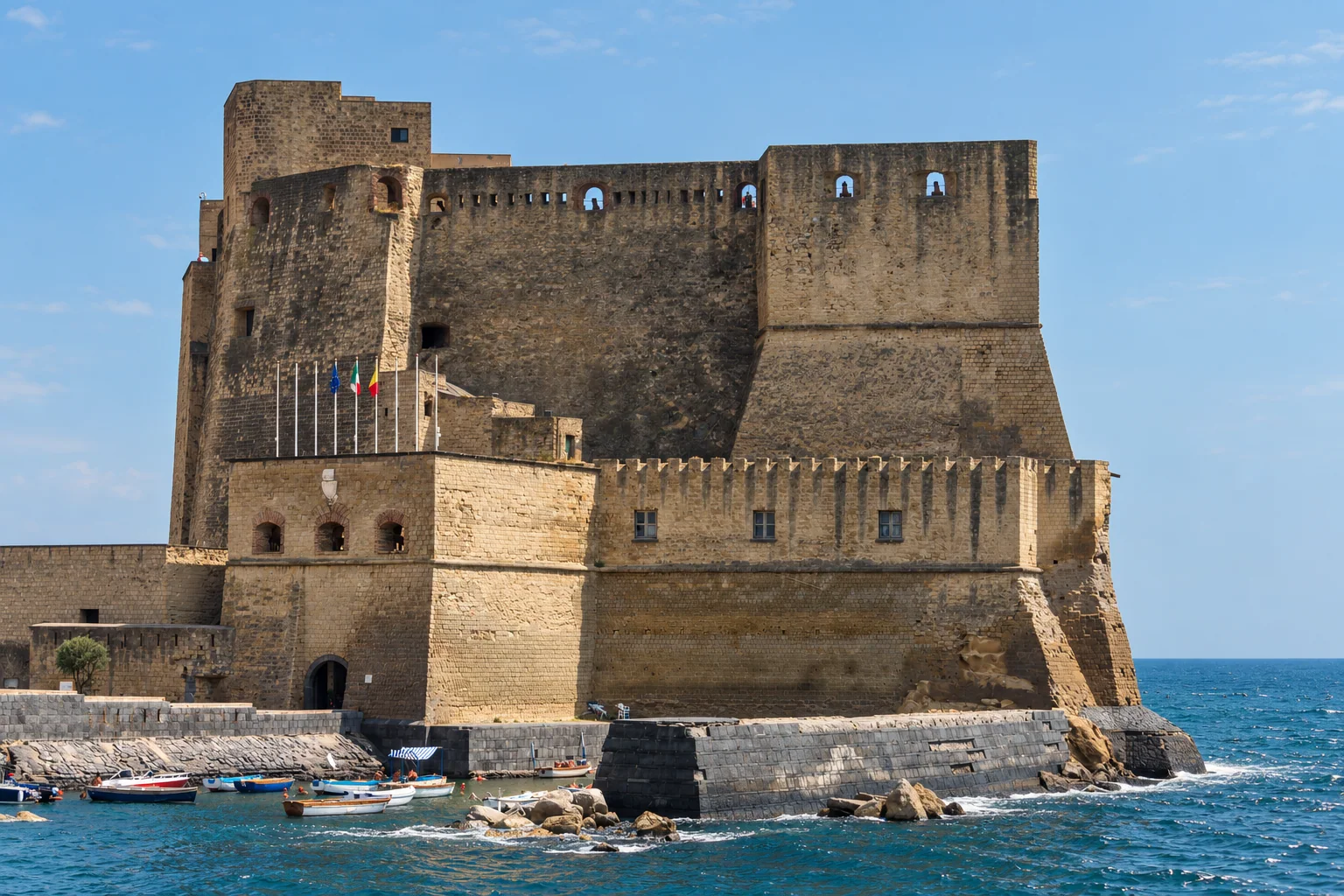
After antiquity, Naples developed as a Byzantine and then autonomous duchy before passing through Norman and Swabian political systems. UNESCO points to early Christian fabric at San Gennaro extra moenia, San Giorgio Maggiore, San Giovanni Maggiore, and Santa Restituta, while Castel dell'Ovo preserves a repeatedly transformed fortified presence. These traces are not all open in the same way: some are active churches and some are archaeological layers.
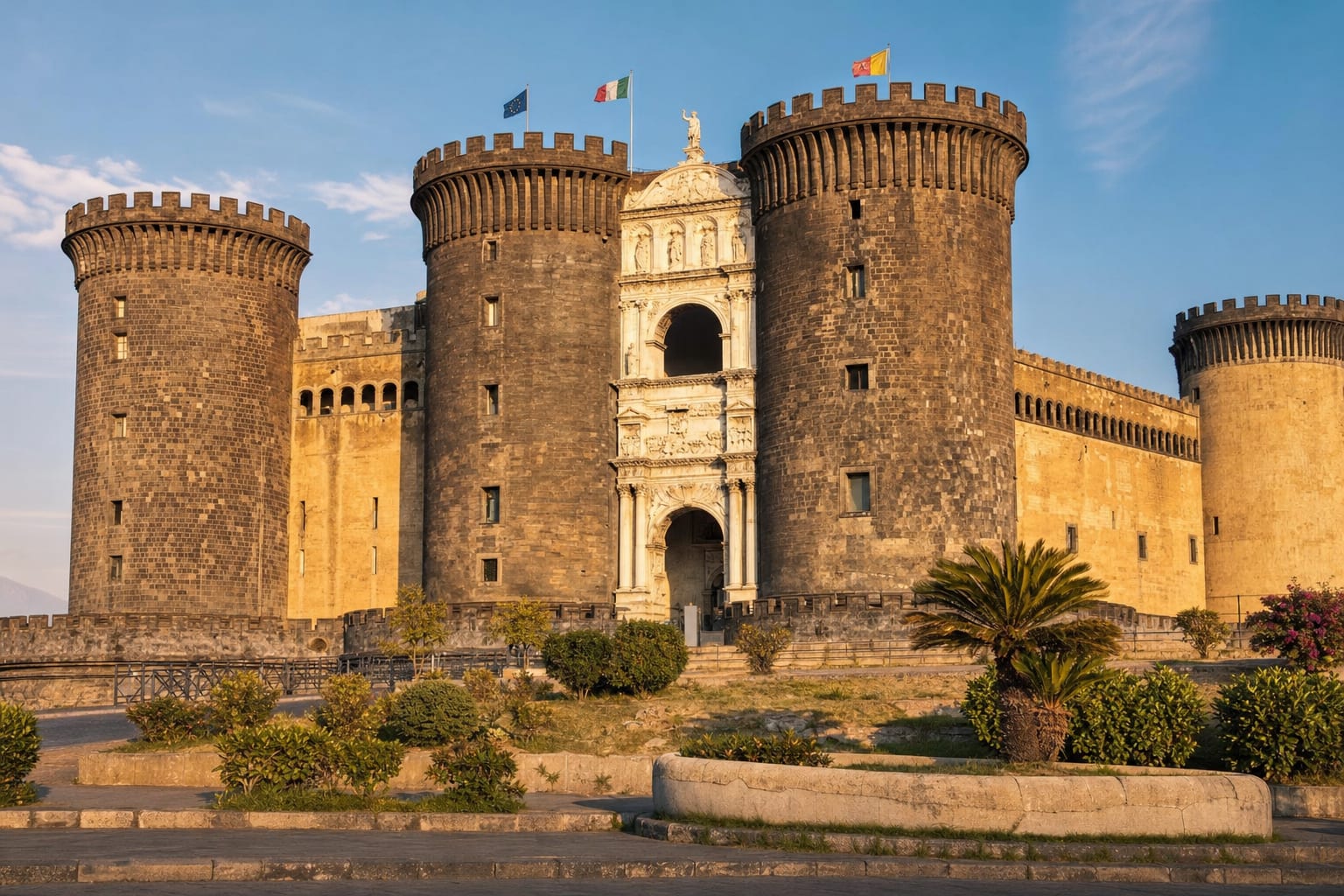
Under the Angevins, the city expanded and acquired major Gothic religious and royal ensembles. Santa Chiara, San Lorenzo Maggiore, San Domenico Maggiore, Donnaregina, and the Cathedral belong to this medieval transformation, though every complex has later interventions. Castel Nuovo began under Charles of Anjou in 1279 as a fortified royal residence. Its present identity also depends on the Aragonese rebuilding and triumphal arch, the civic museum, the Cappella Palatina, the archaeological route, and the Sala dei Baroni. They are components of one castle, not interchangeable names.
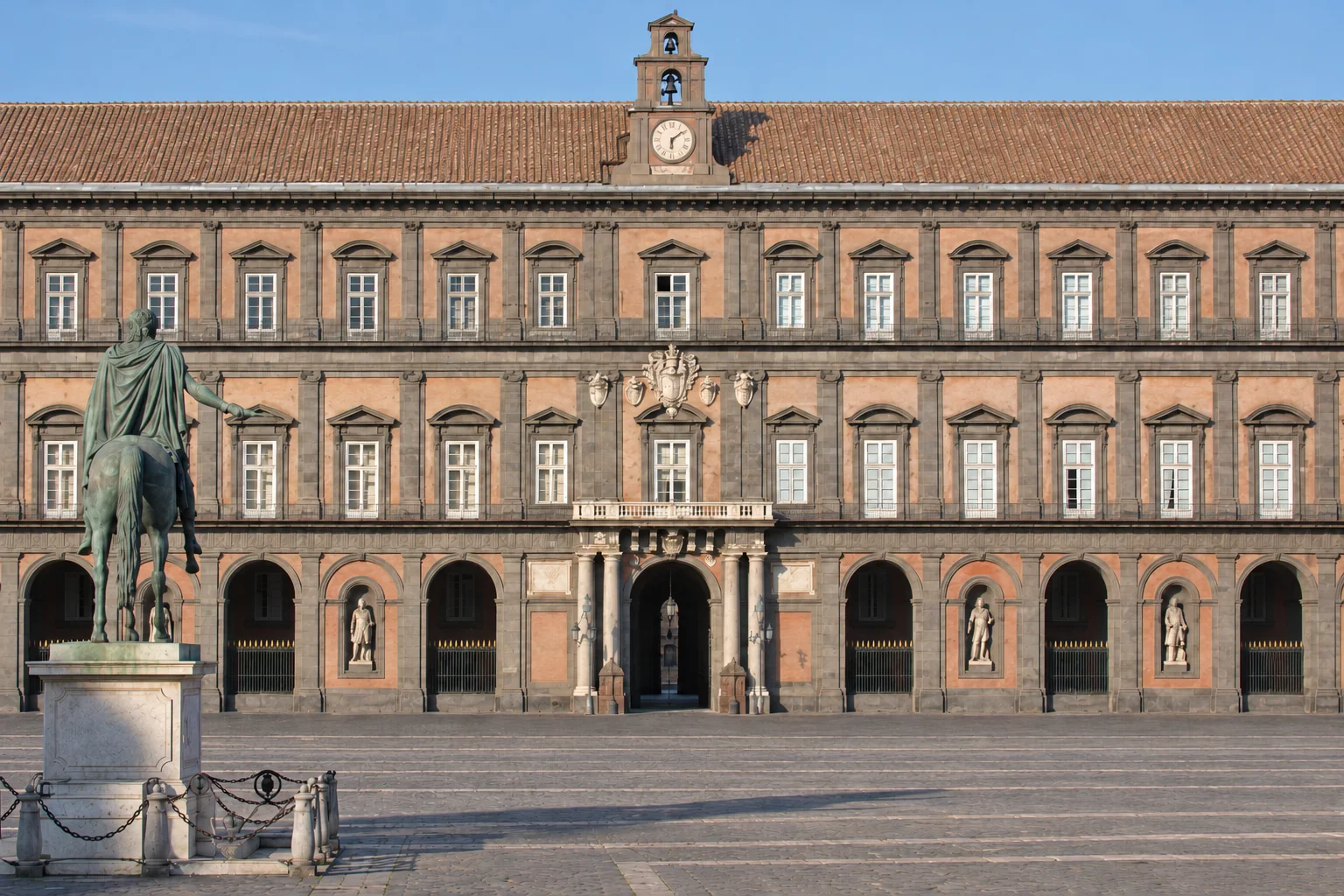
Aragonese and Spanish rule reshaped fortifications, streets, government, and court spaces. Via Toledo, the Quartieri Spagnoli, Castel Sant'Elmo, and the early seventeenth-century Royal Palace belong to different parts of that political landscape. From 1734, the Bourbon court made Naples a major European capital and connected the city to a territorial system of palaces, excavation, collections, industry, theatre, and infrastructure. The Royal Palace, San Carlo, Capodimonte, the archaeological museum, and San Martino each preserve a different institutional memory of that capital.
Napoleonic, Restoration, unification, industrial, wartime, and postwar Naples each left their own marks. The Royal Palace preserves French-period furnishings and later Savoy alterations, and the authorized underground route documents Second World War shelter use.
Cathedral and sacred city
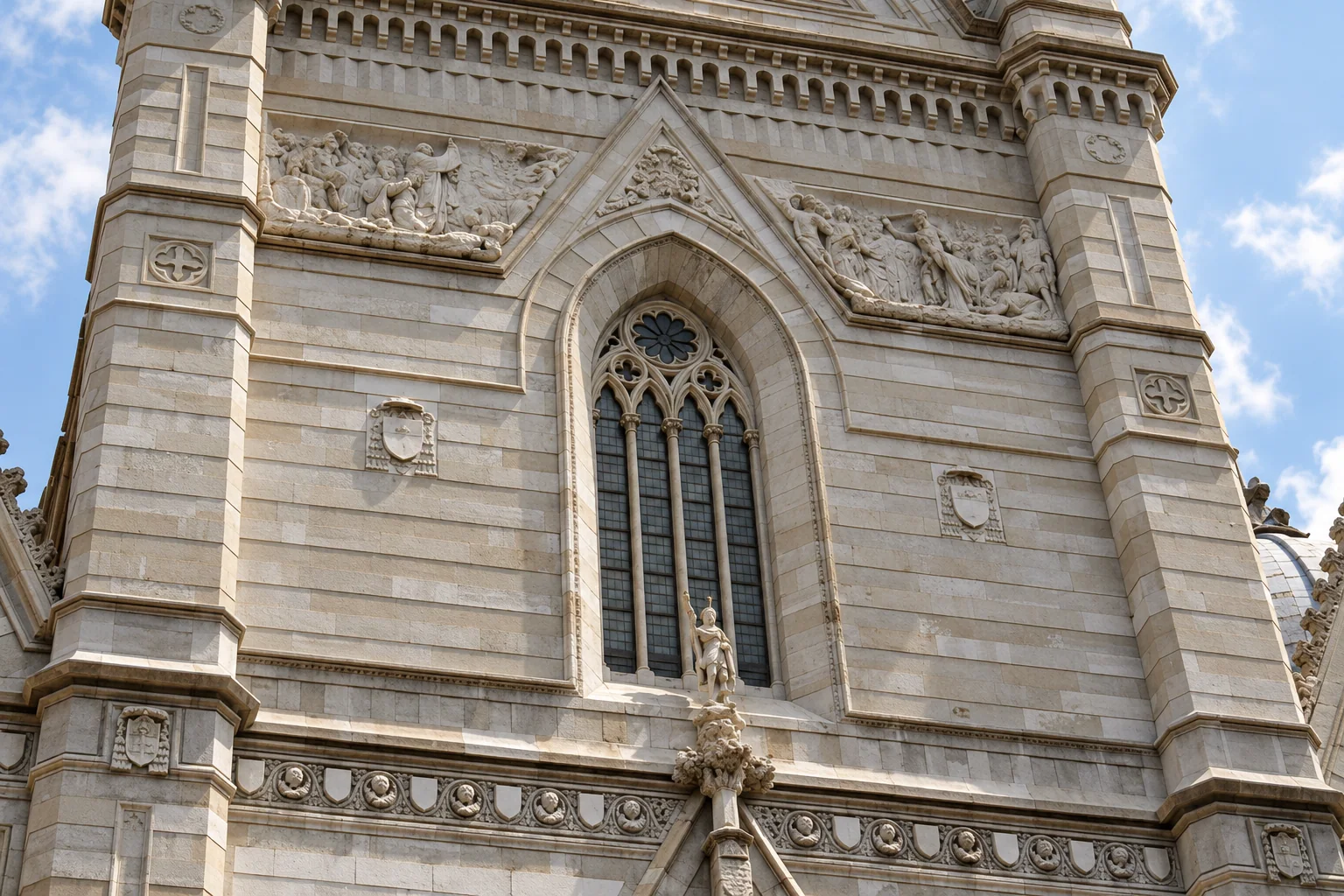
The Cathedral is an active church and a layered complex, not simply the container of a treasure. The complex comprises the Cathedral of Santa Maria Assunta, the Basilica of Santa Restituta, the Baptistery of San Giovanni in Fonte, the Chapel of the New Treasury of San Gennaro, the monumental sacristy, the Succorpo, and other spaces. Santa Restituta and the baptistery preserve early Christian memory within the later cathedral. The Treasury Chapel, built between 1608 and 1637, has its own civic, devotional, artistic, and institutional history.
The chapel contains relics and works connected with San Gennaro, while the adjacent museum presents a treasury assembled over centuries. Reliquary bust, ampoules, silver, bronze, paintings, jewels, and liturgical objects are not one artifact. Nor should devotional language be converted into a scientific assertion.
Sacred Naples extends far beyond the Cathedral. Santa Chiara is a monumental complex formed around a church, monastery, and convent. Pio Monte della Misericordia combines a charitable body, a church, and a collection; Caravaggio's Seven Works of Mercy was commissioned for its church and is kept there, still read in relation to the institution's charitable work. The Catacombs of San Gennaro document burial, worship, and conservation across the centuries. Other active churches keep their own rhythms of worship, so a sightseeing visit is never guaranteed during services.
Museums, collections, and named works
The National Archaeological Museum, or MANN, cannot be summarized as the museum for Pompeii. Its collections include Farnese sculpture and gems, mosaics, frescoes, the Secret Cabinet, Villa of the Papyri material, Egyptian and epigraphic collections, Magna Graecia, coins, and other sections. The Farnese Bull, Farnese Hercules, Farnese Cup, Alexander Mosaic, mosaics from the House of the Faun, bronzes associated with the Villa of the Papyri, and objects from Vesuvian sites are best understood through where they were found as well as where they are kept now.
Rooms and displays change with reinstallations, loans, and conservation work, so the structure of the collections is a better guide than a remembered room number. A named work is best understood through its title, material, date, findspot, and custody considered together.
Capodimonte is another collection system, housed in a royal site with its own park. The collection includes Titian's Danaë and portraits of Paul III, Parmigianino's Antea, Artemisia Gentileschi's Judith Beheading Holofernes, and Caravaggio's Flagellation. The Flagellation was painted in Naples for San Domenico Maggiore, belongs to the Interior Ministry's Fondo Edifici di Culto, and has been kept at Capodimonte since 1972. A single painting can thus have a creator, an original church, a legal owner, a custodian, and a display venue that are all different.
Two works anchor smaller institutions in the historic centre. Giuseppe Sanmartino's Veiled Christ, dated 1753, is in the Sansevero Chapel; the museum's own documentation rejects the legend that the veil was produced by an alchemical process and states that sculpture and veil were carved from one block of marble. Caravaggio's Seven Works of Mercy remains at Pio Monte della Misericordia, where the institution links the painting to its charitable mission and original commission.
Royal, civic, and hilltop Naples
Castel Nuovo and the Royal Palace are independent institutions, one municipal and one state-run, each with its own components and admission. Being close together does not make them a combined site or give them a shared ticket. Palazzo San Giacomo, Galleria Umberto I, Teatro di San Carlo, the National Library, and the public squares around them are separate places in their own right.
The Royal Palace interprets power from the viceregal period through Bourbon, French, Restoration, and Italian phases. Its museum distinguishes the State Apartment, Museum of the Factory, Caruso Museum, gardens, and special routes. Collections include paintings, tapestries, furniture, porcelain, clocks, and decorative arts.
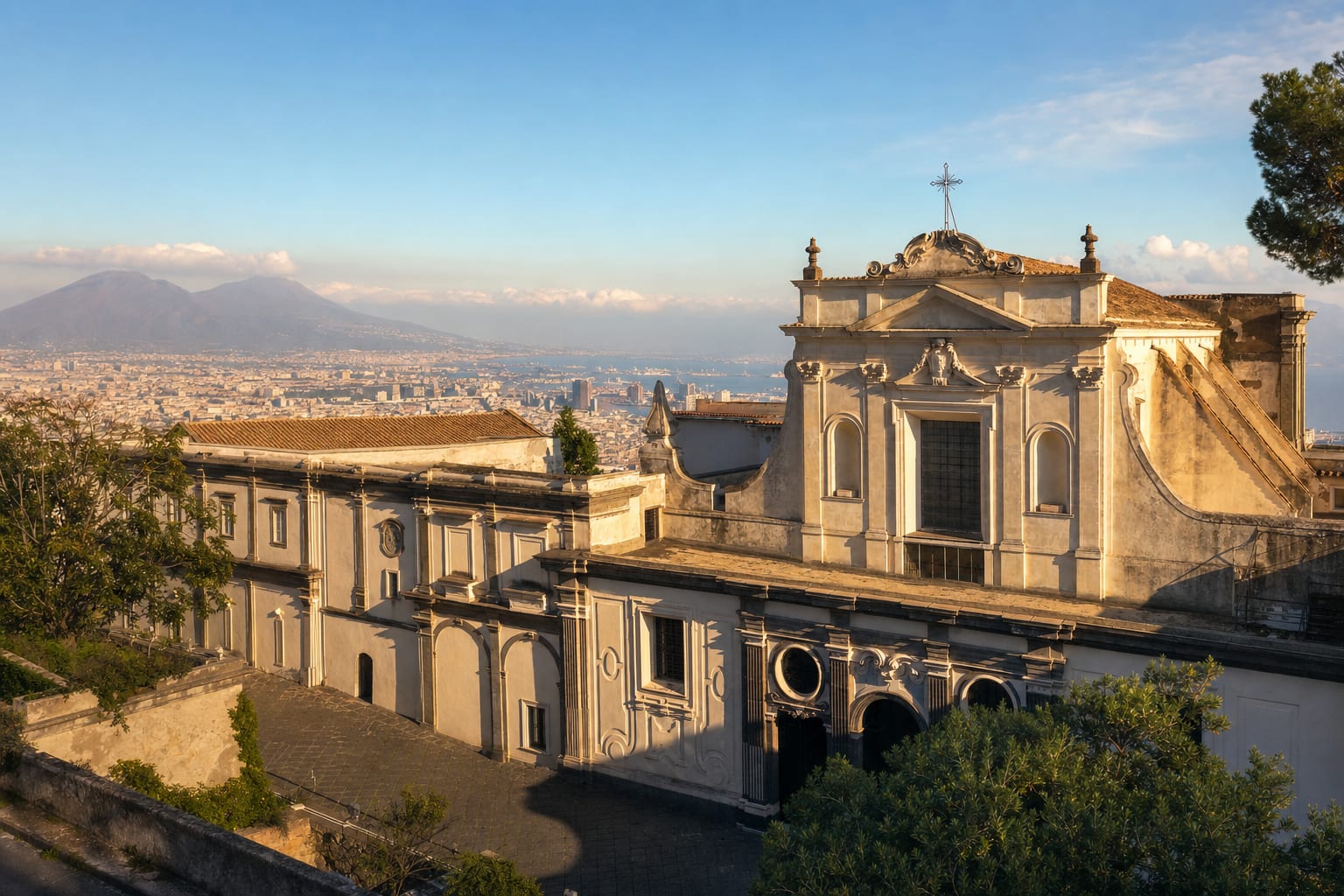
Above the centre, Castel Sant'Elmo and the Certosa di San Martino occupy the Vomero edge but are separate institutions. Sant'Elmo is a star-shaped fortress and museum setting. The Certosa is a monastic complex and museum whose collections interpret Naples, including historical views, decorative arts, maritime material, and the celebrated presepe tradition. Their belvederes help explain the relationship among the ancient grid, royal extension, port, hills, and bay. The climb is part of the visit: the city's funiculars serve the hill, and each museum has its own gradients, surfaces, and lifts.
Neighborhoods without caricature
The city counts ten municipalità and thirty quartieri. Chiaia, San Ferdinando, Posillipo, Vomero, Arenella, Stella, San Carlo all'Arena, Avvocata, Montecalvario, San Lorenzo, Porto, and Pendino carry administrative meaning. Rione Sanità, Quartieri Spagnoli, Borgo Marinari, Santa Lucia, Mergellina, and the Decumani are widely used historical or visitor names, and they do not always map neatly onto those units.
Sanità should be understood through institutions and community life, not reduced to catacombs or a social stereotype. Its streets connect Santa Maria della Sanità, San Gaudioso, Palazzo dello Spagnuolo, Palazzo Sanfelice, local markets, and ascents towards Capodimonte. The Quartieri Spagnoli are a lived district, not a stage set: their lanes connect Via Toledo with the slopes towards Corso Vittorio Emanuele, and homes, churches, workshops, and street art share them with visitors.
Music, theatre, archives, and the living city
Naples's cultural depth is not exhausted by archaeology and painting. Teatro di San Carlo is an operating theatre, with separate performance, ticket, and guided-visit offerings; a guided visit is not admission to a performance.
The Royal Palace has an institutional relationship with the National Library. The Archivio di Stato di Napoli distinguishes state documentation from the private archives it has received by deposit or gift.
San Carlo's programming changes from season to season, and the Cathedral complex keeps its own liturgical calendar.
Food with provenance, not folklore
Pizza is central, but two legal and cultural ideas must remain separate. Pizza Napoletana is registered as a Traditional Speciality Guaranteed with reservation of the name, and its EU specification defines a product and method rather than a municipal border. UNESCO's Art of Neapolitan Pizzaiuolo inscription concerns a living practice, gestures, knowledge, transmission, and community. Neither designation certifies every pizzeria in Naples, and neither is a general award for pizza made anywhere.
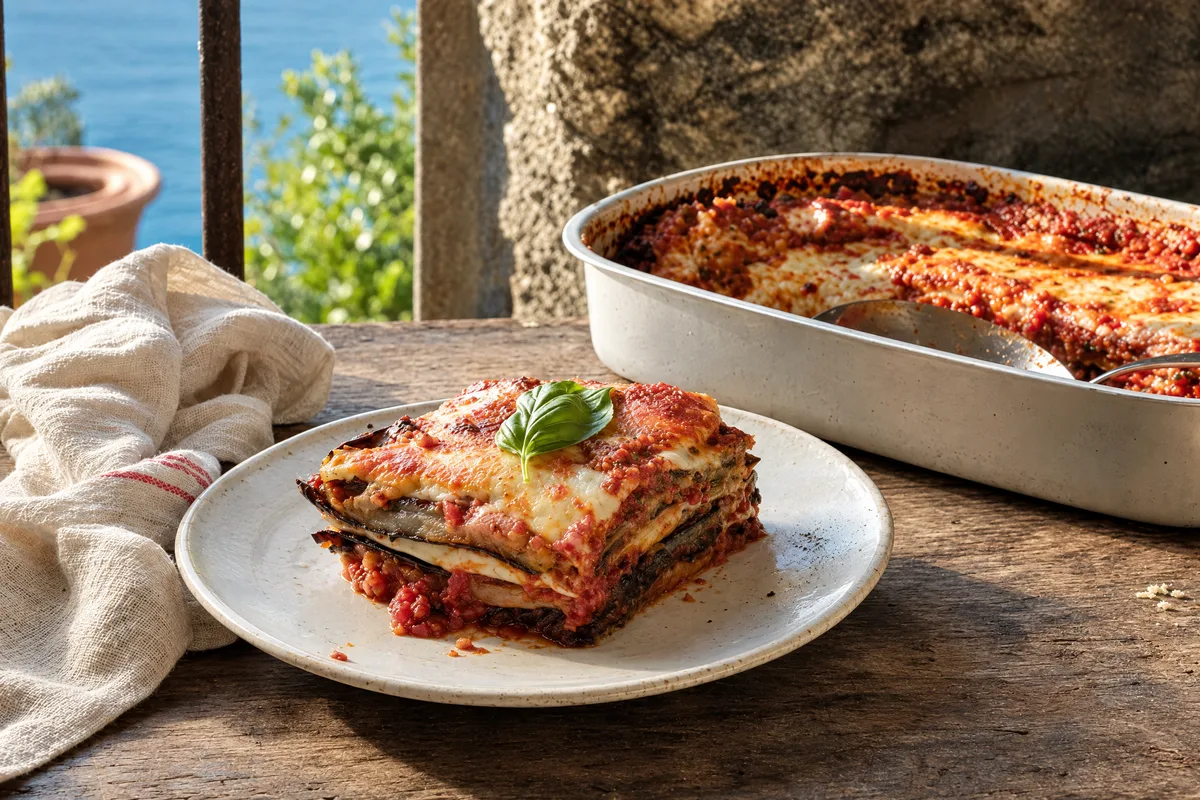
The Campania Region's register of traditional foods lists ragù napoletano, Genovese, and sartù di riso. No single inventor or canonical recipe is established for any of them: variant spellings, feast associations, and domestic and restaurant versions all coexist.
Protected Campanian ingredients and products also retain their own geography. Mozzarella di Bufala Campana PDO, Pomodoro San Marzano dell'Agro Sarnese-Nocerino PDO, Pasta di Gragnano PGI, and Campanian wines are available in Naples, but production and protection areas extend elsewhere or lie outside the municipality. A dish made in Naples does not transfer a PDO or PGI to the city. Ask for the exact protected name, the producer, and the vintage where relevant, and keep protected products, traditional dishes, and marketing adjectives distinct.
Access
There is no single citywide accessibility standard; lifts, thresholds, and step-free routes vary from venue to venue.
Realistic city flows
For one day, choose one historical thread and no more than two substantial interiors. The Sansevero Chapel, the authorized underground route, the Cathedral complex, and Pio Monte each reward the time, though worship constraints and physical demands differ among them. Queues, heat, level changes, and narrow streets make a ten-stop schedule deceptive.
With two days, give the MANN a deliberate half day and pair it with the ancient centre, keeping findspot and museum custody clear. Use the second day for the royal and maritime city: Castel Nuovo, Royal Palace, San Carlo exterior or booked visit, Piazza del Plebiscito, Santa Lucia, and the seafront. Castel dell'Ovo and its harbor work well as an outdoor landmark on that seafront walk.
With three or four days, add one hill system rather than a rushed regional excursion. Vomero can join Castel Sant'Elmo and the Certosa, while Sanità and Capodimonte combine early Christian archaeology, community institutions, urban palaces, park, and art museum. Chiaia, Villa Pignatelli, Mergellina, and Posillipo can form another day, but Gaiola, Pausilypon, and the coast depend on reservations and sea conditions. Keep spare capacity for closures and for collections that deserve time.
What Naples is not
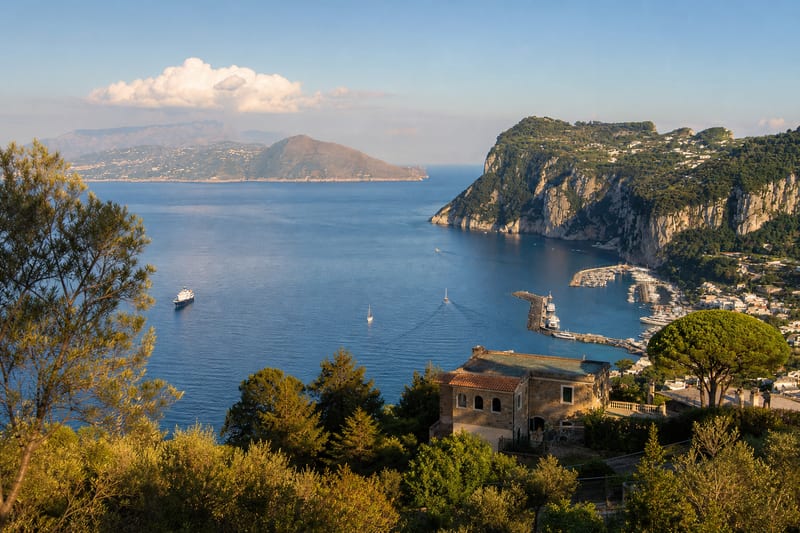
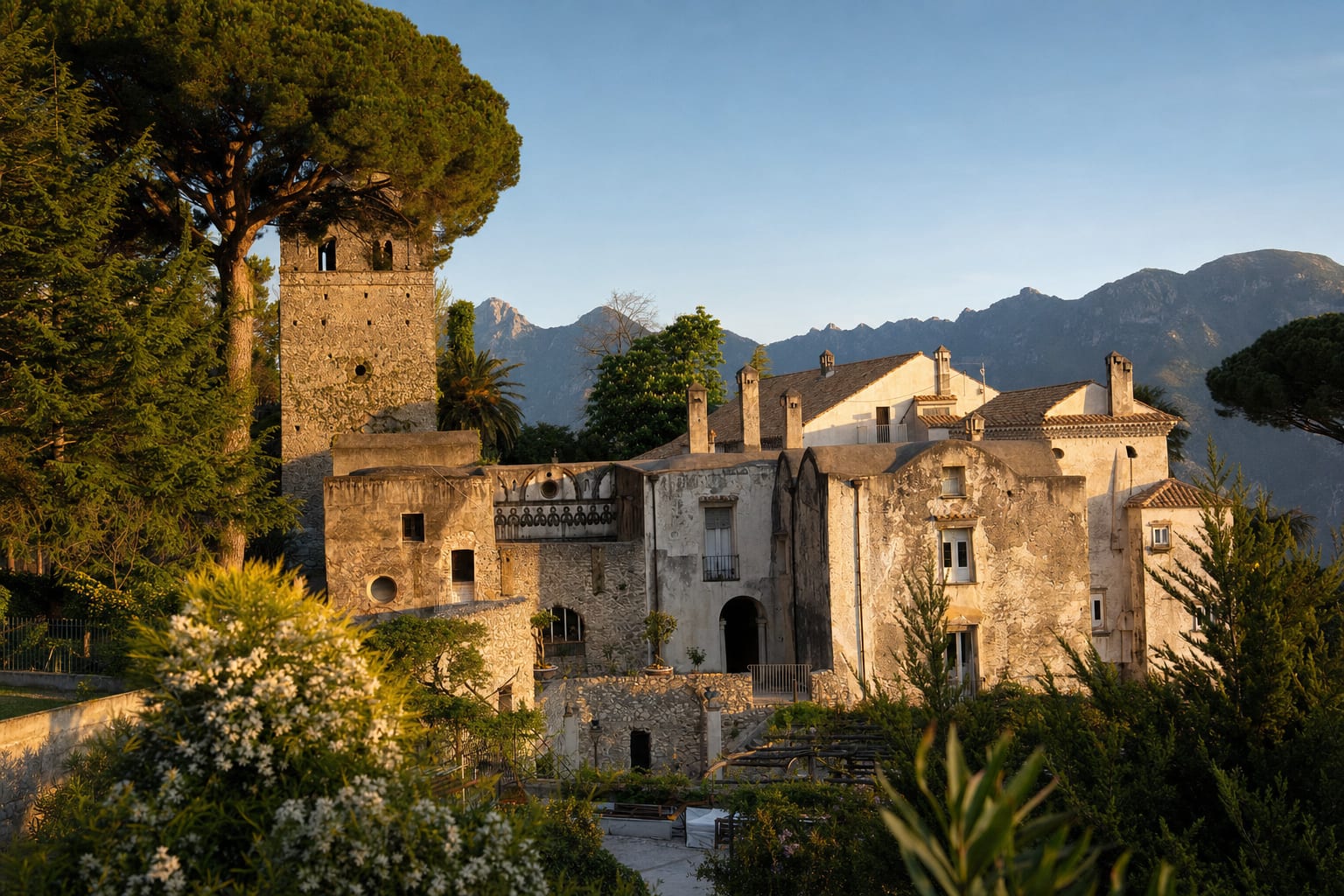
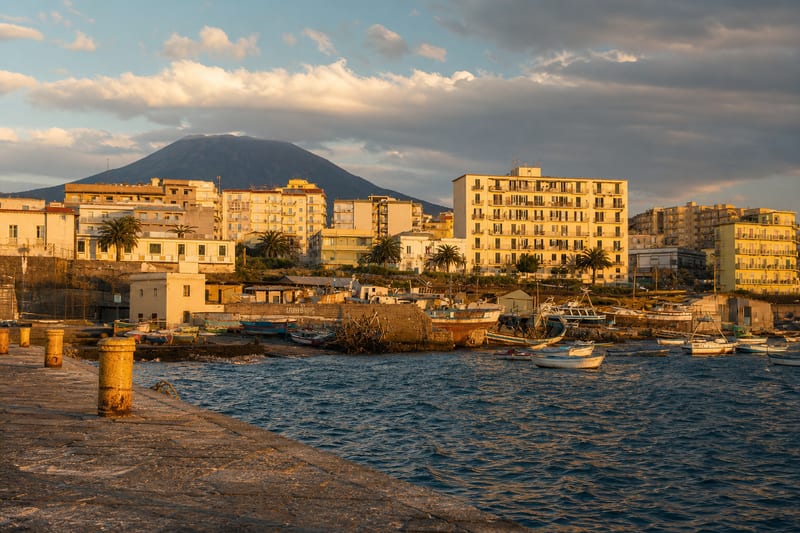
Pompei is a separate legal municipality and ancient Pompeii is an archaeological property component there. Ercolano and ancient Herculaneum are separate identities. Pozzuoli and Bacoli host major Phlegraean systems. Caserta is a separate city, not a Naples neighbourhood. Procida, Capri, Anacapri, and all six Ischia municipalities retain their island and civic relationships. Vesuvius is a volcano and national-park system related to thirteen park municipalities, not a city monument. The Amalfi Coast and Sorrento Peninsula have their own municipalities and protected areas.
Naples is a good gateway to all of them, though each is a destination in its own right. Each day trip has its own municipality, operator, and journey, and distance and queues can make a supposed half-day unrealistic. Naples is richer for not annexing the rest of Campania.
Putting the day together
Build Naples as connected systems: choose an urban zone, one or two deep interiors, food with a clear provenance, and a route whose level changes you understand. Tickets, worship, displays, weather, swimming conditions, the ZTL, lifts, and transit all change, so confirm them with the operators shortly before you go. The places in this guide belong together for lasting reasons; the day-to-day details do not.
More of Campania
A letter from Italy, once a month.
The places, tables and makers we found worth your time. One email, no noise.
One letter a month. Unsubscribe at any time. We never share your address.