

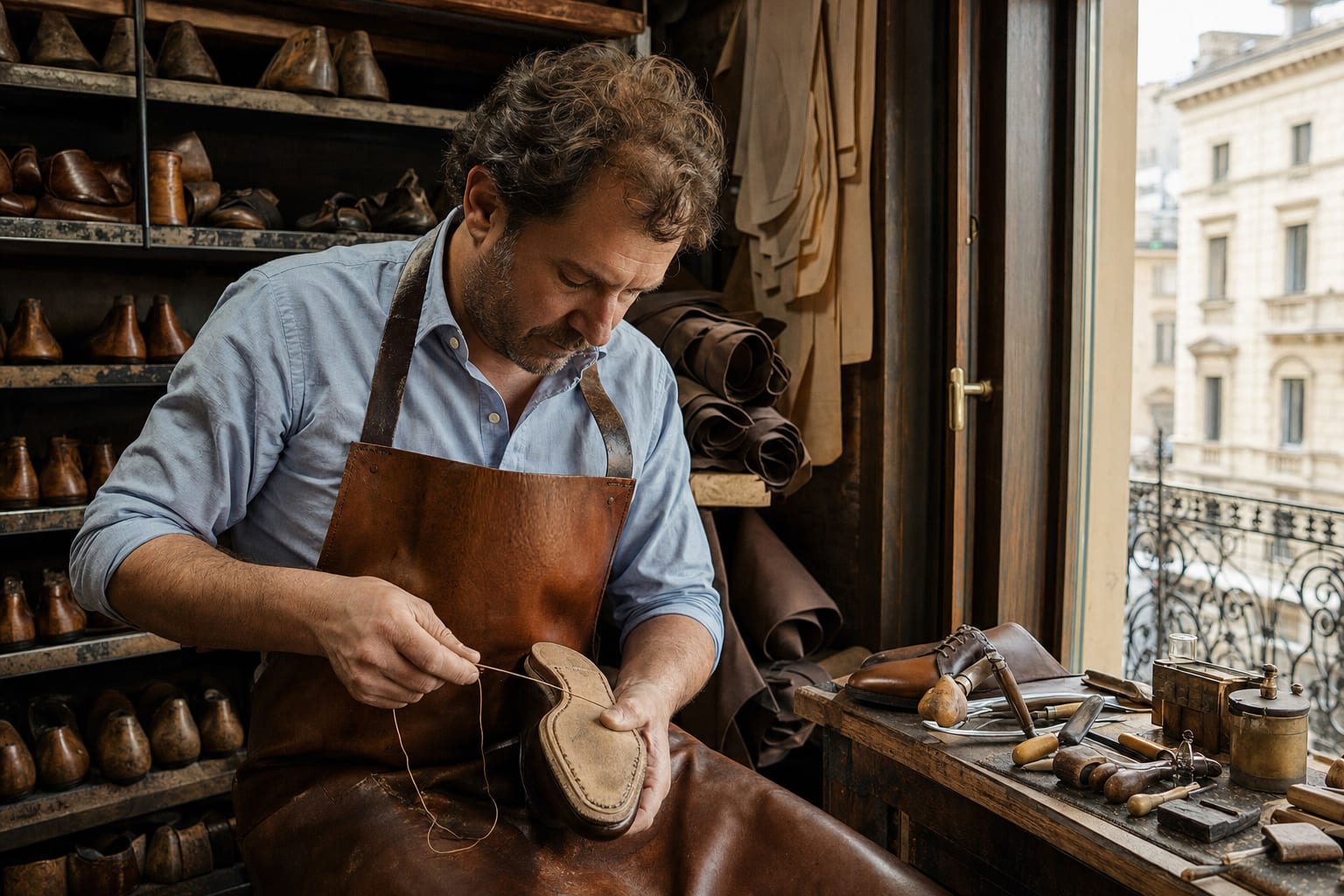
The lift at number 14 Via Montenapoleone opens on the third floor onto a corridor that smells of beeswax and old paper. At the far end, behind a frosted glass door lettered in gold (Calzoleria Rinaldi, fondata 1953), Enrico Rinaldi is at a bench by the window, stitching a welt by hand. He is 67, the son of the founder, and the third pair of hands the shop has ever employed on a finished shoe. The room, to call it by its proper Milanese name, is a sala scarpe: a shoe room, not a shop.
There are no displays. A single oxblood brogue sits on a low table, already sold, waiting for its box. Along the back wall, from floor to ceiling, run shelves of wooden lasts in unvarnished beech, each carrying a small brass plate with a client's name and the year of the first order. Morita, Osaka, 2011. Weber, Zurich, 1998. Hoffmann, Vienna, 1974, inherited son. The lasts are not props. They are the archive, and they are the reason men still get on a plane to stand for twenty minutes in this room with their shoes off.
Bench-made, in Milan, means something specific. The upper is cut by hand from a single side of French calf leather chosen at a tannery outside Lyon, then closed with a lock-stitch at eight stitches per centimetre. The welt, a strip of oak-tanned leather running around the shoe's perimeter, is sewn to the upper and the insole by hand, not machine, using waxed linen thread that Enrico twists himself from a spool bought in Cremona. The outsole is then stitched to the welt in a second hand operation, so that the whole shoe can be taken apart and rebuilt ten years on without disturbing the upper. A pair at Rinaldi begins, today, at 4,800 euro. The wait, at the moment, is eleven months.
A shoe is a room that a foot lives in. If the room is wrong, the foot knows on the third day.
Enrico Rinaldi
Kenji Morita, a Tokyo-based architect in his early fifties, has been a client since 2011. He is in Milan this week for a fitting on his ninth pair, a whole-cut black oxford for a conference in London in October. The process, as he explains it (politely, in careful Italian), has its own rhythm. A first fitting in a trial shoe of unfinished leather, at which Enrico marks adjustments in pencil on the last itself (a millimetre off the inside of the right heel, the instep pitched up by two). Then four months of silence. Then a second fitting in the finished shoe, at which the only acceptable answer, if something is wrong, is to start again. Kenji has never had to start again. Enrico has, twice, on his own judgement, and kept the cost.
The weight of the leather is the first thing a visitor notices. A Rinaldi brogue, size 42, weighs around 480 grams per shoe; a comparable ready-to-wear English brogue is closer to 560. The difference is the filling between insole and outsole, which at Rinaldi is cork from a forge outside Alghero, shaved to the exact topography of the wearer's foot, rather than the compressed fibreboard used in factory production. The cork, over months of wear, softens and takes the print of the foot. The shoe, in the language of the trade, becomes personal.
Why Milan, and not Florence or Northampton. The honest answer, Enrico says, is that Milan had the tailors and the tailors had the clients. Between 1947 and 1972, the sartoria streets around Via Gesu and Via della Spiga sent men to Calzoleria Rinaldi the way they sent them to Caraceni for suits and to Lorenzi on Montenapoleone for razors. The city was a small republic of rooms that spoke to one another. Most of those rooms are gone now; the razors went first, the shoes are holding. When asked who will do this work after him, Enrico gestures, without fuss, to a young woman at a back bench skiving a lining. Her name is Chiara Brambilla, she is 31, she trained in Vigevano and came north four years ago. Her bench is the third bench, and the plate on her stool still says, in pencil, apprendista.
At five minutes to noon, Kenji stands in his trial pair and walks the length of the corridor twice. Enrico watches his ankle, not his face. A quiet conversation in Italian and English, two pencil marks on the right last, a bow from the client, a handshake from the maestro. The fitting is over. The October shoes are now due on the second Thursday of June. Kenji's flight back to Osaka leaves at seven in the evening. He says, putting on his coat, that he has eaten three lunches in Milan this week and only has one more to go. Enrico, already back at the bench, nods without looking up.


