

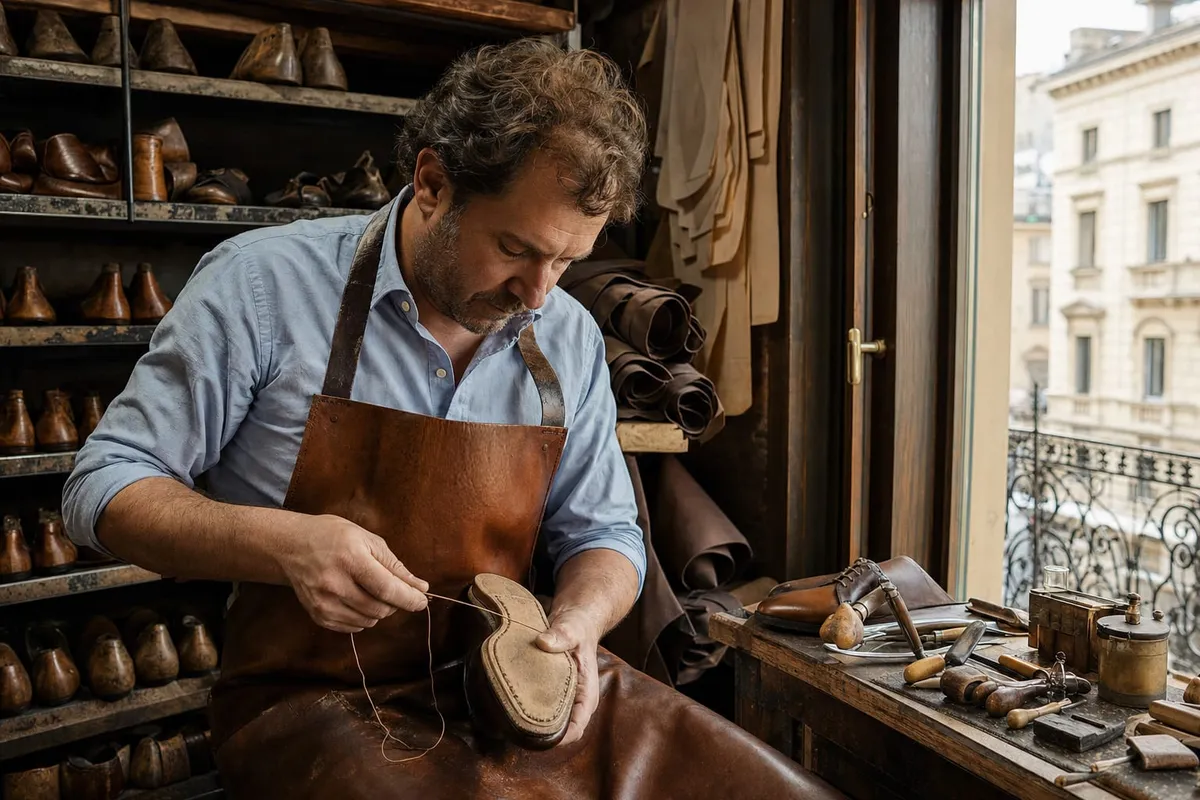
In Milan the best shoes are not made in shops. They are made upstairs. Walk the Quadrilatero della Moda, the grid formed by Via Montenapoleone, Via della Spiga, Via Sant’Andrea and Via Manzoni, and the street level belongs to the big fashion houses and their windows. The bench-made shoemakers, the few calzolai who still build a pair from nothing for one particular pair of feet, tend to work a floor or three above, behind a buzzer and a small brass plate, in rooms that smell of beeswax, leather and old paper. There is rarely anything you would call a display. Often a single finished shoe sits on a low table, already sold, waiting for its box.
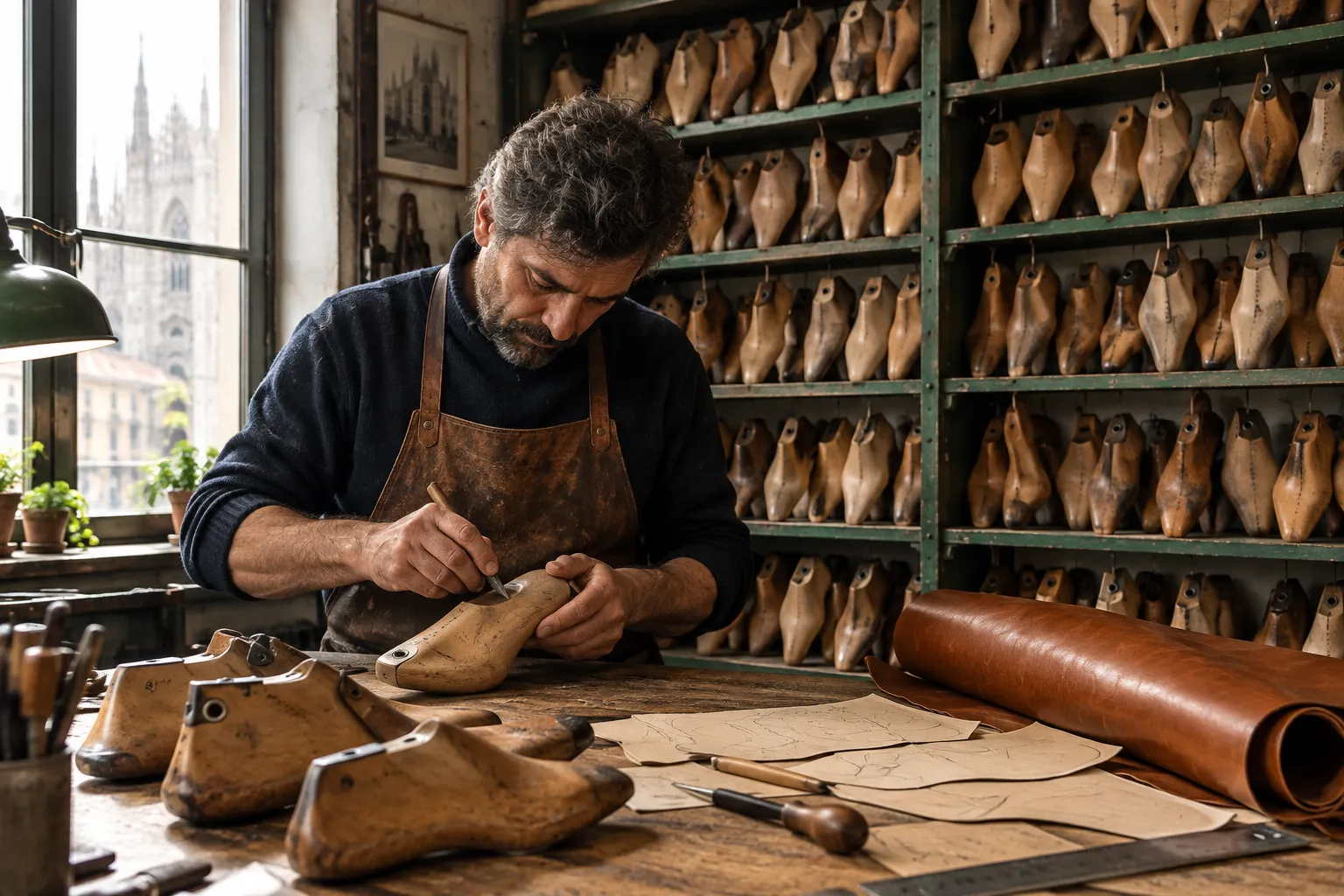
What there is, instead, is a wall of lasts. The last (la forma) is a wooden model of a client’s foot, carved or built up by hand, usually in beech or hornbeam, and in a bespoke workshop it is the most valuable thing in the room. Shelves of them run from floor to ceiling, each tagged with a surname and a city, and in Milan those cities are often a long way off: Tokyo, Osaka, Zurich, Vienna, New York. The lasts are not props. They are the archive, and they are the reason people still get on a plane to stand for twenty minutes in a small room with their shoes off.
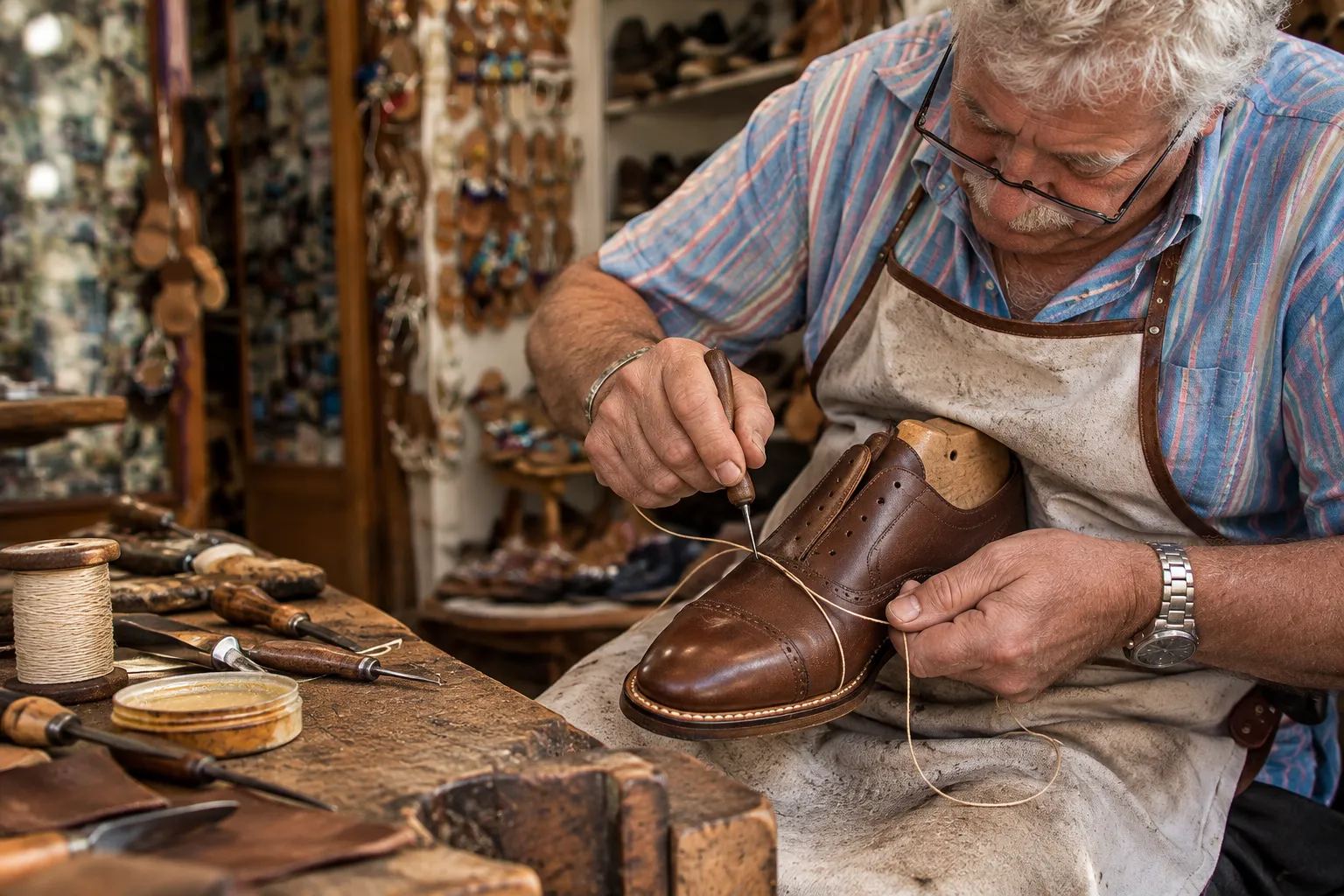
Bench-made means something specific. The upper is cut by hand from a hide chosen for its grain, usually calf, and closed with fine stitching. Then comes the step that separates this work from almost everything else sold as a good shoe. The welt, a narrow strip of leather running around the shoe’s edge, is sewn by hand to the upper and to a rib carved into the leather insole, with waxed thread pulled tight stitch by stitch. The outsole is then stitched to the welt in a second operation. Because the sole is attached to the welt rather than to the upper, the shoe can be resoled again and again over decades without disturbing the part that fits your foot. A factory Goodyear welt imitates all this with a machine and a canvas rib glued to the insole. A hand-welted shoe is the original the machine was built to copy.
They are the archive, and they are the reason people still get on a plane to stand for twenty minutes in a small room with their shoes off.
The process has its own rhythm, and it is slow on purpose. First come the measurements: length, width, the girth around the ball of the foot, the instep and the heel, a tracing of each foot standing, and a good deal of simply looking. Then the last is made or adapted. Then a trial shoe, often in cheaper or unfinished leather, which the client wears at the first fitting while the maker watches the ankle, not the face, and marks changes in pencil directly on the last: a millimetre off the inside of the heel, a little more height over the instep. Then, for months, nothing. Long waits are normal at the most sought-after benches, and a first pair of true bespoke shoes costs several thousand euro. The second fitting is in the finished shoe, and the unwritten rule of the trade is that if something is really wrong at that point, the maker starts again.
A first-time client notices the weight, and then the feel. Between the insole and the outsole of a welted shoe there is a shallow cavity, and what fills it matters. Many factory shoes use a cork paste or a pressed board; a hand-welted shoe, where the cavity is thinner, can take a sheet of real cork shaved to fit. Over months of wear the cork gives a little and takes the print of the foot, which is why a good pair feels firm for the first few weeks and then, quite suddenly, like nothing at all. The shoe, as the trade puts it, becomes personal.
Why Milan, and not Florence or Northampton? Partly because Milan had the tailors, and the tailors had the clients. Through the twentieth century the city’s sartorie dressed industrialists, bankers and the people who came to Milan to do business with them, and a man who had his suits cut by hand tended to want his shoes made the same way. Shoemaking also runs deep in Lombardy. Vigevano, about forty minutes south-west of the city, was for decades the industrial capital of Italian footwear and keeps an international shoe museum inside its Sforza castle. Most of the small specialist rooms that once made up Milan’s republic of craft, the razor sellers, the glovers, the hatters, have gone. The shoes are holding.
The fitting itself, when you finally stand in one of these rooms, is quieter than you expect. You walk the length of the floor twice in the trial pair. The maker kneels, presses a thumb at the toe, runs a hand along the heel, watches you walk away and walk back. A few words in Italian and English, two pencil marks on the last, a handshake. Twenty minutes, perhaps less. Then you are back in the noise of Via Montenapoleone, looking for somewhere to have lunch, at the start of a long wait for a pair of shoes that will outlast most of what you own.
Sources
- Becoming A Shoemaker Part 4: Cork Filling & Hand-Sewing A Sole · misiuacademy.com
- Cork Filler in Dress Shoes · handsole.com
- Goodyear welt · Wikipedia
- International Footwear Museum · in-lombardia.it
Comments
No comments yet. Start the conversation.