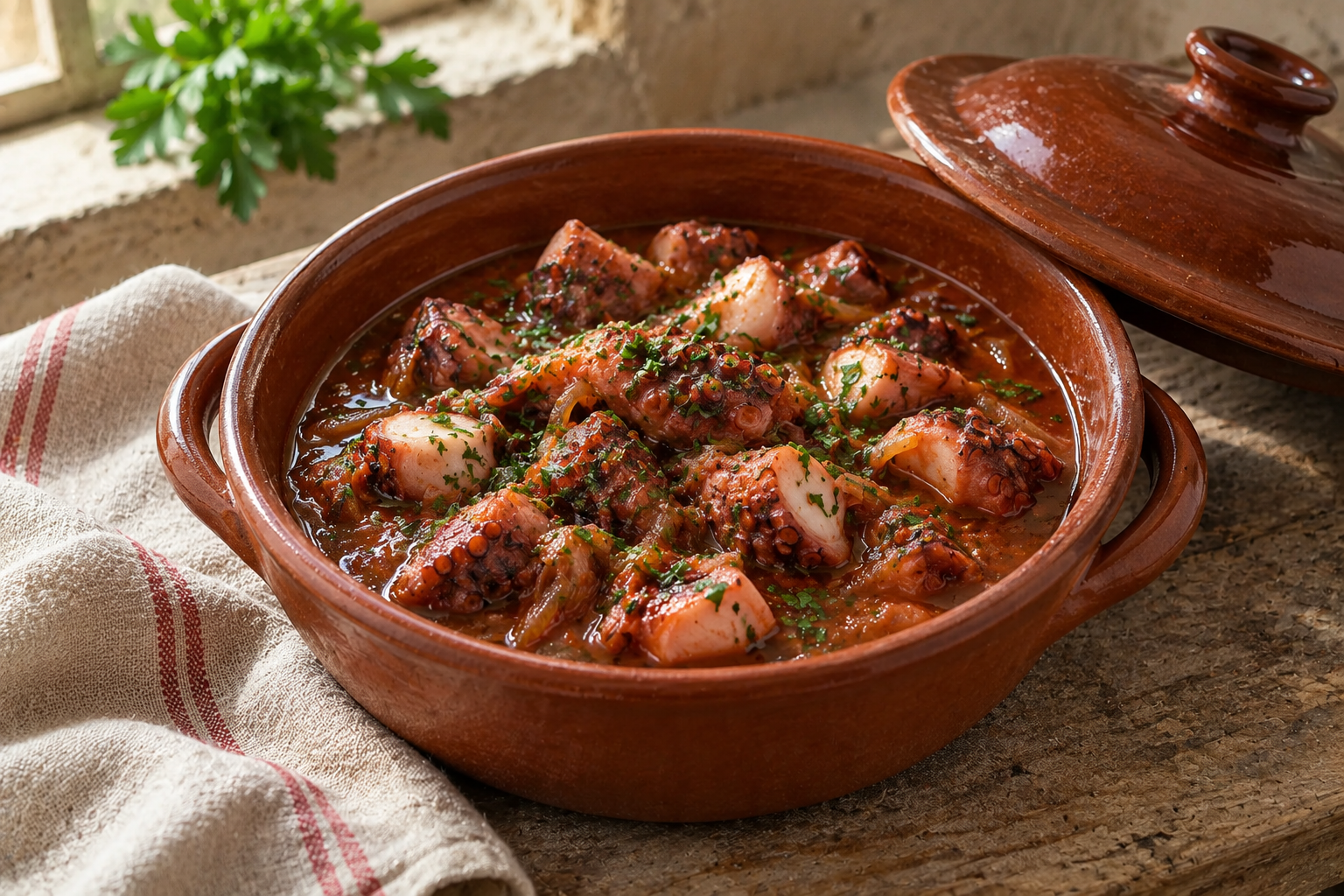
Use a pot rated for your hob and follow its maker’s heat instructions. A heavy lidded casserole is a practical alternative.
Make ahead Slice the vegetables before starting and serve the stew hot after its uncovered reduction.
Polpo alla pignatta
Prep 20 min · Cook 2 hr 15 min · Yield 4 portions (4 servings per batch) · Difficulty Medium
Method
Have the fishmonger clean the octopus, removing beak, eyes and innards. Cut the cleaned octopus into 4–5 cm pieces; keep the thick arm sections similar in size. Slice the onion finely and chop the tomatoes and parsley.Have the fishmonger clean the octopus, removing beak, eyes and innards. Cut the cleaned octopus into 1½–2 in pieces; keep the thick arm sections similar in size. Slice the onion finely and chop the tomatoes and parsley.
Put the octopus, tomatoes, onion, parsley, oil, pepper and 50 ml water in the pot. Cover and bring gradually to a gentle simmer over moderate-low heat, allowing about 15 minutes to reach the simmer. Avoid thermal shock with earthenware and use a diffuser if its maker requires one.Put the octopus, tomatoes, onion, parsley, oil, pepper and 3½ tbsp water in the pot. Cover and bring gradually to a gentle simmer over moderate-low heat, allowing about 15 minutes to reach the simmer. Avoid thermal shock with earthenware and use a diffuser if its maker requires one.
Cook covered for about 90 minutes at a very gentle simmer. Check occasionally that the base stays moist; the octopus and vegetables should release their own liquid. Add a little reserved hot water only if it threatens to catch.Cook covered for about 90 minutes at a very gentle simmer. Check occasionally that the base stays moist; the octopus and vegetables should release their own liquid. Add a little reserved hot water only if it threatens to catch.
Uncover and cook for at least another 30 minutes, reducing the juices without drying the pot. Test a thick piece with a fork: it should yield easily. If still firm, continue gently, checking every 15 minutes and keeping enough liquid to prevent scorching.Uncover and cook for at least another 30 minutes, reducing the juices without drying the pot. Test a thick piece with a fork: it should yield easily. If still firm, continue gently, checking every 15 minutes and keeping enough liquid to prevent scorching.
Taste the sauce before adding any salt. Divide octopus and concentrated juices between serving bowls and serve hot.Taste the sauce before adding any salt. Divide octopus and concentrated juices between serving bowls and serve hot.