Start with an established firm lievito madre at 50% hydration. Four refreshments are included below; this recipe does not start a new culture. Use the specified low 1 kg paper mould.
Make ahead Keep the starter healthy before starting. Allow about 53 hours including refreshments and cooling; fermentation may take longer. Prepare secure hanging supports before baking.
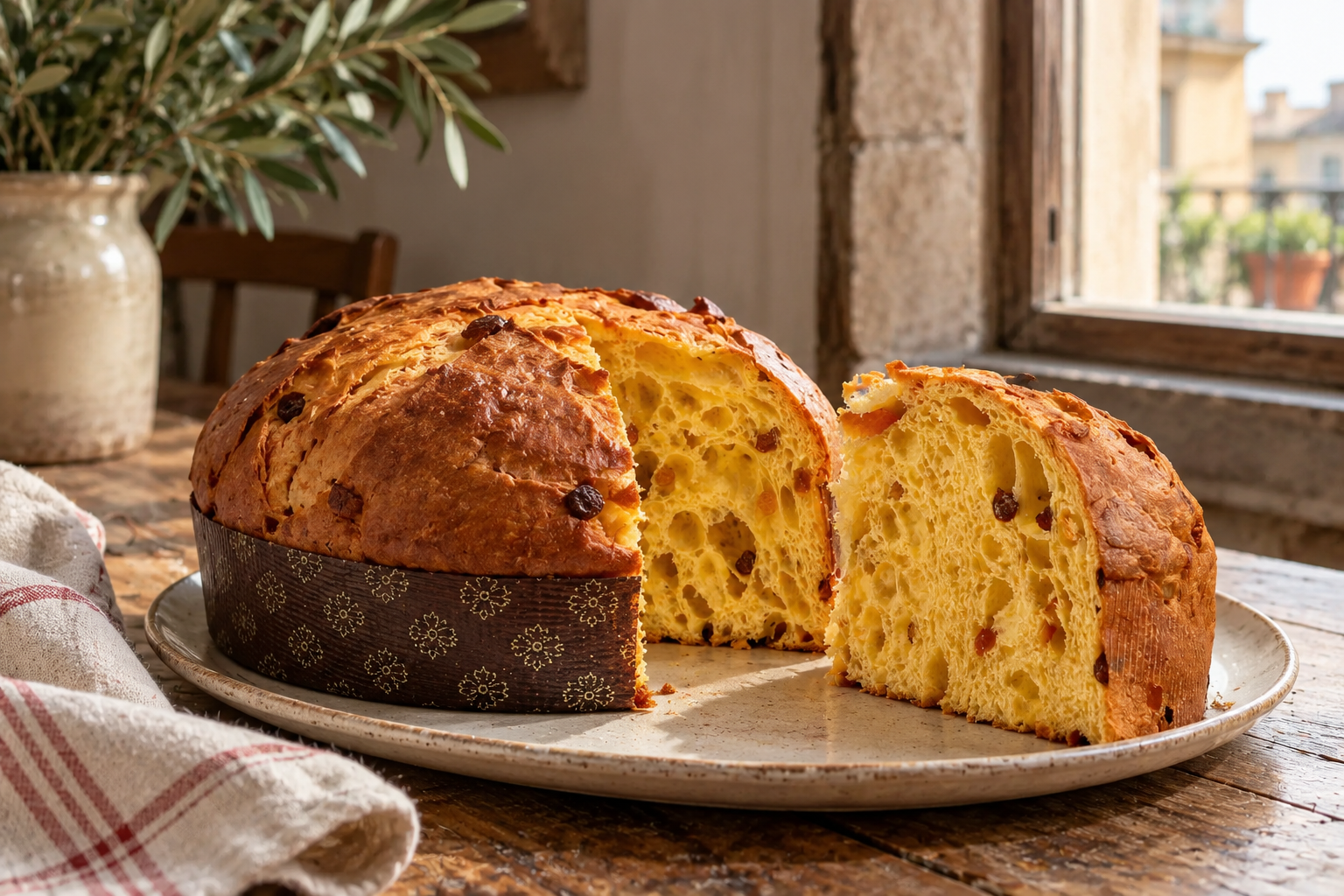
Panettone milanese with raisins and candied citrus
Prep 1 hr 50 min · Cook 1 hr · Rest 50 hr · Yield 1 loaf (About 10 slices; nominal 1 kg low mould, baked weight varies.) · Difficulty Hard
Method
Mix the starting 50 g firm starter with 50 g of the refresh flour and 25 g of its water. Knead smooth, place in a clean marked container, cover without sealing airtight and keep at 26–28°C for about 4 hours, until well risen and airy. Repeat three more times, each time taking only 50 g of the refreshed starter and adding another 50 g flour and 25 g water. Set the surplus aside; it does not go into the panettone. After the fourth refresh, weigh 38 g for the first dough. If the starter is sluggish, collapsed or sharply vinegary, restore its regular activity before attempting the dough.Mix the starting 1¾ oz firm starter with 1¾ oz of the refresh flour and 1 oz of its water. Knead smooth, place in a clean marked container, cover without sealing airtight and keep at 78.8–82.4°F for about 4 hours, until well risen and airy. Repeat three more times, each time taking only 1¾ oz of the refreshed starter and adding another 1¾ oz flour and 1 oz water. Set the surplus aside; it does not go into the panettone. After the fourth refresh, weigh 1¼ oz for the first dough. If the starter is sluggish, collapsed or sharply vinegary, restore its regular activity before attempting the dough.
For the first dough, break the 38 g refreshed starter into its 48 g water at 22–24°C. Add the 64 g yolks and 160 g flour and mix with the hook until cohesive. Add the 38 g sugar in portions, then the 58 g soft butter a little at a time, letting each addition disappear before the next. Work until smooth and elastic enough to stretch into a thin membrane, about 20–25 minutes overall, adjusting speed to your machine. Aim for 24–26°C dough; pause and cool the bowl if it approaches 28°C rather than continuing to heat it.For the first dough, break the 1¼ oz refreshed starter into its 1¾ oz water at 70–75°F. Add the 2¼ oz yolks and 5½ oz flour and mix with the hook until cohesive. Add the 1¼ oz sugar in portions, then the 2 oz soft butter a little at a time, letting each addition disappear before the next. Work until smooth and elastic enough to stretch into a thin membrane, about 20–25 minutes overall, adjusting speed to your machine. Aim for 75–80°F dough; pause and cool the bowl if it approaches 80°F rather than continuing to heat it.
Put the dough in a covered marked container with room to triple. Keep at 26–28°C for about 10–12 hours, until it has actually tripled in volume. Continue only at that endpoint, even if the clock runs longer. During this rise weigh 96 g soft ready-to-use raisins and check that their surfaces are dry; do not soak them.Put the dough in a covered marked container with room to triple. Keep at 78.8–82.4°F for about 10–12 hours, until it has actually tripled in volume. Continue only at that endpoint, even if the clock runs longer. During this rise weigh 3½ oz soft ready-to-use raisins and check that their surfaces are dry; do not soak them.
Return the tripled dough to the mixer. Add the second dough’s 80 g flour and the vanilla and work until elastic again. Gradually add the 80 g sugar, honey and half the 96 g yolks. When incorporated, add the salt with a little more yolk, then the remaining yolk, 80 g of the second butter and its 48 g water in small additions. Keep the dough smooth and elastic throughout; allow roughly 30–35 minutes for this dough, including the fruit, and avoid overheating.Return the tripled dough to the mixer. Add the second dough’s 2¾ oz flour and the vanilla and work until elastic again. Gradually add the 2¾ oz sugar, honey and half the 3½ oz yolks. When incorporated, add the salt with a little more yolk, then the remaining yolk, 2¾ oz of the second butter and its 1¾ oz water in small additions. Keep the dough smooth and elastic throughout; allow roughly 30–35 minutes for this dough, including the fruit, and avoid overheating.
Melt the remaining 16 g of the second butter and let it cool until just fluid. Coat the dried raisins and both candied fruits with it, then mix them into the dough at low speed for 3–4 minutes, just until evenly distributed. Turn out onto a clean unfloured surface, round gently and rest for 40–60 minutes at about 28°C.Melt the remaining ½ oz of the second butter and let it cool until just fluid. Coat the dried raisins and both candied fruits with it, then mix them into the dough at low speed for 3–4 minutes, just until evenly distributed. Turn out onto a clean unfloured surface, round gently and rest for 40–60 minutes at about 80°F.
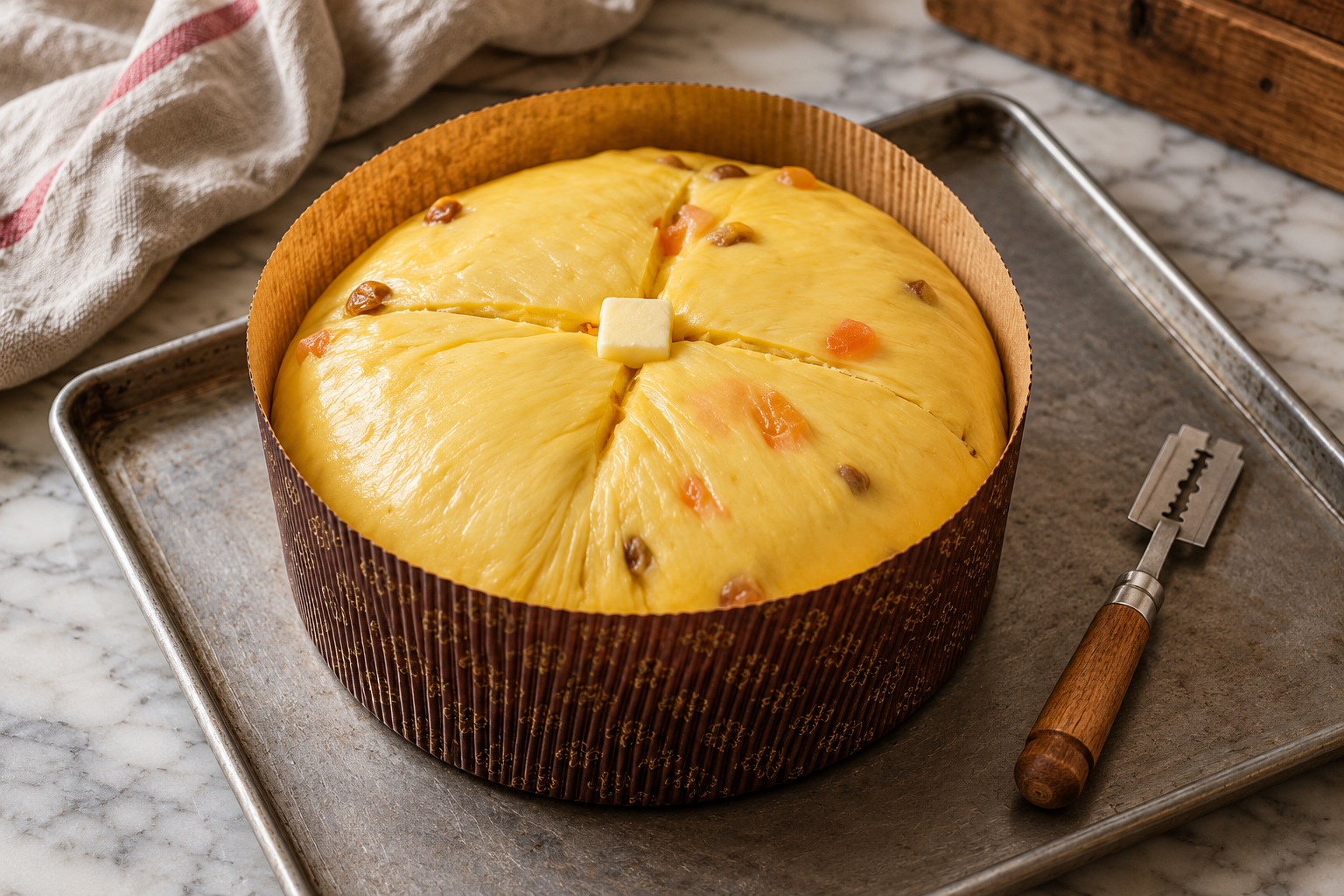
Round again, tightening the outer surface without tearing it, and place seam-side down in the low 1 kg mould on its tray. The batch gives about 1.08 kg dough before the finishing butter. Cover loosely and prove at 26–28°C until the crown is nearly at the mould’s rim, about 6–7 hours. Do not load this amount into a smaller mould.Round again, tightening the outer surface without tearing it, and place seam-side down in the low 2¼ lb mould on its tray. The batch gives about 2½ lb dough before the finishing butter. Cover loosely and prove at 78.8–82.4°F until the crown is nearly at the mould’s rim, about 6–7 hours. Do not load this amount into a smaller mould.
Heat a static oven to 185°C with a shelf low enough for the dome to rise. Uncover the dough briefly so the surface is no longer tacky, make a shallow cross with a clean razor and place the 5 g finishing butter in its centre. Bake for 5 minutes. Draw the tray out carefully, lift the four cut tips gently with a small knife and return promptly to the oven.Heat a static oven to 375°F with a shelf low enough for the dome to rise. Uncover the dough briefly so the surface is no longer tacky, make a shallow cross with a clean razor and place the 5 g finishing butter in its centre. Bake for 5 minutes. Draw the tray out carefully, lift the four cut tips gently with a small knife and return promptly to the oven.
Continue baking until deeply golden and 94°C at the centre, roughly 50–65 minutes in total. Check the centre with a probe without touching the tray; shield the top loosely with foil if it colours too quickly. Have the skewers and supports ready before taking the loaf out.Continue baking until deeply golden and 200°F at the centre, roughly 50–65 minutes in total. Check the centre with a probe without touching the tray; shield the top loosely with foil if it colours too quickly. Have the skewers and supports ready before taking the loaf out.
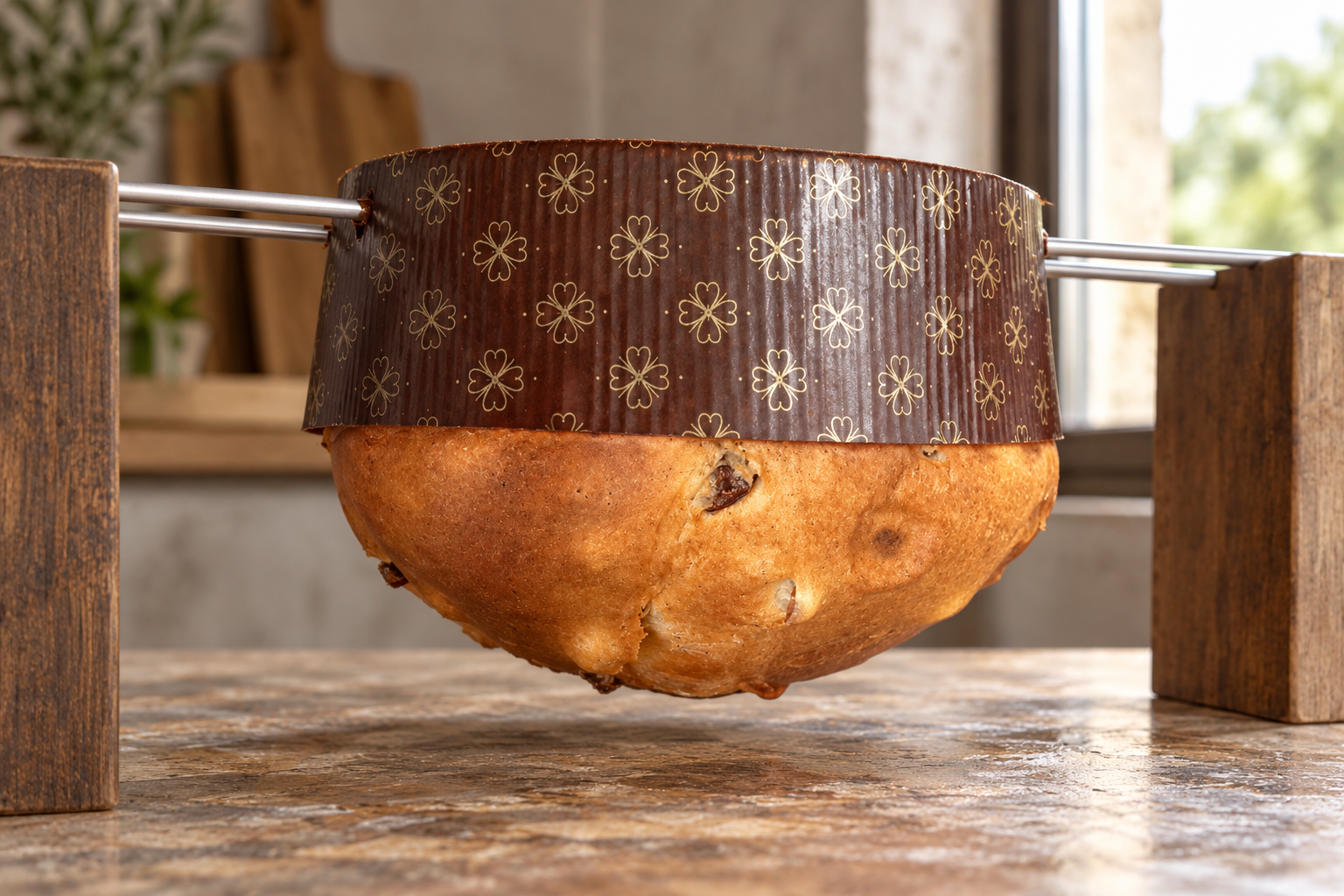
Immediately pierce the lower part of the loaf through its paper with two parallel panettone skewers, turn it upside down and suspend securely between the supports without the dome touching anything. Leave inverted for 12–14 hours, until completely cool and stable. Turn upright, remove the skewers and slice. Bag only when fully cold; do not taste the raw dough.Immediately pierce the lower part of the loaf through its paper with two parallel panettone skewers, turn it upside down and suspend securely between the supports without the dome touching anything. Leave inverted for 12–14 hours, until completely cool and stable. Turn upright, remove the skewers and slice. Bag only when fully cold; do not taste the raw dough.