

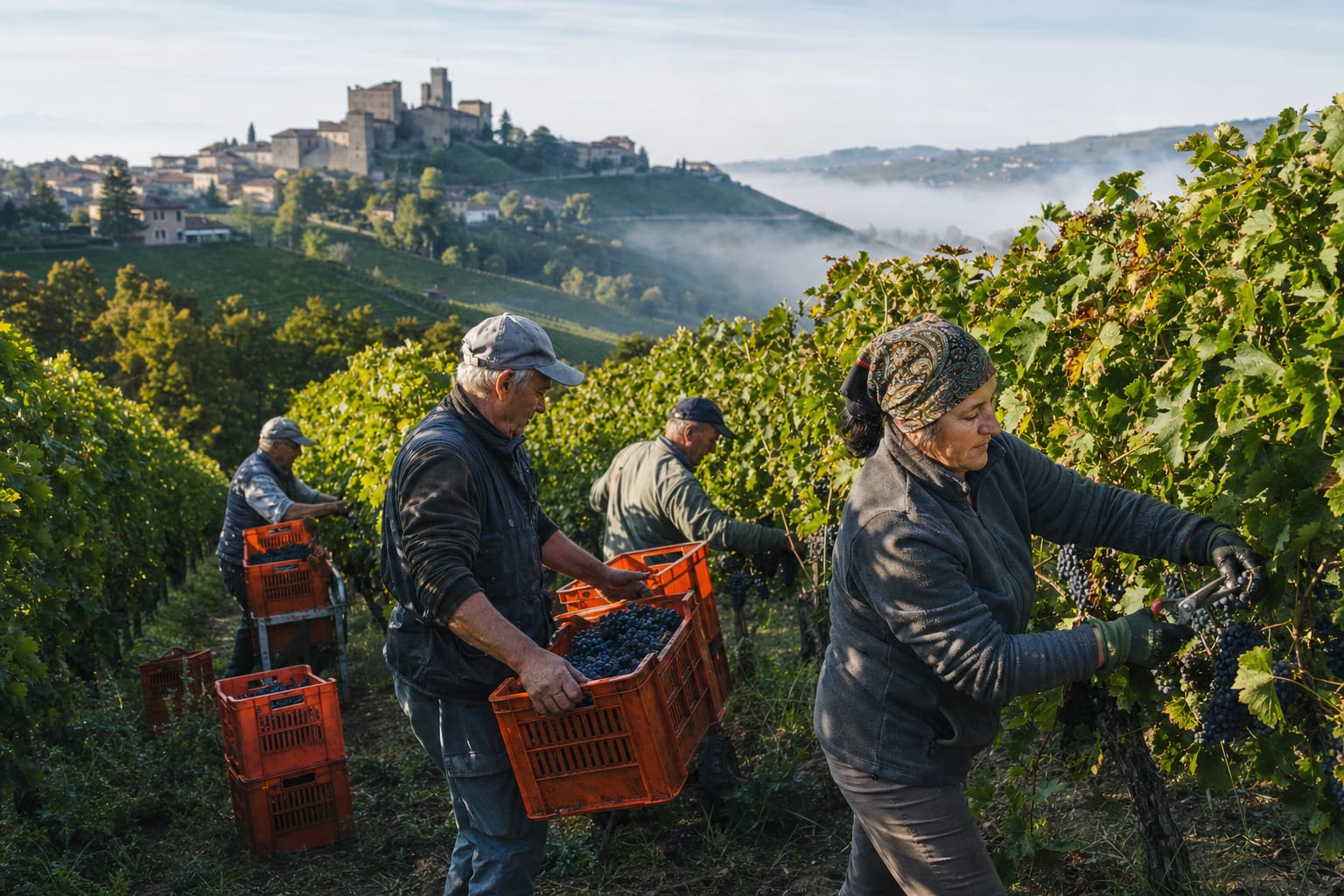
At 07.15 on a Tuesday in early October, Paolo Boschis walks the ridge of Baudana with the fog still on the river valley below. He holds a grape between thumb and forefinger, presses, and puts the split skin to his tongue. He does this forty times a morning for the three weeks that decide the year. At Cascina Boschis di Baudana, on the shoulder of Serralunga d'Alba, his family has farmed Nebbiolo since his great-grandfather bought the parcel in 1919. Paolo is 54. He has been the one tasting since 1996.
Nebbiolo is the slowest-ripening red grape in Italy. In the Langhe, the Dolcetto comes in first, the Barbera follows, and then the vineyards go quiet. Paolo does not touch his Nebbiolo rows until the first week of October, and in a year like this one he often waits until the second. The grape accumulates sugar quickly, then for several weeks keeps accumulating phenolics (the tannins, the anthocyanins, the fine bitter compounds in the skin) at a rate the sugar curve does not show. Cut a week early and the wine will be pretty and forgotten in a decade. Cut at the right moment and it will hold its shape at thirty.
The weight of the grape is the reliable sign. A ripe cluster on the Serralunga side weighs roughly 180 to 220 grams by the first week of October. A cluster cut too early feels light, almost hollow; a cluster cut at the right moment has the density of a small stone fruit, the skin giving slightly under the thumb before it splits. Paolo reads it the way an older man reads a barometer. He checks the numbers too (sugar, pH and total acidity, three times a week from 20 September on), but the numbers, he says, tell you the same thing the hand tells you, only later.
You do not pick Nebbiolo by the sugar. You pick it by the weight, and by the week the fog starts coming in at night.
Paolo Boschis
Baudana runs to nine and a half hectares across three parcels: a south-facing crest for the Riserva, a cooler eastern slope for the base Barolo, a small block of clay marl just below the road for Langhe Nebbiolo. The harvest is done by hand, as the DOCG requires, into plastic cassette that replaced the wicker baskets his father used until 1998. Forty pickers, from Serralunga and La Morra, work 07.30 to about 12.30, then stop for lunch at a long table under the fig tree. They return in the afternoon only if the day is cool; warm grape at the press is the enemy of Nebbiolo.
What slows Paolo in the last week before he calls the pick is the night temperature. Nebbiolo wants cold nights in the final stretch: ideally below 10 C for five nights in a row. The cold fixes colour and aroma in the skin and slows the sugar curve enough that the phenolic ripening catches up. In 2017, a year of warm autumn nights, many producers in Serralunga picked at standard sugar levels and made wines drinking well now that will not see forty. In 2023 the nights turned cold on 28 September and stayed cold. Paolo waited until 12 October to start, by which point neighbours were knocking at his gate to tell him he would lose the crop to rain. It did not rain until the 19th. The 2023 Barolo, tasted out of stainless steel the following April, kept him quiet for a long minute.
The last grape off the hill at Baudana is cut on the ninth of October, from the row under the cypresses on the Riserva block, by a picker named Franca who has worked the harvest here since 1991. She lays the cluster into the cassette with both hands. Paolo weighs it on the kitchen scale inside the cantina: 214 grams. He writes the number in the harvest book under the year, closes the book, pours two fingers of his father's 1999 Barolo into a tumbler, and sits on the step outside in the late sun. The work of the vintage, which is twenty-two years long if you count properly, has begun.


