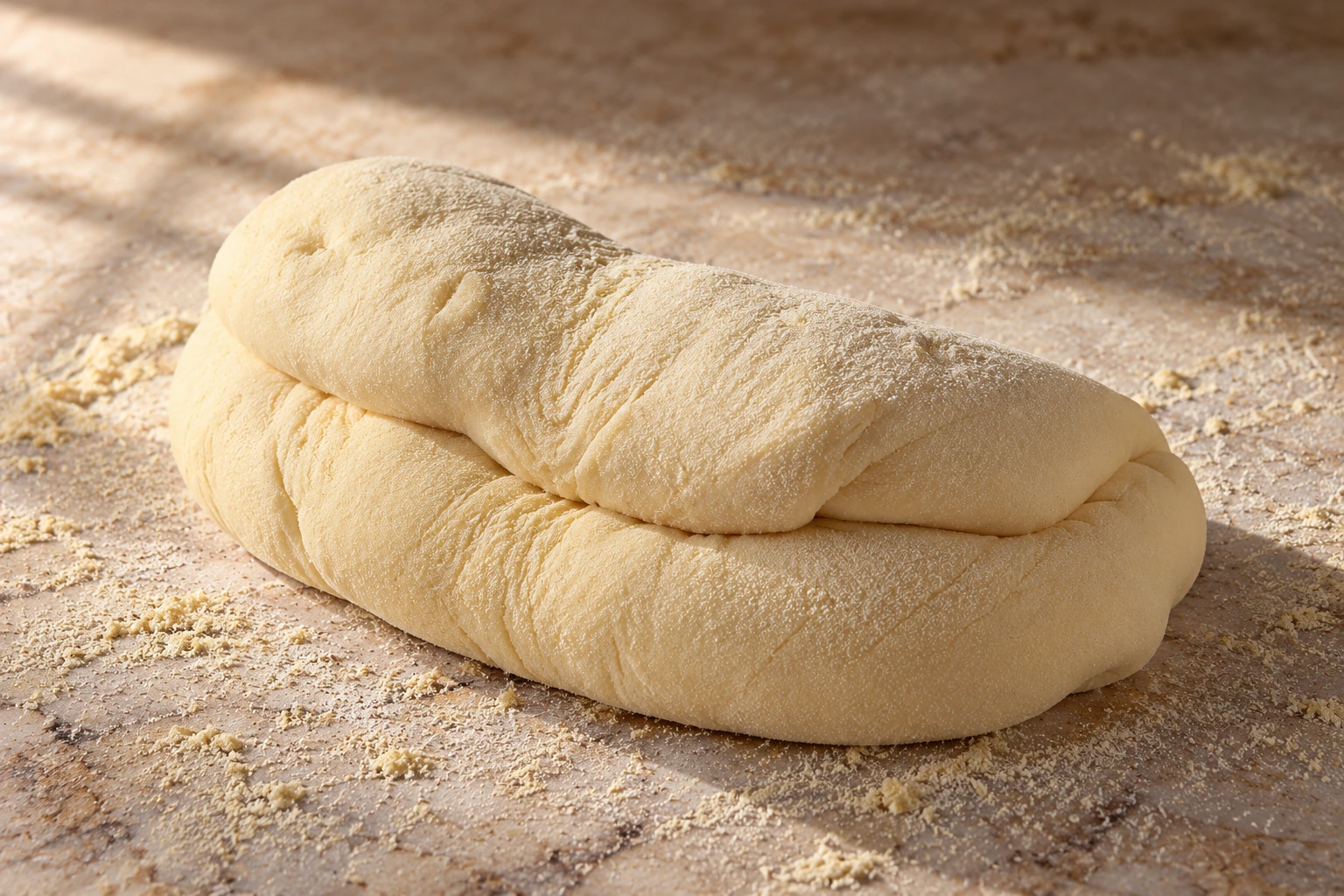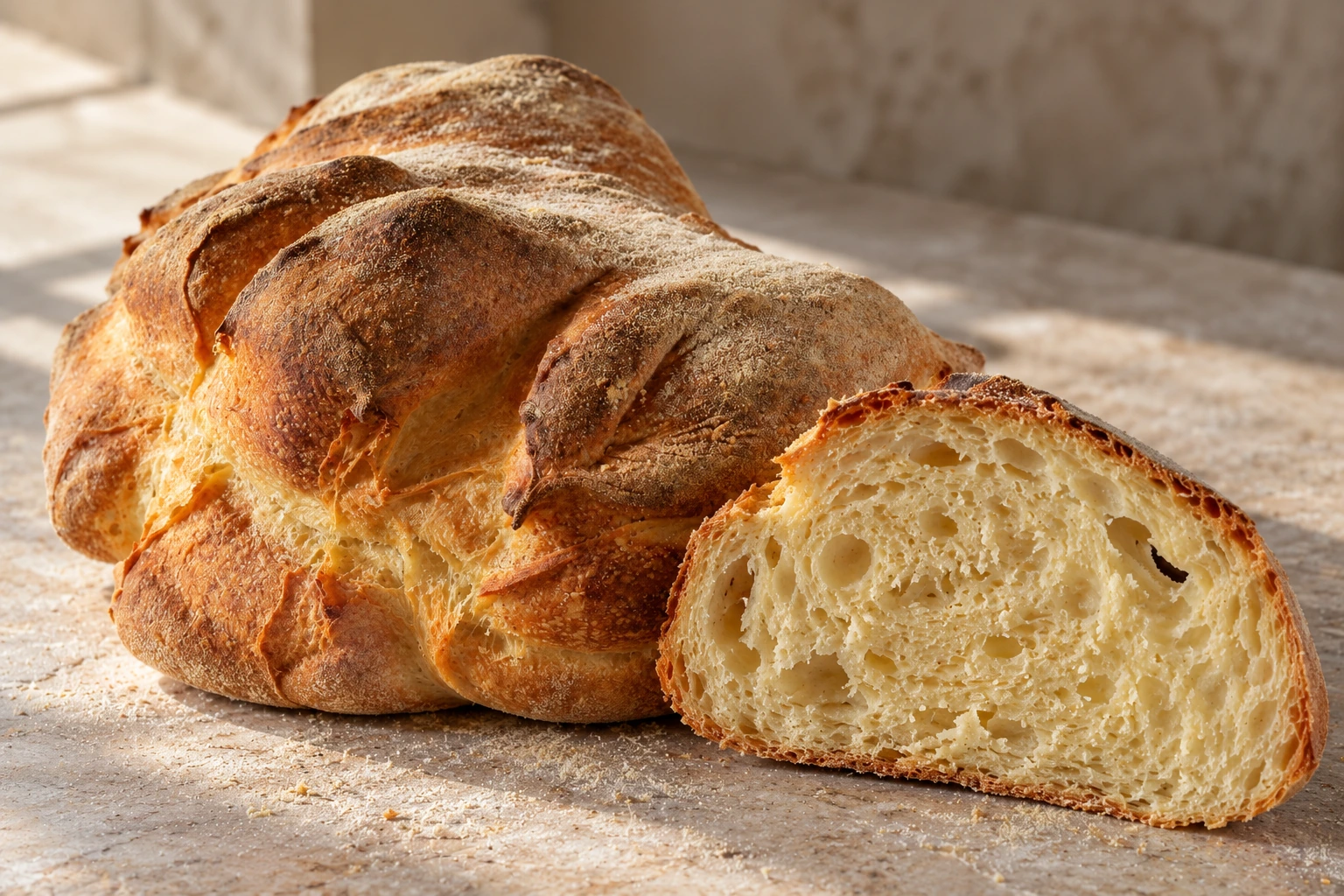
The final folds build the horn shape. Press the central join firmly while keeping the dough’s outer skin intact.
Make ahead Refresh a ripe firm starter before mixing the main dough. Plan for an overnight refrigerator rise, then leave enough time for warming, final proofing and complete cooling.
Matera-style sourdough bread
Prep 1 hr · Cook 1 hr 20 min · Rest 25 hr 30 min · Yield 1 whole loaf (about 12 slices each) · Difficulty Hard
Method
Mix the ripe firm starter with 60 g water and 60 g semolina. Cover and leave in a comfortably warm place until doubled, allowing about 4 hours. At the same time, mix 500 g semolina with 325 g water until evenly moistened. Cover this separate bowl and rest for 4 hours; keep it in the refrigerator if the room is warmer than 19°C.Mix the ripe firm starter with 2 oz water and 2 oz semolina. Cover and leave in a comfortably warm place until doubled, allowing about 4 hours. At the same time, mix 1 lb semolina with 11½ oz water until evenly moistened. Cover this separate bowl and rest for 4 hours; keep it in the refrigerator if the room is warmer than 65°F.
Combine the doubled preferment with the rested semolina dough. Add the remaining 25 g dough water and the salt. Mix first with the paddle, then knead with the hook until elastic and pulling cleanly from the bowl. Coat the fermentation bowl with most of the oil, transfer the dough, cover and rest for 1 hour.Combine the doubled preferment with the rested semolina dough. Add the remaining 1 oz dough water and the salt. Mix first with the paddle, then knead with the hook until elastic and pulling cleanly from the bowl. Coat the fermentation bowl with most of the oil, transfer the dough, cover and rest for 1 hour.
Give the dough a set of folds in the bowl at 30-minute intervals, 3 times in all: lift an edge and fold toward the center, working around the bowl. After the third set, cover and leave for another 2 hours. Refrigerate, covered, for about 10 hours.Give the dough a set of folds in the bowl at 30-minute intervals, 3 times in all: lift an edge and fold toward the center, working around the bowl. After the third set, cover and leave for another 2 hours. Refrigerate, covered, for about 10 hours.
Let the dough warm for about 1 hour, until visibly expanded. Use a little of the reserved 20 g semolina on the bench, fold the dough once and round it gently. Dust the top, cover with an upturned bowl lightly coated with the remaining oil and let rise for about 3 hours, until clearly swollen.Let the dough warm for about 1 hour, until visibly expanded. Use a little of the reserved ¾ oz semolina on the bench, fold the dough once and round it gently. Dust the top, cover with an upturned bowl lightly coated with the remaining oil and let rise for about 3 hours, until clearly swollen.
For the final 45 minutes of proofing, heat the conventional oven and stone to 250°C, with a small metal steam tray on a lower shelf. Turn the dough onto the lightly dusted bench and ease out the largest bubbles. Fold one end into a point, then roll that end toward the center. Draw the side edges inward and pinch together. Turn the dough around and point and roll the opposite end toward the center. Press the central join firmly with a floured rolling pin. Fold one rolled half over the other and curve the ends into a horn about 28–30 cm wide.For the final 45 minutes of proofing, heat the conventional oven and stone to 475°F, with a small metal steam tray on a lower shelf. Turn the dough onto the lightly dusted bench and ease out the largest bubbles. Fold one end into a point, then roll that end toward the center. Draw the side edges inward and pinch together. Turn the dough around and point and roll the opposite end toward the center. Press the central join firmly with a floured rolling pin. Fold one rolled half over the other and curve the ends into a horn about 11–11¾ in wide.
Transfer to a peel dusted with the remaining semolina. Make 3 evenly spaced cuts about 1 cm deep across the raised outer part. Press the inner curve gently toward the cuts. Slide onto the hot stone. Wearing oven gloves and keeping clear of the steam, carefully add the reserved 200 g hot water to the metal tray. Bake for 15 minutes at 250°C. Remove the steam tray carefully, lower to 200°C and bake for 20 minutes, then 180°C for 30 minutes. Briefly open the oven to release steam, close it and finish at 150°C for 15 minutes.Transfer to a peel dusted with the remaining semolina. Make 3 evenly spaced cuts about ½ in deep across the raised outer part. Press the inner curve gently toward the cuts. Slide onto the hot stone. Wearing oven gloves and keeping clear of the steam, carefully add the reserved 7 oz hot water to the metal tray. Bake for 15 minutes at 475°F. Remove the steam tray carefully, lower to 400°F and bake for 20 minutes, then 350°F for 30 minutes. Briefly open the oven to release steam, close it and finish at 300°F for 15 minutes.
Cool on a rack for at least 3 hours and until the center is completely cool before slicing. For larger quantities, shape additional loaves of the same size and bake in separate batches if needed; keep the steam tray clear of the bread.Cool on a rack for at least 3 hours and until the center is completely cool before slicing. For larger quantities, shape additional loaves of the same size and bake in separate batches if needed; keep the steam tray clear of the bread.