

Skip to content

Calatafimi-Segesta

Segesta

Unfinished Doric temple, hilltop Greek theatre, Elymian city ruins.

Photograph · Segesta

At a glance

Segesta facts that matter

Names, makers, dates, and context before the story opens up.

What it isArchaeological site
WhereCalatafimi-Segesta, Sicily
Known forUnfinished Doric temple, hilltop Greek theatre, Elymian city ruins

The story

What you're looking at

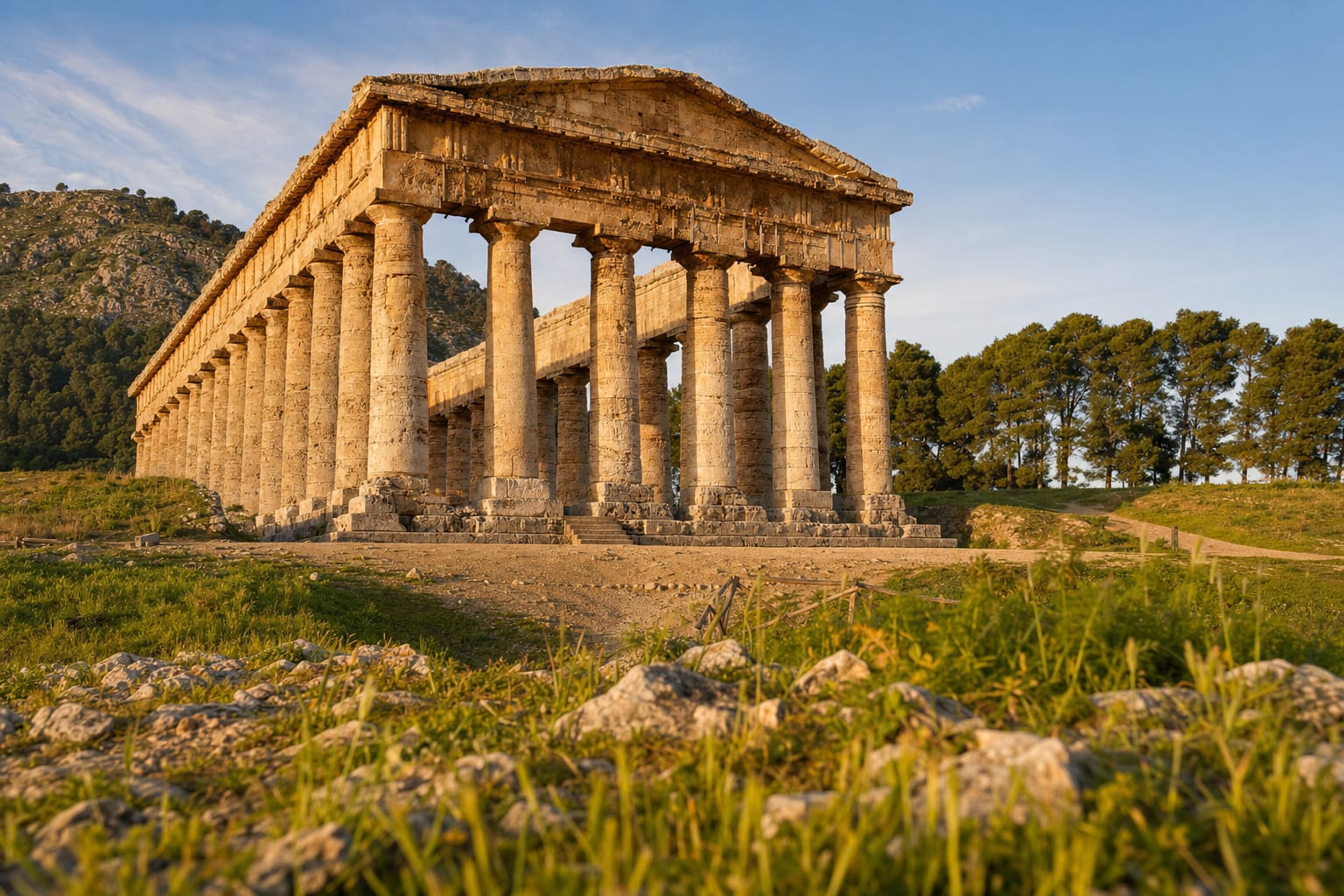
The Elymians raised a Doric temple here around 420 BC and never finished it: the columns were left unfluted and the cella was never built. On Monte Barbaro above, a Greek theatre opens onto hills that run down to the Gulf of Castellammare.

Verified details

Each statement below is linked to the record or institution that supports it.

Segesta is an archaeological city within the Parco archeologico di Segesta. Its north and south acropoleis, agora, theatre, housing, walls and gates belong to a wider urban system; the Doric temple stands outside the walls. The temple and theatre are related but not interchangeable names for the whole site.1

The park dates the oldest identified houses to the end of the sixth century BCE and describes urban transformations from the fifth century BCE to the second century CE. It records prosperity and a reorganisation on Asia-Minor city models between the second and first centuries BCE, followed by late-antique, Byzantine, Muslim and Norman-Swabian layers on the north acropolis.1

The Temple is a 6-by-14-column Doric-Siceliote peripteros, built outside the walls around 430–420 BCE. The park says it was probably left unfinished after events of 409–408 BCE, while another theory links its unusual construction to a non-Greek cult. Its dedication and altar have not been identified. Preserve every qualification.1

The park dates the theatre to the middle of the second century BCE, when Segesta was under Rome's political sphere and making a new monumental arrangement. It also records substantial nineteenth-century remaking and says no historical source describes the theatre or what occurred there. Modern performances do not prove ancient programming details.1

Segesta is managed within the regional Parco archeologico di Segesta, whose current service also manages separate sites including Grotta Scurati, Rocca di Entella, Monte Castellazzo, Mokarta and San Miceli. This is an institutional relationship, not a claim that one entry ticket, route, opening status or accessibility statement applies to every site.2

Sources and citations (2)
  1. Parco archeologico di Segesta, Regione SicilianaIl ParcoUrban area and temple descriptionRead source
  2. Regione SicilianaServizio – Parco archeologico di SegestaService scope and dependent sitesRead source

Plan your visit

Before you go

Booking
Walk-up friendly

Find it

Where to find Segesta

Get directionsGoogle MapsApple Maps