

Skip to content

Saline dello Stagnone

Stagnone Salt Pans

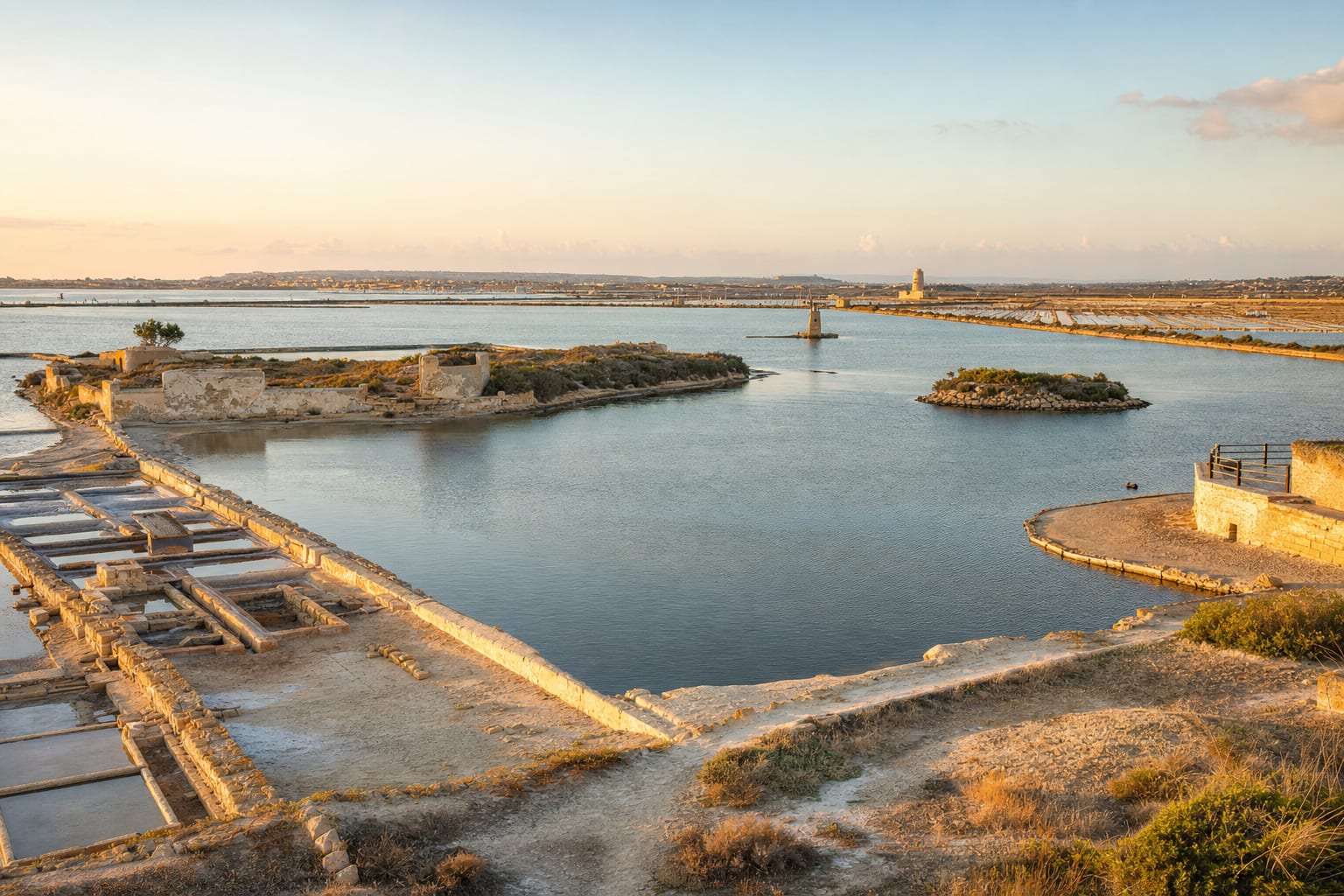
Windmill-studded saltscape, pink evaporation pools, Mozia island, sunset mirror lagoons.

Photograph · Saline dello Stagnone

At a glance

Stagnone Salt Pans facts that matter

Names, makers, dates, and context before the story opens up.

Italian nameSaline dello Stagnone
What it isNature
WhereMarsala, Sicily
Known forWindmill-studded saltscape, pink evaporation pools, Mozia island, sunset mirror lagoons

The story

What you're looking at

Between Trapani and Marsala, salt has been harvested from shallow lagoons since the Phoenicians, who left their island of Mozia in the middle. Windmills and white salt pyramids stand over pools that turn pink and gold at evening.

Verified details

Each statement below is linked to the record or institution that supports it.

The Stagnone salt-pans landscape belongs within the Riserva Naturale Orientata Isole dello Stagnone di Marsala, in the municipality of Marsala. The proper reserve identity is broader than a single saltworks: it includes a lagoon, islands and mainland areas.1

The reserve is an oriented nature reserve of 2,012.15 hectares, established by D.A. 215 of 4 July 1984 and managed by the Libero Consorzio Comunale di Trapani. It is associated with Natura 2000 sites including ZSC ITA010001 and ZPS ITA010028. These are protected-area designations, not individual UNESCO status for the salt pans.1

The reserve protects Sicily's largest lagoon and includes San Pantaleo or Mozia, Schola, Santa Maria and Isola Lunga. The regional record explains that the largest island forms a barrier between coast and open sea, creating the shallow lagoon. The islands and Mozia require separate place and heritage records rather than being collapsed into generic salt-pans content.1

The reserve record identifies Posidonia oceanica meadows, fish, algal and mollusc communities, salt-adapted terrestrial vegetation and wetland habitat used by migratory birds. It describes the Stagnone and the Trapani salt pans as one environmentally homogeneous system shaped by the long-standing presence of salt works. These are reserve-scale ecological relationships, not a wildlife-sighting guarantee or permission to enter restricted habitat.1

Regional landscape documentation describes each saltworks as an autonomous system of basins, channels and equipment arranged in a regular grid. It identifies persistent wind, relatively impermeable ground, a warm dry climate and access to a suitable port as conditions behind saltwork development on western Sicily's coast.2

The reserve regulation encourages salt cultivation, the maintenance of traditional crops and organic techniques, and provides a defined support route for eligible salt-pan owners or operators. Salt production is therefore a managed part of the reserve landscape.3

Sources and citations (3)
  1. Regione SicilianaRiserva Naturale Isole dello Stagnone di MarsalaReserve identity, municipality and descriptionRead source
  2. Regione SicilianaArticolazione per sistemi e componentiSaltworks infrastructure and environmental conditionsRead source
  3. Regione SicilianaApprovazione nuovo regolamento della Riserva naturale orientata Isole dello Stagnone di MarsalaArticle 7, salt cultivation and traditional cropsRead source

Plan your visit

Before you go

Booking
Walk-up friendly

Find it

Where to find Stagnone Salt Pans

Get directionsGoogle MapsApple Maps