

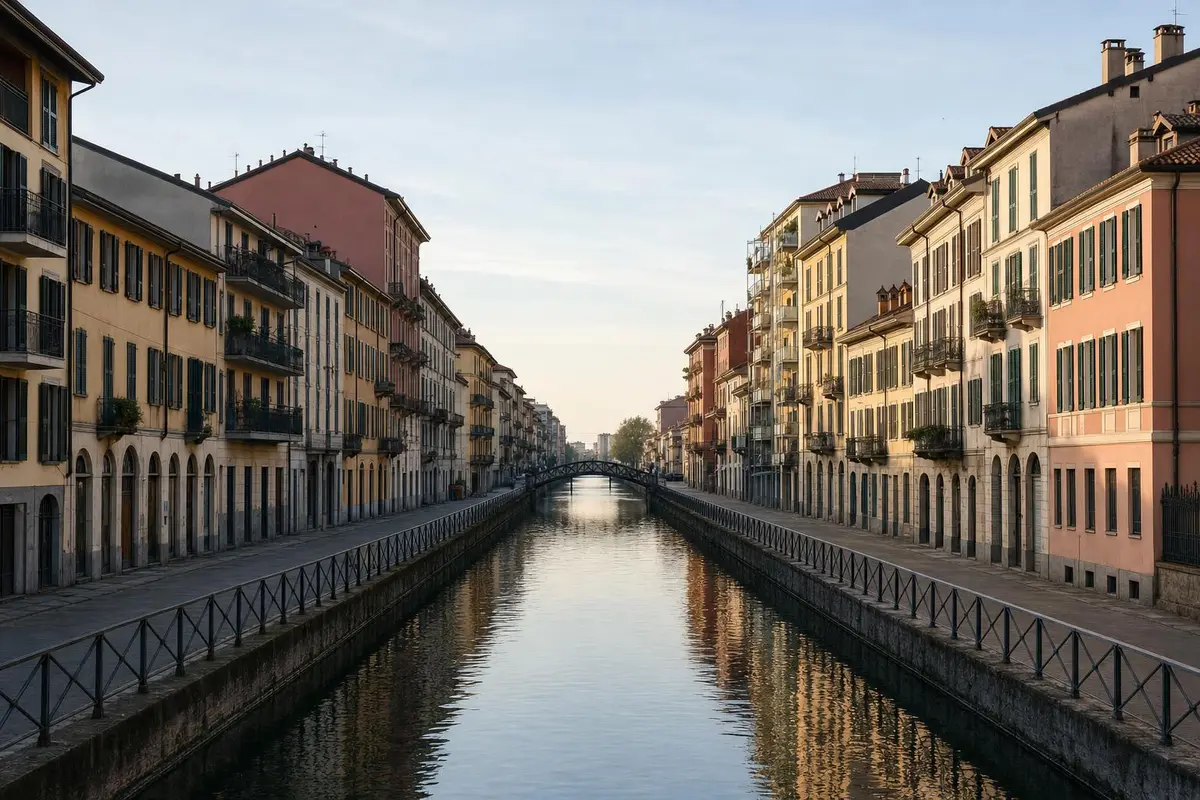
Milan’s Navigli are the canal-side neighbourhood shaped by the Naviglio Grande and Naviglio Pavese. The two waterways meet at the Darsena, the city’s old harbour, now a gathering place for a walk and an evening aperitivo. Their banks belong to a much wider water system, and a short visit here follows only a small part of that history.
Candoglia marble for the Duomo travelled by the Toce, Lake Maggiore and the Ticino, then along the Naviglio Grande to the Darsena at Sant’Eustorgio. A system of locks carried the stone onward to the Laghetto, close to the building site. The route gives the canals a direct link to Milan Cathedral, where the marble became part of the city’s most recognizable landmark.
At the Vicolo dei Lavandai, stone washbasins recall the people who did laundry by the canal. A male guild once worked here. Later, women washed clothes for Milan’s wealthy households, the sciuri. Pause at the basins before continuing along the quay.
Leonardo’s water studies lead to another part of Milan’s canal system. A drawing by Leonardo from around 1506 is associated with the Conca di San Marco on the Naviglio Martesana. It is unclear whether he was improving the lock gates or recording those already in place. Begin at the Darsena, follow the Grande to the Vicolo, and stay for the waterfront at dusk; the monthly antiques market brings a different rhythm to the same canal banks.
Where the walk goes next
After the washhouse, keep following the Naviglio Grande away from the harbour. The early part of the canal has bars and shopfronts, with glimpses of the shared balconies and courtyards of the old railing houses. As you approach San Cristoforo, look for the two adjoining church fronts, part of a complex built in different periods. The longer walk puts the old working neighbourhood back around the more familiar aperitivo scene. Allow about two kilometres one way from the Darsena to the church, or turn back at the washhouse for an easier outing.
For the route, use the Darsena to San Cristoforo walk. Start at Piazza XXIV Maggio if you want to see how the two canals meet, or at Porta Genova if you are arriving on the M2.


