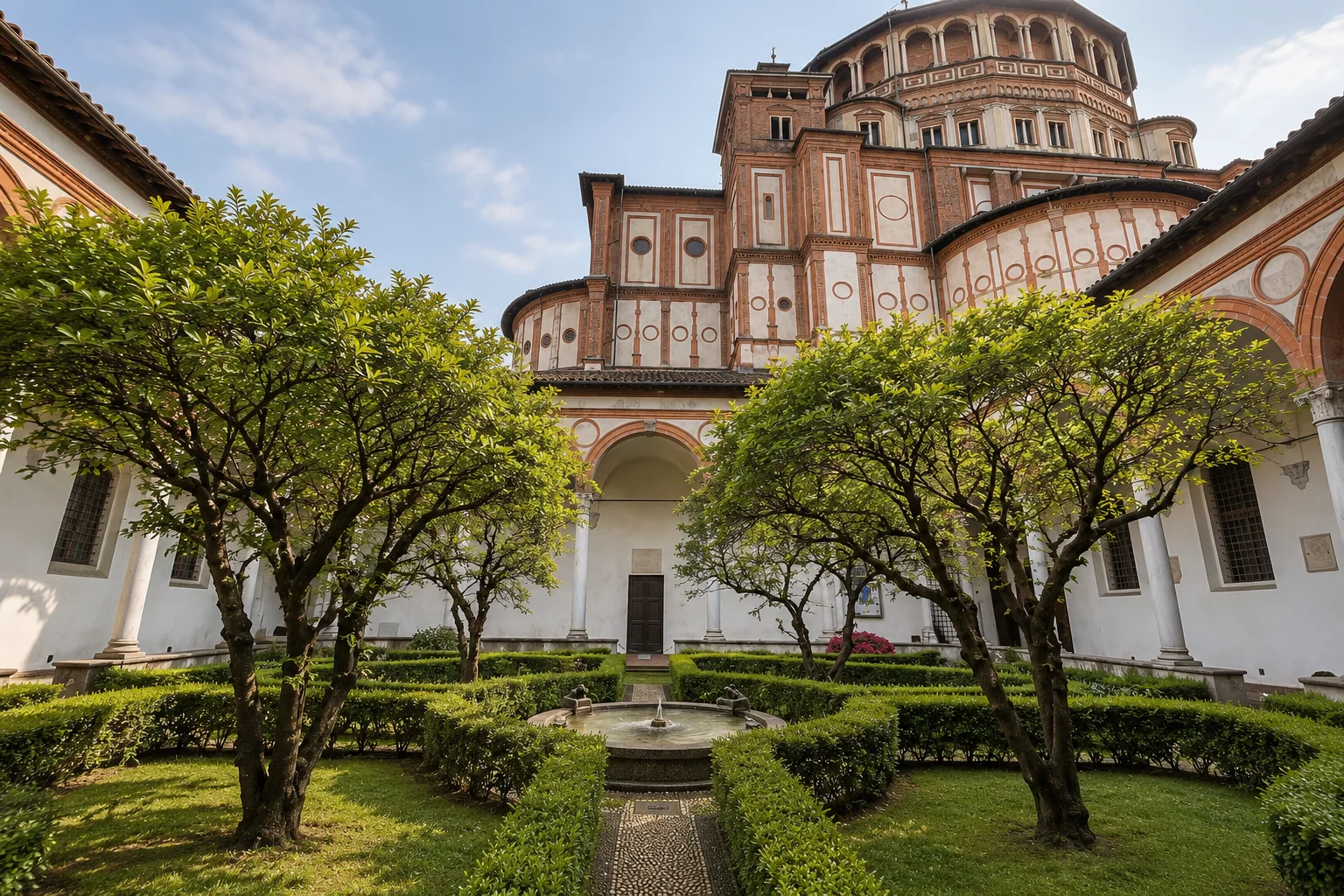
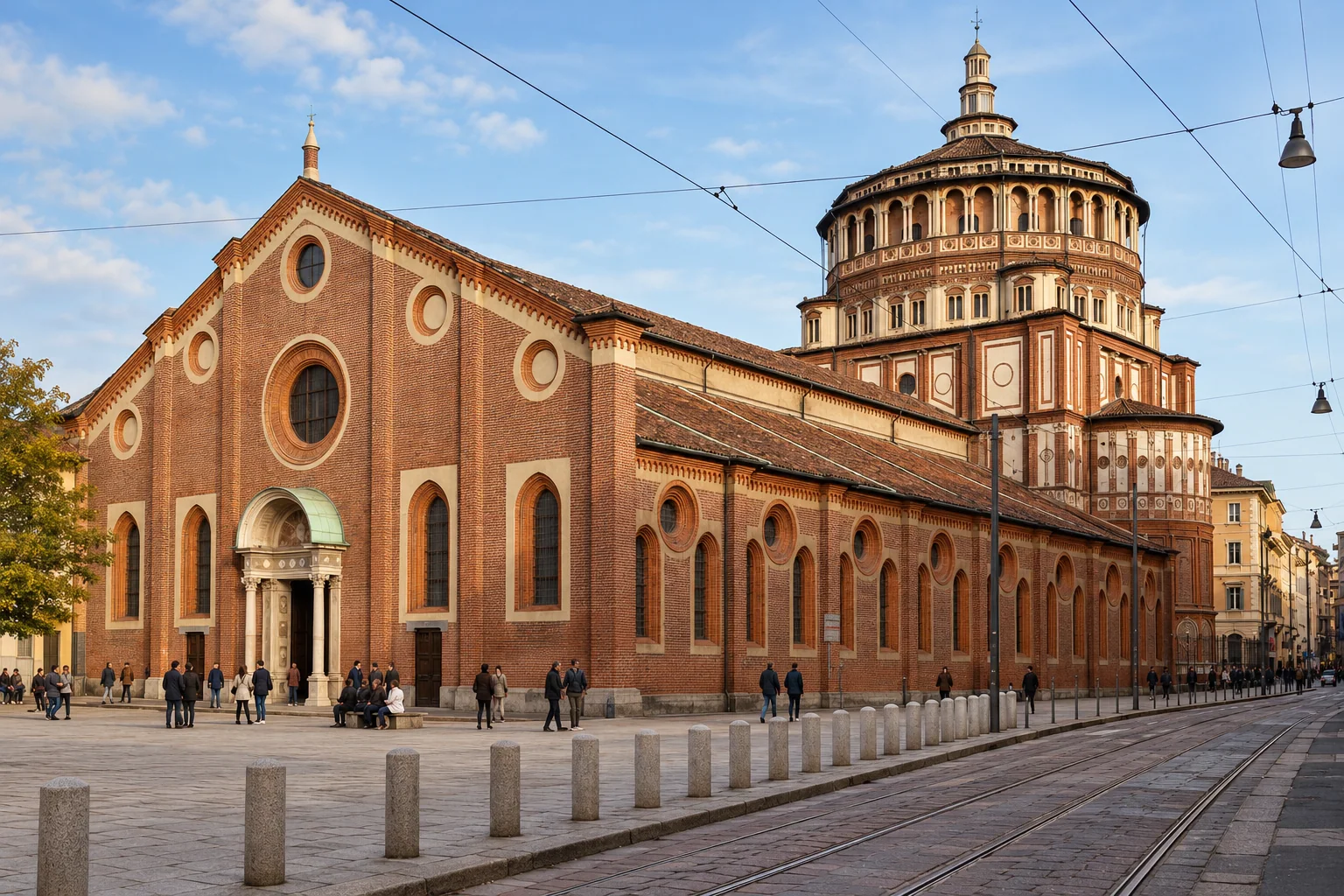
Santa Maria delle Grazie is a Dominican church and convent whose story begins before Leonardo's mural. Construction began in 1463 under Guiniforte Solari; the church was completed in 1482. Its three aisles, pointed ribbed vaults, brick masonry and granite Corinthian capitals belong to the Lombard architecture of the early Renaissance. The side chapels served Milanese families for private prayer and burial, so this was a working religious house as well as a monument.
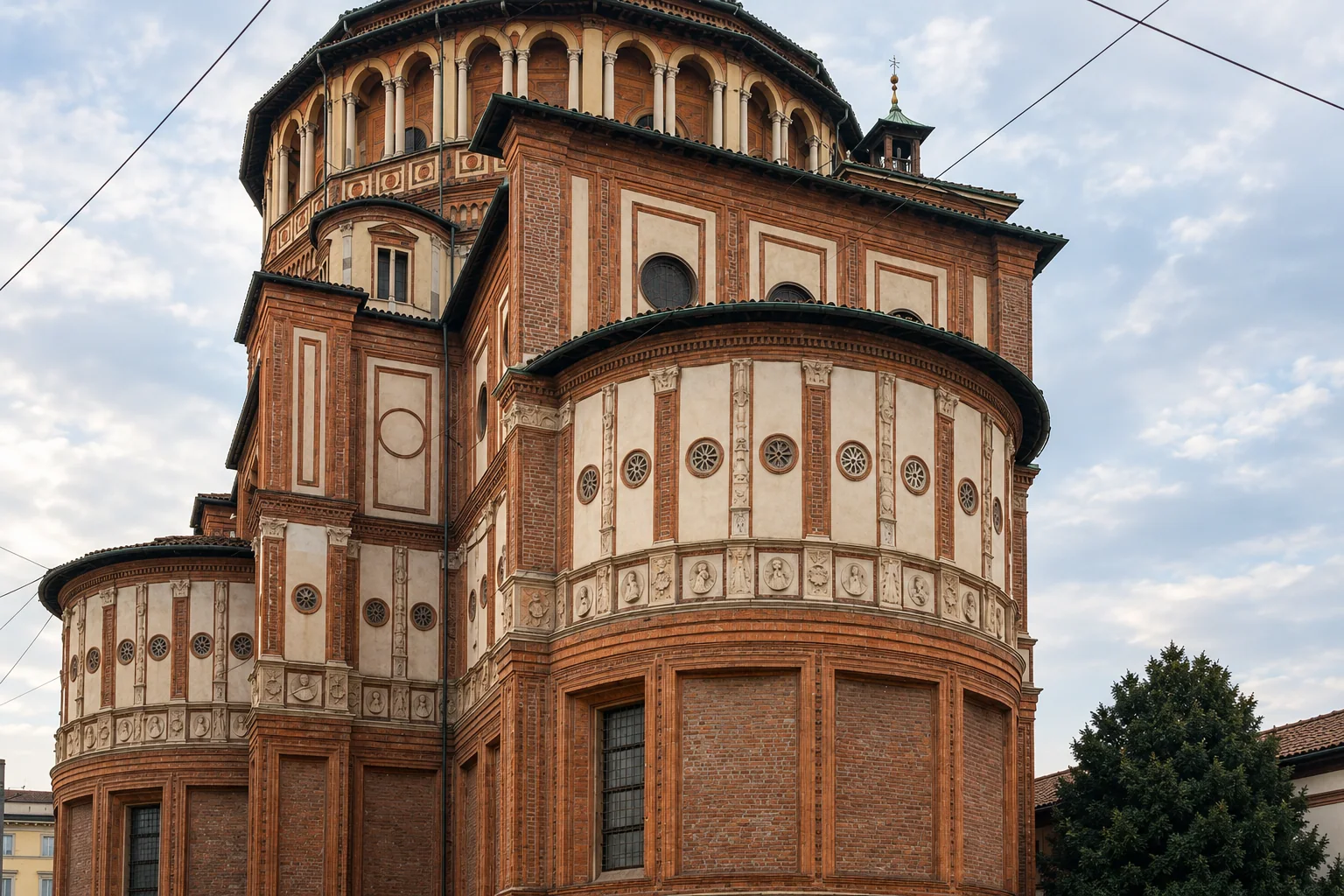
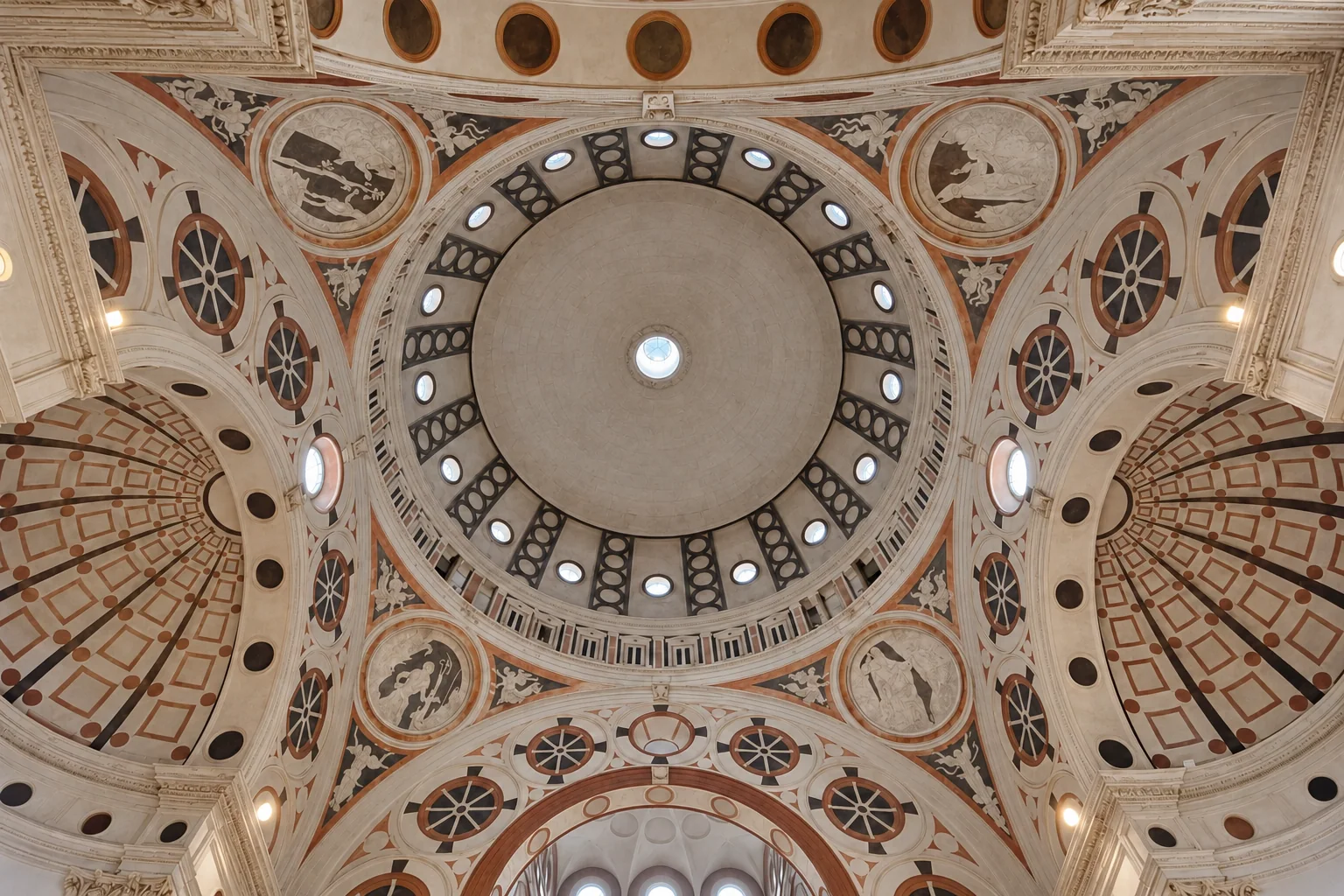
Under Ludovico Sforza, the complex became a dynastic project. He entrusted Donato Bramante with the church's eastern enlargement, where semicircular apses gather beneath the tribune's drum and dome. Leonardo painted the Last Supper on the north wall of the Dominican refectory, opposite Donato Montorfano's Crucifixion. Rather than use fresco, he worked in tempera on dry plaster, a slower method that gave him room to revise the image but left its paint layer vulnerable; the work began deteriorating soon after completion. Bombing in 1943 brought down the refectory roof, vaults and eastern wall, while the two end-wall paintings survived. The church, convent and refectory are one UNESCO World Heritage property, but they are separate visits: a church visit does not include the museum. Explore the Sforza court at Castello Sforzesco, then see the museum's own Last Supper account for the painting's conservation story.
The church is free to enter; the Last Supper is a separately ticketed museum visit. Consult the parish visitor guidance for church access around services, and the museum’s official booking information before planning to see Leonardo’s painting.
Sources and citations (12)
- Museo del Cenacolo VincianoFAQ: free and reduced admissionFAQ items on free admission and reduced admission, lines 90–126; disability and booking form/documentation, lines 142–150. In particular lines 120–126 specify age 18 to 25 not yet completed, reciprocity, and no €2 reduction after the 25th birthday; l […]Read source
- Regione LombardiaBasilica di Santa Maria delle Grazie e Cenacolo VincianoPage text, lines 22–28: Basilica entry described as free, with a link to parish visitor information; lines 38–39 distinguish the Cenacolo Museum entrance to the left of the church façade. The same page retains dated/obsolete museum visit-limit copy, […]Read source
- Parrocchia Santa Maria delle GrazieOrari — Chiesa di Santa Maria delle Grazie, parish websiteTourist-visits and guided-visits section: lists Basilica, cloister and Bramante sacristy visits separately from worship; says visits are prohibited during celebrations.; Guided-tour notice: a donation from €5 is welcomed for maintenance of the comple […]Read source
- Museo del Cenacolo VincianoFAQ: free and reduced admission (English)English FAQ items 'Who is entitled to a reduced admission fee to the Museum?' and 'I have a disability. Am I entitled to free admission?', lines 102–128 in rendered page. It independently confirms the incomplete-25th-birthday/reciprocity rule and L.1 […]Read source
- Museo del Cenacolo VincianoFAQ: ticket costs and booking rulesFAQ items 'Quanto costa l’ingresso al Museo?' and 'Nel sistema di prenotazione on line il costo del biglietto è maggiorato rispetto a quanto indicato inizialmente. Come mai?', lines 90–97 and 115–132 in rendered page: €15 full / €2 reduced headline p […]Read source
- Museo del Cenacolo VincianoSanta Maria delle Grazie — Museo del Cenacolo Vinciano, official websiteLines 83–84: 1463 start under Guiniforte Solari; convent substantially complete 1469 and church complete 1482.; Lines 88–99: nave and two aisles; Lombard early-Renaissance style; pointed vaults, terracotta masonry and granite capitals with Corinthian […]Read source
- Museo del Cenacolo VincianoSanta Maria delle Grazie — Museo del Cenacolo Vinciano official church factsheet (Italian PDF)PDF page 1, lines 5–18: three-nave church, Solari's Lombard Gothic description, pointed vaults, terracotta gabled façade; captions identify nave and exterior.; PDF page 2, lines 25–33: Bramante's semicircular apses and Renaissance tribune/dome; lines […]Read source
- Museo del Cenacolo VincianoThe Last Supper — Museo del Cenacolo Vinciano, official artwork pageLines 69–76: painting's approximate period and Leonardo's treatment of gestures/emotions.; Lines 86–95: World Heritage relationship, title/artist/date, dry wall-painting technique, dimensions and location.; Lines 120–126: reservation and short viewin […]Read source
- Museo del Cenacolo VincianoHistory — Museo del Cenacolo Vinciano, official websiteLines 70–77: refectory was the Dominican friars' dining/prayer room; current route passes surviving 17th-century fragments and overlooks the Cloister of the Dead.; Lines 91–92: Ludovico Sforza intended the complex as a family mausoleum and entrusted […]Read source
- UNESCO World Heritage CentreChurch and Dominican Convent of Santa Maria delle Grazie with The Last Supper — UNESCO World Heritage CentreProperty description, lines 47–51: historical and architectural relationship of church/refectory, Bramante intervention and dome/tribune; painting date/technique.Read source
- Museo del Cenacolo VincianoInfo — Museo del Cenacolo Vinciano, official English visitor pageLines 79–81: 15-minute refectory view; arrive 30 minutes before booked time; advance reservations for everyone and every ticket type.; Lines 87–99 and 107–133: booking releases in quarterly groups and official booking channels.; Lines 137–148: full € […]Read source
- YesMilano / Milano AccessibileBasilica di Santa Maria delle Grazie: accessibilitySections 'Entrances', 'Interior spaces', and information-panel/QR-code text. Search-indexed full page states churchyard step 12 cm, main door 95 cm, aisles without obstacles, alternate altar ramp (10% with bilateral handrails), cloister wheelchair ro […]Read source