

At 05.40 on a Wednesday in late June, the light on the Lagazuoi terrace is the colour of unsweetened tea. Martino Colli, warden of Rifugio Lagazuoi since 2011, brings two mugs of coffee onto the deck and sets one in front of me without saying anything. The house rule: speak softly before 06.30, and not at all on the terrace when the sun crests. We drink in silence for four minutes while the top of Monte Pelmo, thirty kilometres south, lights up like a match.
Alta Via 1, the classic Dolomite high route, runs roughly 120 kilometres from Lago di Braies down to Belluno. Eleven days, eleven rifugi, a rhythm road travel will not give you. This is a report on day five: from Rifugio Lagazuoi at 2,752 metres down to Rifugio Nuvolau at 2,575, by way of the Cinque Torri. Ten kilometres. Eight hundred metres of descent, then two hundred and forty of climb at the end. Six and a half hours if the weather holds.
The first hour off the Lagazuoi is the one most walkers get wrong. The path drops steeply behind the rifugio into the Val Travenanzes, on scree the rain softens and the sun bakes hard again by noon. Martino's standing advice is to leave by 06.45, which puts you below the scree band before the sun reaches it. The Dolomites reward walkers who plan their water; the scree section has none. I refill at a small spring at the edge of the conifer line, marked with a red arrow on a limestone boulder; the paint, Martino says, predates his tenancy.
The mountain does not care whether you are fast. It cares whether you are honest about how tired you are.
Martino Colli, warden
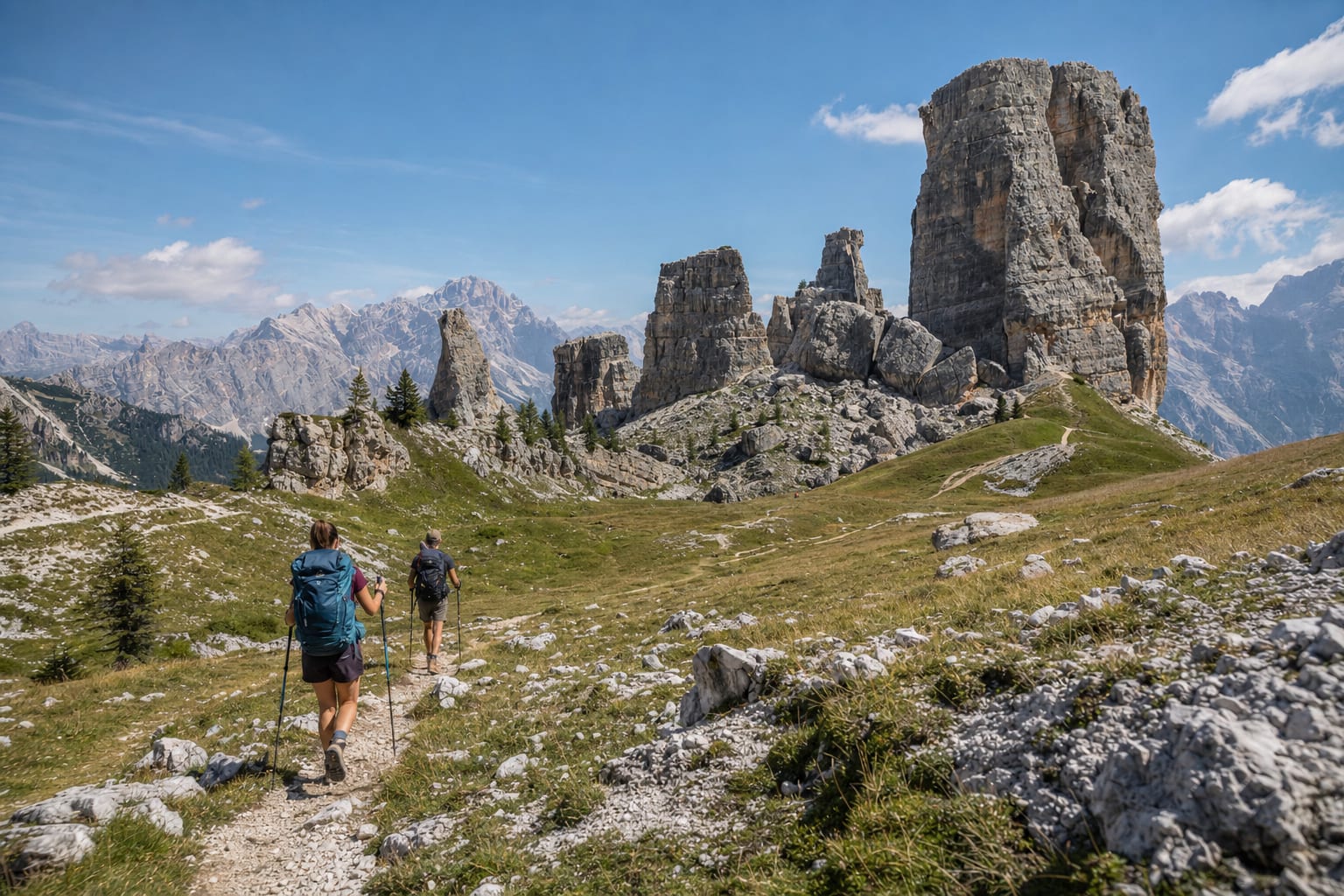
By 09.30 the path reaches the Cinque Torri, a cluster of limestone towers on a meadow of gentian and alpine aster. The via ferrata routes here have been training ground for the Italian alpine guides since the 1930s. The small Rifugio Scoiattoli, on the shoulder above the towers, is where the AV1 walker takes a late breakfast. The orzotto (pearl-barley risotto) with speck and wild thyme is the dish the Scoiattoli is known for. I sit on a larch bench and write four lines in the notebook.
The middle stretch, from the Scoiattoli to the base of Nuvolau, is deceptive. On the map, two and a half kilometres of nearly level walking along a balcony above the Val Costeana. On the ground, the path narrows in two places to a ledge about forty centimetres wide, with a fixed cable for hands. A walker of normal fitness will find the cable more reassuring than necessary. A walker who dislikes drop-offs should know this in advance.
At 12.50 the path begins the final climb to Nuvolau. The rifugio sits on a rock dome at 2,575 metres, one of the oldest high huts in the Dolomites (built by the Austro-Hungarian alpine club in 1883, rebuilt after the First World War). From its terrace, in a single slow turn, you see Tofana di Rozes, Pelmo, Civetta, Marmolada and Antelao. The climb takes thirty-five minutes without baggage. I do it in forty-three, with the wind on my left cheek and wood-smoke from the hut getting stronger.
The warden of Nuvolau, Giorgia Zardini, runs the hut with the same precision Martino runs Lagazuoi, which is to say she will not let you sit down to dinner in damp wool. Boot room to the right of the door. Socks over the pipe by the window. Jacket on the hook, not the chair. Dinner at 19.00. Soup first (barley, mountain vegetables, a dice of smoked pork), then canederli in brodo, then strudel with cream, then grappa, then sleep. The window above my head frames the Antelao at the moment the last of the sun leaves it.
A day on AV1 is not a summit day, nor a rest day, nor any of the categories an average calendar knows about. You eat because you walked, you sleep because you ate, you wake because the first light is on the rock. Tomorrow, Giorgia says, leave by 06.30. The weather is good, for now.


