

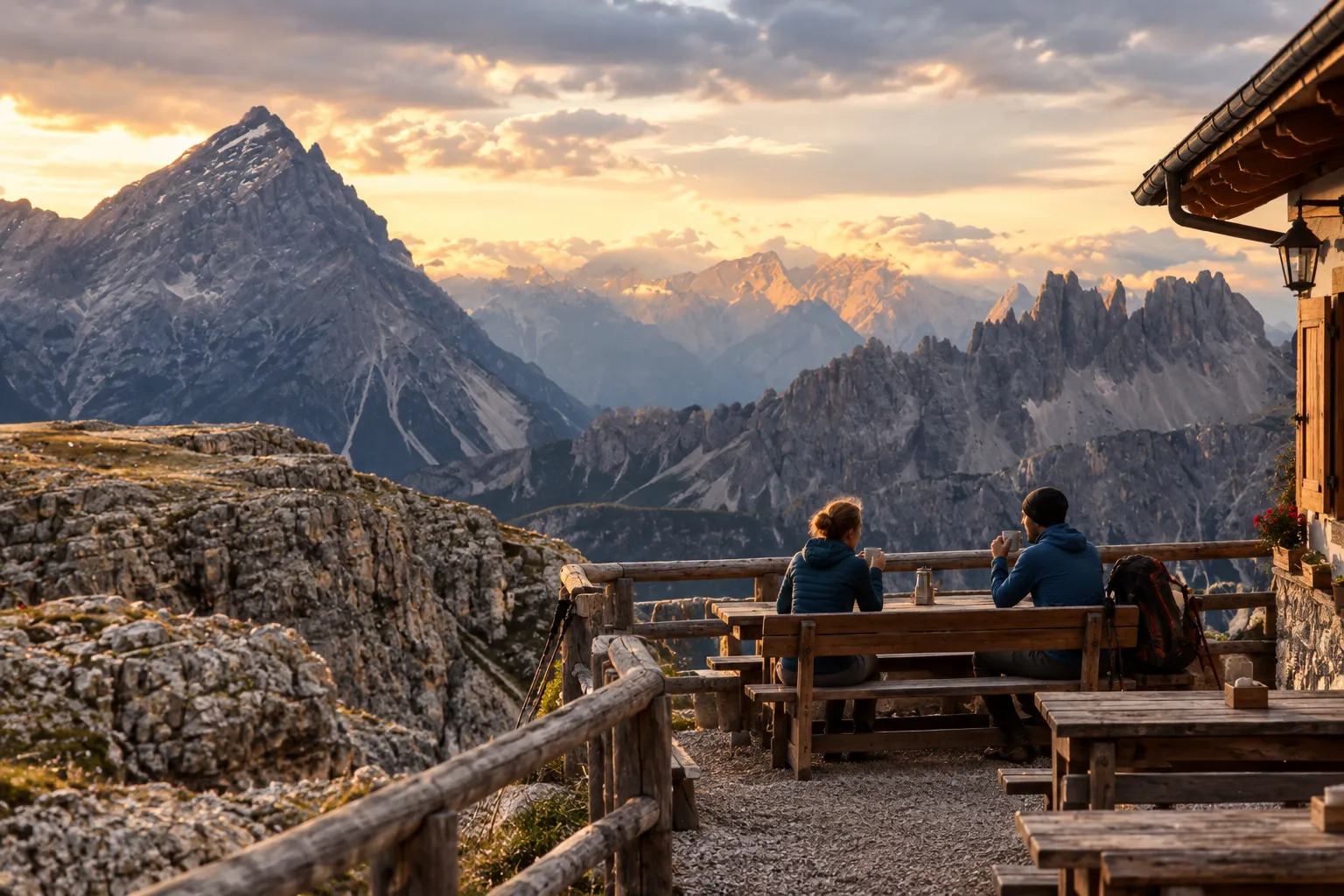
At first light in late June, the terrace of Rifugio Lagazuoi is the colour of weak tea. The hut sits at 2,752 metres, just below the summit of the Piccolo Lagazuoi, and it is one of the finest places in the Dolomites to watch the sun come up: coffee in hand, nobody saying much, the top of Monte Pelmo to the south lighting up like a struck match. Most rifugi have a quiet hour early in the morning, and the people who come back year after year keep it.
Alta Via 1, the classic Dolomite high route, runs roughly 120 kilometres from Lago di Braies in the north to Belluno in the south. Most walkers take ten days or so, sleeping in a different hut each night. This is one of its best days: from the Lagazuoi down to Passo Falzarego, across to the saddle below Monte Averau, and up to Rifugio Nuvolau at 2,575 metres, with a detour to the Cinque Torri if your legs allow. On paper it is short, around ten kilometres depending on your line, but you give away more than six hundred metres of height before you win some of it back.
The first hour is the one most people get wrong. The way down to Passo Falzarego is steep and loose, scree that softens in rain and bakes hard again by midday, and it is far kinder in the cool of the morning. There are two ways to do it on foot. The open path zigzags down beneath the cable car. The other goes through the mountain itself. In the First World War, Austro-Hungarian and Italian troops fought here at close quarters and dug galleries through the rock to mine each other’s positions, and a restored tunnel now descends inside the Lagazuoi toward the pass. Take a headlamp and a helmet, and go slowly.
You eat because you walked, you sleep because you ate, you wake because the first light is on the rock.
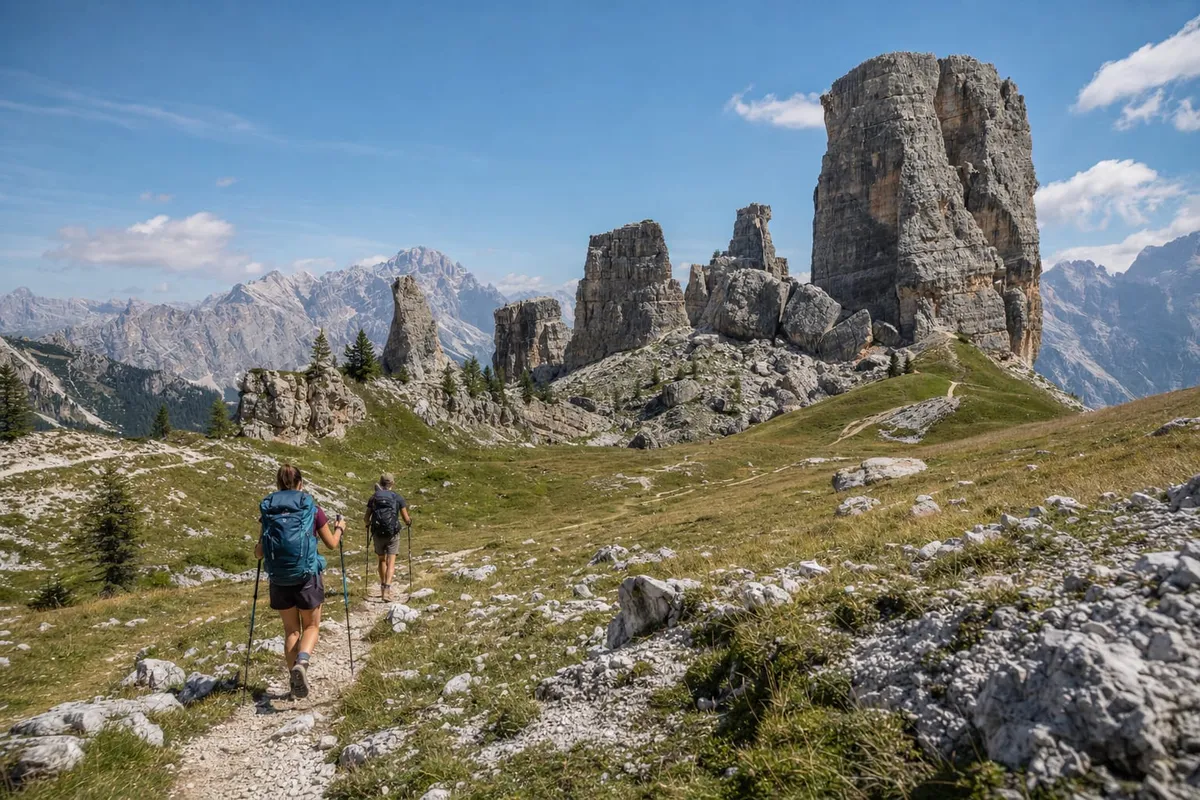
Across the pass, the path climbs toward the Averau saddle, and from there a short detour drops to the Cinque Torri, a cluster of limestone towers standing on a meadow of gentian and alpine aster. Cortina’s climbers have trained on these walls for generations, and the Italian artillery positions that faced the Austrian lines on the Lagazuoi have been restored along a walking loop. Rifugio Scoiattoli, on the shoulder above the towers, is the place for a late breakfast or an early lunch. Order an orzotto (pearl barley cooked like a risotto) with speck, and take it to a larch bench in the sun.
The stretch back up to the saddle and on toward Nuvolau is where the day asks for your attention. The ground steepens, the path turns rocky, and in a few places you will use your hands. None of it is technical for a fit walker on a dry day, but the last approach to the summit dome feels airy, and the via ferrata you will see on the Averau itself is another undertaking altogether. Carry water from the morning. There is little on the way.
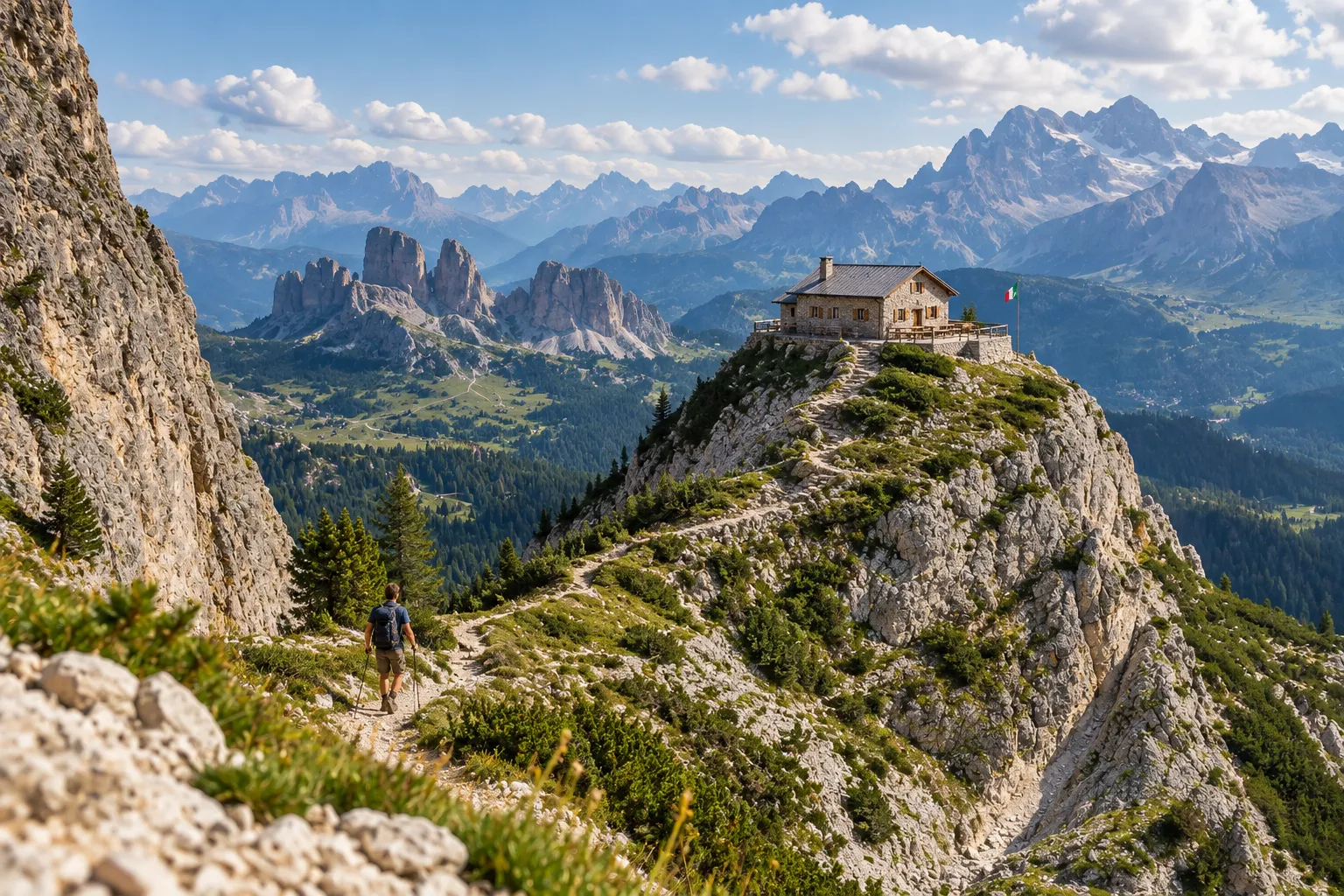
Rifugio Nuvolau sits on its rock dome at 2,575 metres and is often called the oldest hut in the Dolomites. It opened in August 1883, paid for by a Saxon colonel, Richard von Meerheimb, who credited the air of Ampezzo with curing his lungs, and the valley named it the Sachsendankhütte, the Saxon’s thank-you hut. It was wrecked in the First World War and reopened, enlarged, in 1930. From its terrace, in one slow turn, you see the Tofane, Pelmo, Civetta, Marmolada and Antelao. The final climb takes thirty-five or forty minutes. You do it with the wind on one cheek and the wood-smoke from the hut getting stronger.
Every rifugio runs on house rules, and they are much the same everywhere. Boots off at the door and into the boot room, hut slippers on. Wet socks over the stove pipe, jacket on the hook, not on the chair. Dinner at a fixed hour, usually around seven, and you eat what the kitchen has made: a barley or vegetable soup, canederli (bread dumplings) in broth, strudel with cream, and then, if you ask, a grappa. Then sleep. If your window faces east, it frames the Antelao at the moment the last of the sun leaves it.
A day on the Alta Via is not a summit day, nor a rest day, nor any of the categories an ordinary calendar knows about. You eat because you walked, you sleep because you ate, you wake because the first light is on the rock. Ask at dinner about tomorrow’s weather, and set off early.
Sources
- Rifugio Nuvolau · cortinadelicious.it
- The Hut’s history · rifugionuvolau.it
- Lagazuoi Open Air Museum · alta-badia.org
- The WW1 Open-Air Museum at the 5 Torri · cortinadelicious.it
- The World War I Museum at the 5 Torri · 5torri.it
Comments
No comments yet. Start the conversation.