

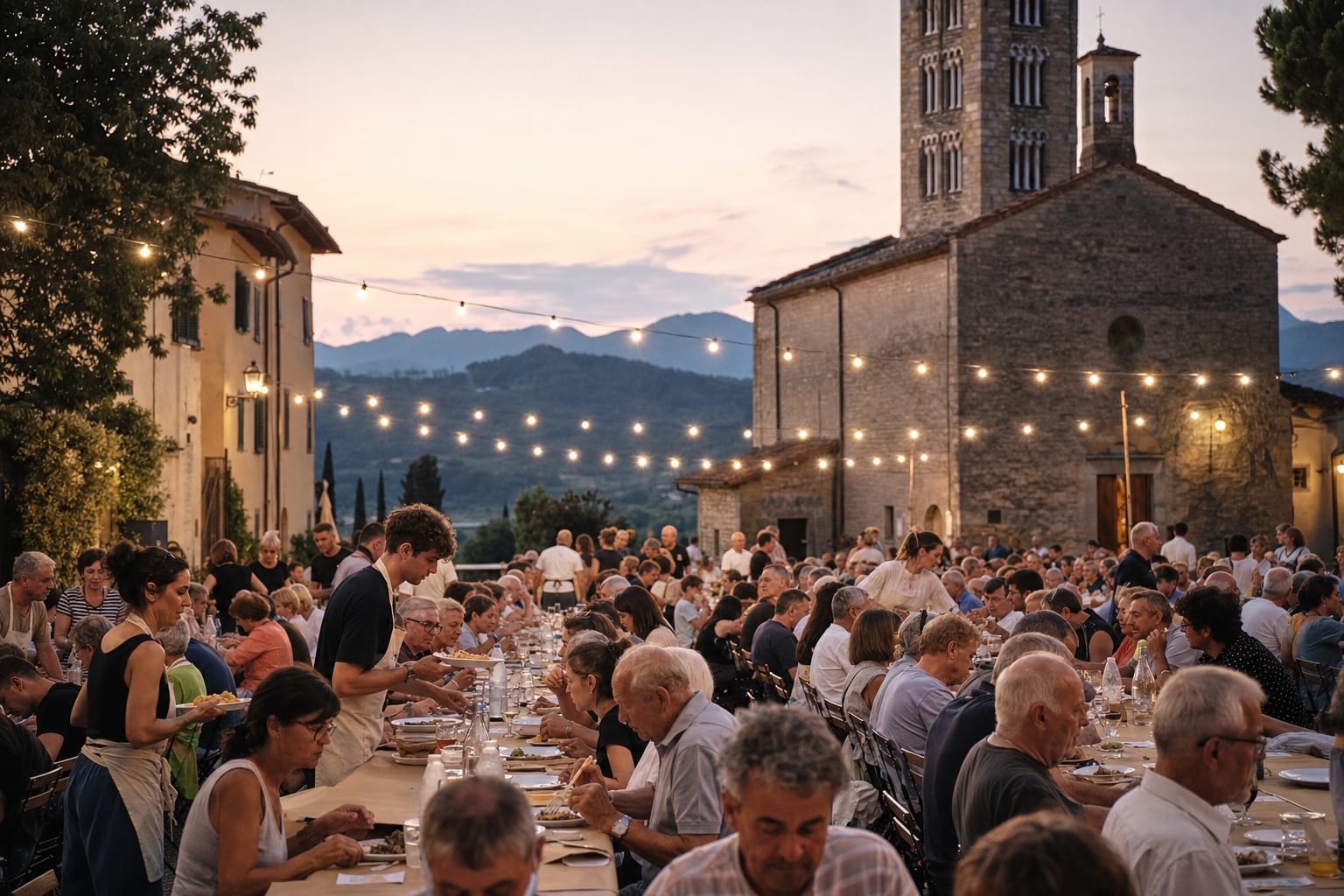
Mutigliano, a frazione of Lucca of roughly 1,400 residents, sits on the first rise of hills north of the city walls, where the plain begins to fold toward the Apuan Alps. From mid-July, for four consecutive evenings, the small Piazza della Chiesa at its centre is closed to cars, strung corner to corner with paper lanterns, and set with trestle tables long enough to seat 600 people at a time. This is the Sagra della Zuppa Lucchese, run since 1971 by the parish of Santa Maria Assunta and the local circolo, a civic and sporting club. One dish is served. The dish is farro.
Zuppa di farro alla lucchese is a thick soup of spelt, borlotti beans, passata, soffritto, a sprig of sage and rosemary, a slick of Lucchese oil, and black pepper, served over a slice of unsalted Tuscan bread rubbed with garlic. The farro is from the Garfagnana, just up the valley, where it has been grown under a 1996 IGP protection and, before that, for fourteen centuries of monastic agriculture. The beans are the tondini of Pescia. The oil is from the hills between Mutigliano and Monte San Quirico. Nothing on the plate has travelled more than forty kilometres to reach it.
The volunteer system is the thing to understand. The sagra is run by a committee of 22 (ten from the parish council, twelve from the circolo) and staffed, across the four nights, by 180 residents on rotating shifts. The rota, drawn up every March by Sig.ra Maria Benedetti, 74, who has done it since 1998, is posted on the door of the sacristy in mid-May. Shifts are three hours long. There is a peeling shift at 2 p.m. for the onions and carrots of the soffritto, a simmering shift from 3 to 6 at the cauldrons in the parish hall, a serving shift from 7.30 to 10.30, a dishwashing shift until midnight, and a dismantling shift that starts, every fourth morning, at 5 a.m. with benches, tables and lanterns coming down. The compensation for all of it is a plate of zuppa, a glass of Colli Lucchesi rosso from the parish cellar, and a name on the roll that is read, once a year, at the Mass of San Paolino in mid-July.
A restaurant serves you. A sagra serves with you. The difference is what keeps us alive.
Giancarlo Puccinelli, committee president
The economics are almost invisible, by design. A plate of zuppa with bread costs seven euro. A half-litre carafe of the house rosso is six. A coffee from the small bar the Alpini run under an awning next to the church is one. At 600 covers across four nights, plus a second turn on the Saturday, gross takings reach about 38,000 euro in a good year. After food cost (roughly 8,000), wine (3,200), the rental of a refrigerated truck from a farm in Segromigno (600), the licensing fee to the comune (420), and the parish's own quarter share (a convention settled in 1983), the circolo clears around 18,000 euro. It goes, every year, to three things in fixed proportion: the upkeep of the parish football pitch, the repair of the church roof tiles (a slow and unending project), and a small scholarship for a resident attending the agrarian institute at Mutigliano or the conservatory at Lucca.
Restaurants in the Lucchesia cannot reproduce this, and in conversation with the committee the reason becomes obvious. A restaurant must price a plate to cover rent, rates, staff, insurance, waste, and the margin that lets the owner eat in winter. A sagra has none of these costs. The piazza is free. The cooks are paid in zuppa. The washing-up is done by teenagers who will, next July, be doing the serving; the grandmothers at the cauldrons were, in 1989, the teenagers doing the washing-up. The whole structure is an agreement between generations to subsidise one another's evening for four nights a year. There is no equivalent commercial form. When a Lucchese osteria closes (and three have closed in Mutigliano and the neighbouring frazioni since 2019), the sagra is what remains of its table.
At half past eight on the second Thursday, the piazza fills. The bells of Santa Maria Assunta ring the half-hour. A row of servers, each with a plastic apron over their Sunday shirt, walks the length of the table with earthenware bowls held in both hands. A four-year-old climbs onto her grandfather's lap. Two men from Sorbano del Giudice, who have come for this sagra every year since 1987, argue quietly about the bean ratio, which one of them insists has shifted this year toward fewer borlotti and more cannellini. A girl from Milan, on holiday with her Lucchese cousins, eats her bowl in silence with an expression that suggests she is considering a transfer. A ladle scrapes the bottom of a cauldron. The dish, in its fifty-sixth summer, is exactly as it was.
The Sagra della Zuppa Lucchese runs this year from Thursday 16 to Sunday 19 July. There is no reservation. There is no menu. There is one parish, one piazza, one dish, and roughly 180 reasons it will be on the table again in 2027.


