

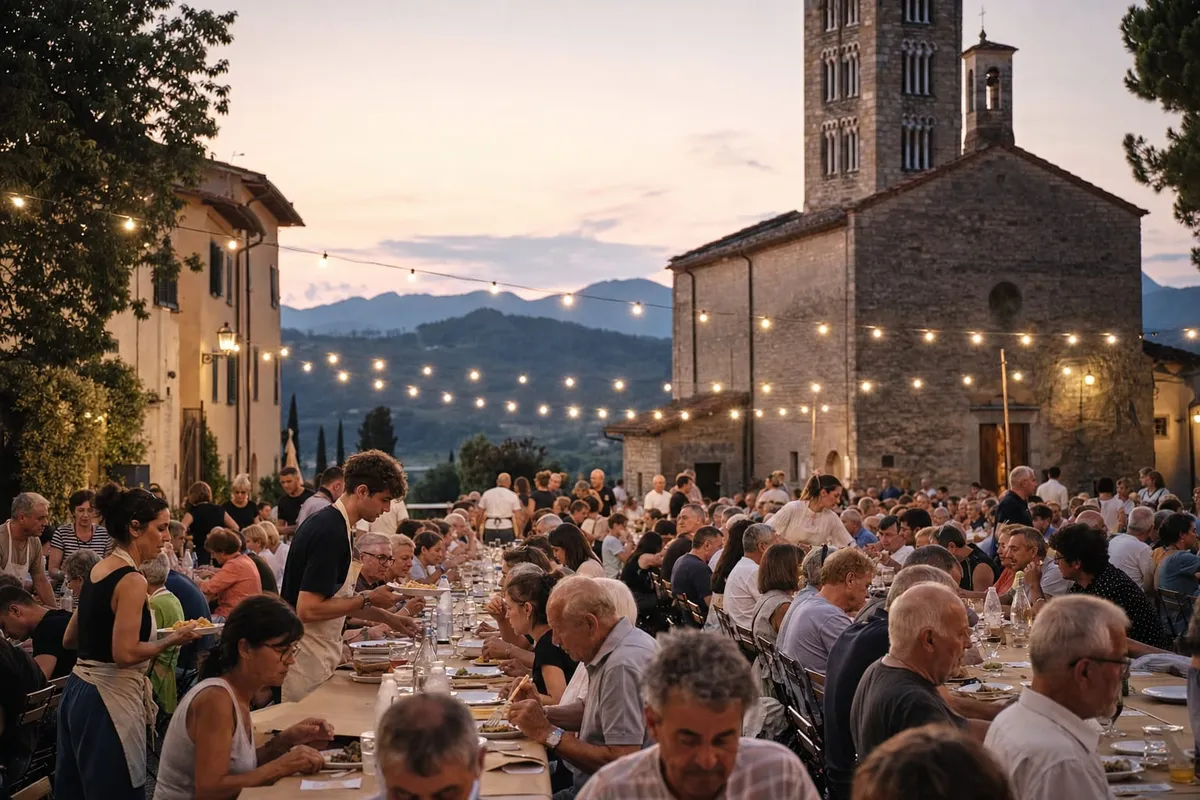
Lucca’s walls are the famous part. The sagra happens outside them. Drive a few kilometres north of the city into the first folds of the hills, where the plain begins to rise toward the Apuan Alps and each village (a frazione, in the language of the comune) gathers around a church and a bar, and on a July evening you may find the little piazza closed to traffic, strung corner to corner with lights and set with trestle tables long enough to seat hundreds. That is a sagra. The word comes from the Latin sacrum, and the oldest of them grew out of a parish’s feast day. Most today are run by a parish, a Pro Loco or a village circolo, and many are built around a single dish.
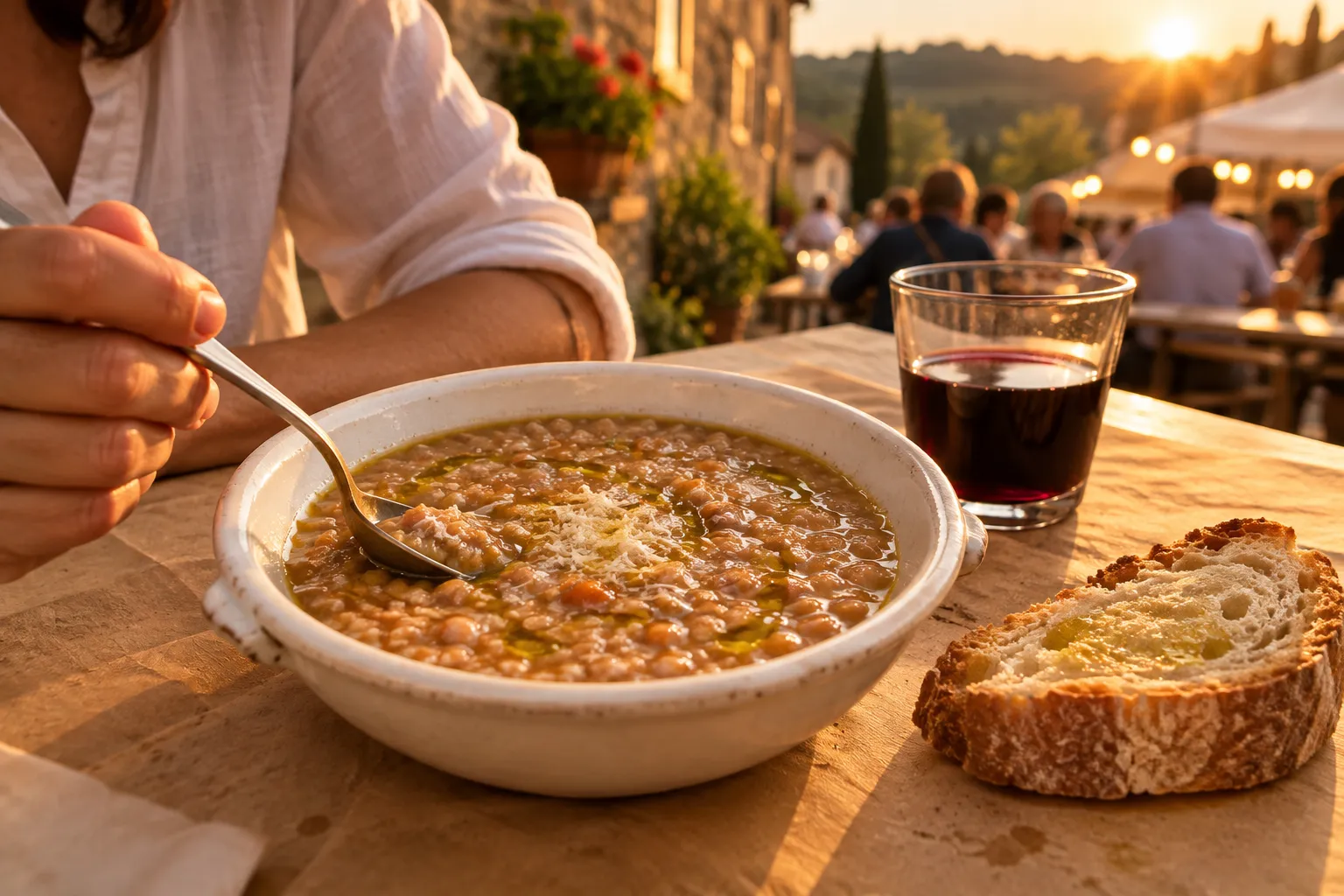
Around Lucca, that dish is very often farro. Zuppa di farro alla lucchese is a thick soup of spelt and beans, cooked with a soffritto of onion, carrot and celery, a little tomato, sage and rosemary, finished with a thread of oil and black pepper, and served in many homes over a slice of unsalted Tuscan bread. The farro comes from the Garfagnana, the valley of the Serchio just north of Lucca, where it has been grown for centuries in small mountain fields and has carried a protected IGP since 1996. The oil, in a good year, is from the hills of the Lucchesia, which has its own DOP. It is not unusual for nothing in the bowl to have travelled very far.
The volunteer system is the thing to understand. A village sagra is usually run by a small committee and staffed, across its nights, by residents on rotating shifts. The rota goes up weeks ahead, on the door of the parish hall or the bar. There is a peeling shift in the afternoon for the onions and carrots, a long simmering shift at the big pots, a serving shift through the evening, a washing-up shift that runs toward midnight, and, on the last morning, the crew that takes down the benches, tables and lights. The pay for all of it is a bowl of whatever is being served, a glass of Colline Lucchesi red, and the satisfaction of being on the list.
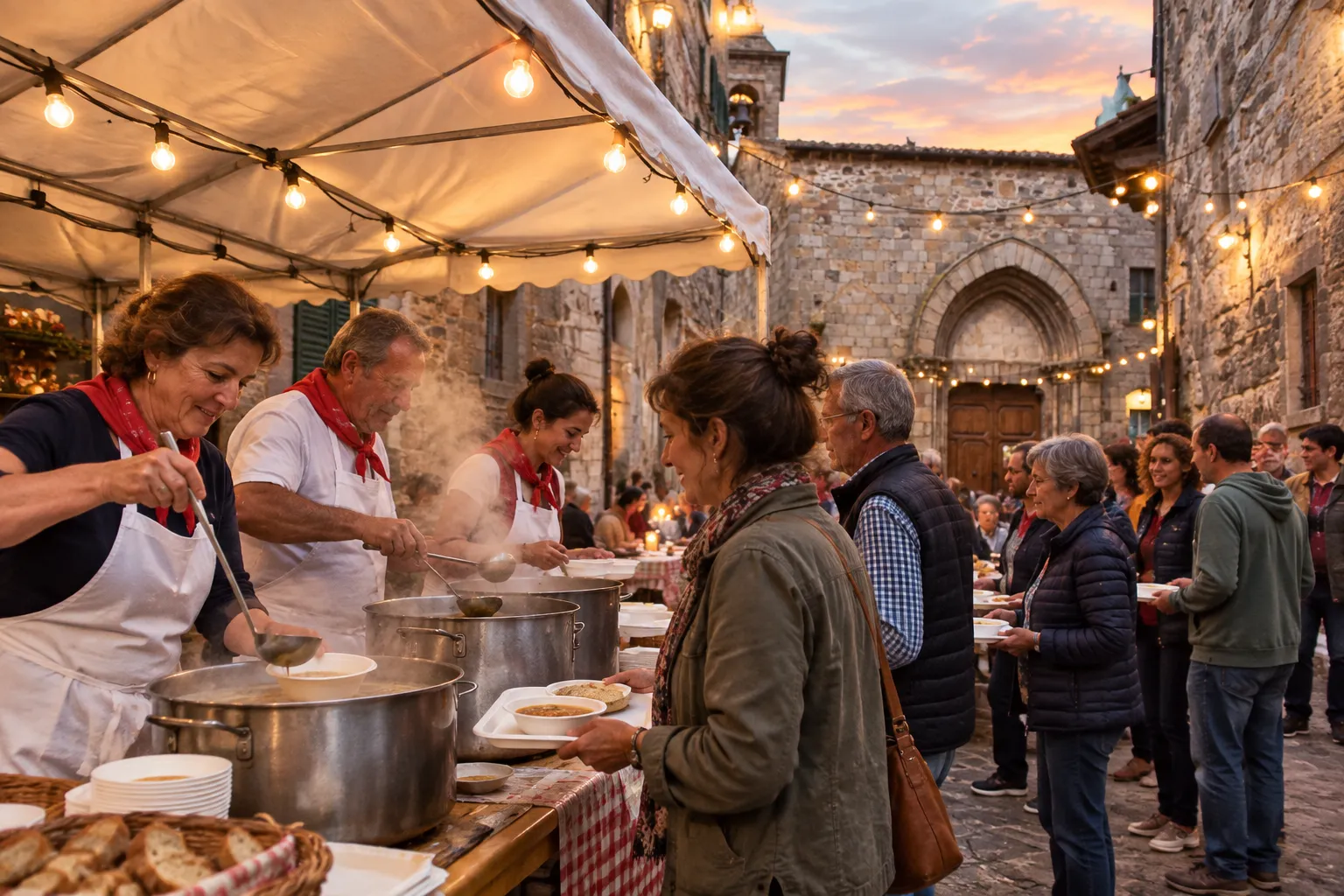
A restaurant serves you. A sagra serves with you.
The economics are almost invisible, by design. Prices are low: a bowl of soup with bread, a carafe of the local wine, a coffee from the bar under an awning, a few euro each. Costs are low too, because the labour is donated and the piazza is free, and whatever is left after food, wine, equipment and permits goes back into the community that cooked it: a church roof, a football pitch, the village band, a local charity. Every sagra is different, and plenty have grown into large, commercial affairs. The ones worth driving into the hills for still run this way.
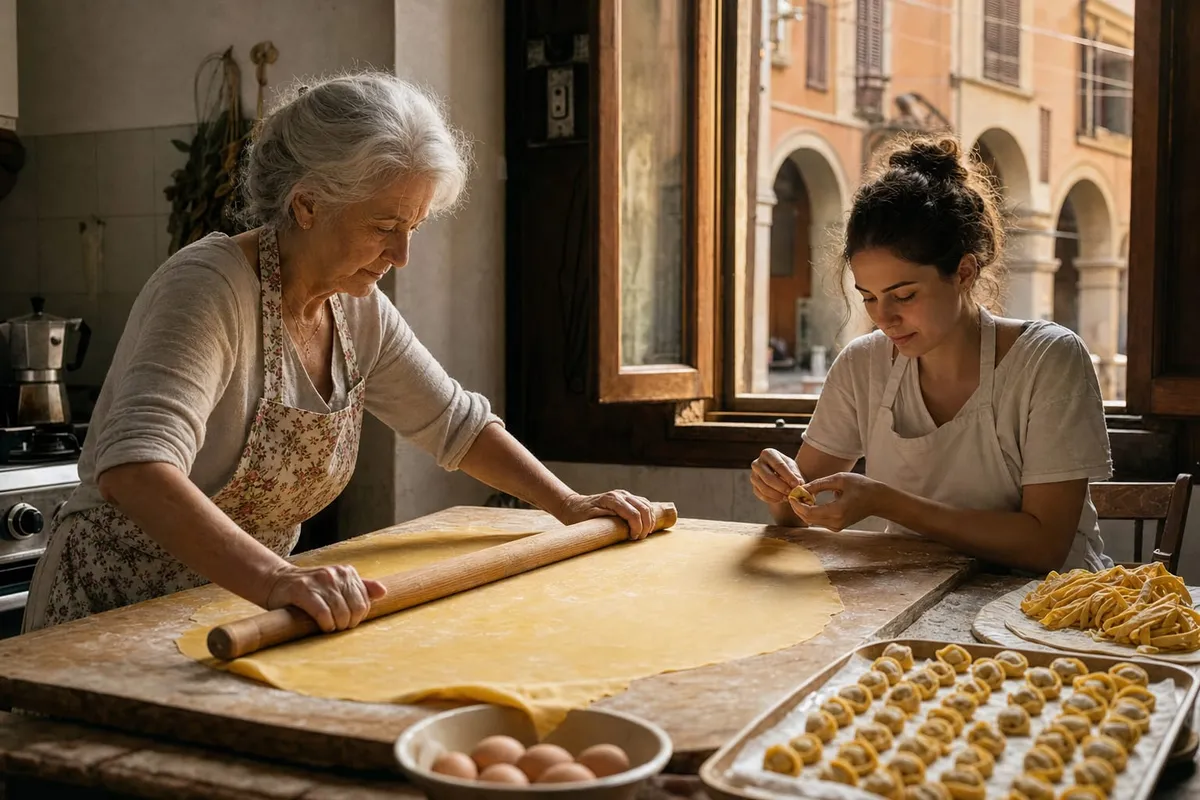
Restaurants in the Lucchesia cannot reproduce this, and it is not a question of cooking. A restaurant has to price a plate to cover rent, staff, insurance, waste and the margin that lets the owner eat in winter. A sagra carries almost none of those costs. The teenagers washing up this July will be serving next year; the women at the pots were, a few decades ago, the teenagers washing up. The whole structure is an agreement between generations to subsidise one another’s evening for a few nights a year, and no commercial form quite matches it. A restaurant serves you. A sagra serves with you.
At half past eight on a July evening the piazza fills. The church bell rings the half hour. A row of servers, plastic aprons over their good shirts, walks the length of the tables with bowls held in both hands. A small girl climbs onto her grandfather’s lap. Two men at the end of the table argue quietly about the beans, which one of them insists are not what they used to be. A cousin visiting from Milan eats her soup in silence, with the expression of someone considering a transfer. A ladle scrapes the bottom of a pot. The dish, whatever summer this is, tastes exactly as it did last year, which is the whole idea.
To find one, look for the posters. In summer they are taped to bar windows, tobacconists’ doors and roadside boards across the province, announcing a village, a dish and a handful of dates, and the local Pro Loco and tourism pages list many more. July is a busy month around Lucca: the city’s patron saint, San Paolino, has his feast on 12 July, and the days around it bring processions, a candlelit luminara and pageantry inside the walls. There is no booking at a sagra. There is rarely a menu. There is one piazza, one dish, and a few hundred reasons it will be on the table again next summer.
Sources
- Farro della Garfagnana IGP · garfagnanadream.it
- Farro della Garfagnana PGI (Wikidata) · wikidata.org
- Festa San Paolino, patrono di Lucca e della Diocesi · diocesilucca.it
- I giorni di San Paolino · turismo.lucca.it
Comments
No comments yet. Start the conversation.