

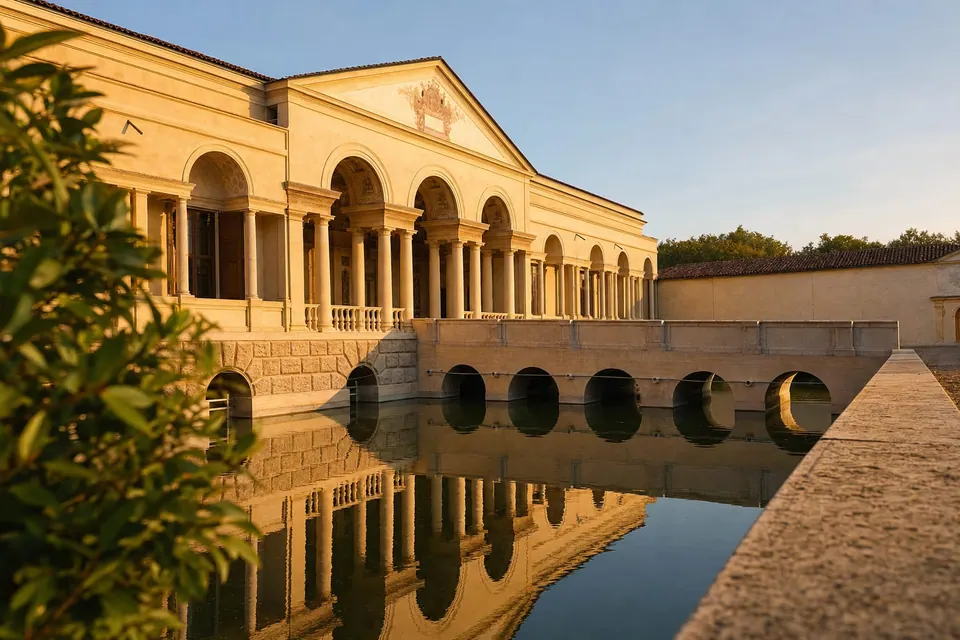
Federico II Gonzaga commissioned Giulio Romano to turn the Teieto stables into a villa in Mantua. Built and decorated from 1525 to 1535, Palazzo Te was a place for the prince’s leisure and meals, as well as for receiving distinguished guests. The project grew beyond the modest retreat first imagined.
A square court gives the villa its classical frame. Giulio Romano drew on ancient Roman and Greek forms, shaping architecture and decoration into one expressive whole. Its rooms move from Renaissance order toward the restless invention of Mannerism.
In the Hall of the Horses, six life-size portraits show Gonzaga horses against painted landscapes; two are named Morel Favorito and Dario. Hercules appears in bronze-like scenes above them. In the Room of the Giants, Jupiter’s battle with the Giants unfolds amid falling mountains. The myth can also be read in the context of Charles V’s rise and the Gonzaga court’s relationship with his power.
Palazzo Te was both a leisure villa and a setting for courtly hospitality. For another view of Gonzaga Mantua, continue to the Ducal Palace of Mantua, whose rooms include Mantegna’s Camera degli Sposi.
Watch the corners disappear
In the Hall of the Horses, compare the portraits beneath the painted architecture. The poses, names and landscapes give the stable’s prized animals the status of sitters. Then look for the change in the Room of the Giants: the rounded corners and the continuous painting make it difficult to tell where wall gives way to ceiling. Follow the falling masonry towards Jupiter above, and step back far enough to see the giants caught in the collapse.
Allow about ninety minutes for the historic rooms and courtyard. Start the day at the Ducal Palace if you have a timed appointment there. The Palazzo Te visitor page has current tickets and hours, including the later opening on Tuesdays.
Designed by Giulio Romano for Federico II Gonzaga and built and decorated from 1525 to 1535, Palazzo Te is a major Mannerist villa. Its original role joined princely leisure with Gonzaga hospitality, and its later additions record the complex’s continued architectural evolution.


