

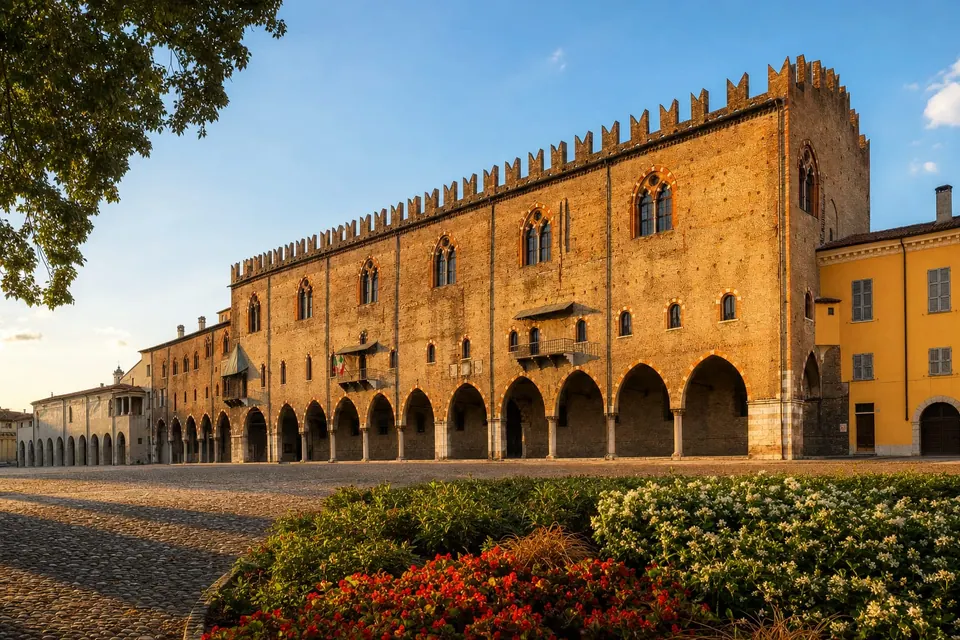
Begin in Piazza Sordello, where the size of Palazzo Ducale is hard to judge from the fronts facing the square. The Gonzaga residence grew by joining buildings and adding new wings and courts. Allow time for the walk itself: the distance from the castle to the older palace helps explain how a ruling household could occupy a district within its own city.
Mantegna made a room seem to open
Start with the timed entrance to Castello di San Giorgio. In the Camera degli Sposi, find the Gonzaga court above the fireplace and the meeting between Marquis Ludovico and his son, Cardinal Francesco, on another wall. Mantegna painted curtains across the darker walls and drew them aside on the brighter ones. Follow the fictive pilasters upwards to the oculus, where putti and onlookers peer down from the painted balustrade. Real window light is part of how the illusion works.
The rest of the residence
After the castle, continue to Corte Nuova and Corte Vecchia. Choose a small number of rooms and give yourself time to see how portraits, tapestries and painted ceilings served different settings. The Archaeological Museum has a separate entrance from the square. If you are seeing both Gonzaga palaces in a day, book the Camera first and leave the afternoon for Palazzo Te, where Giulio Romano took painted illusion in a different direction.
Check the official tickets and the entrance and lift details. The time on the ticket is for the castle. If collecting it in person, allow fifteen minutes at the Piazza Sordello desk.


