
In this article
The sound arrives before you see the players: a held note, a brighter melody and two instruments answering different parts of the same tune. Zampognari are the musicians associated with the zampogna, the bagpipe of central and southern Italian traditions. At Christmas, a familiar partnership brings a zampogna together with a ciaramella, a separate reed instrument.
Follow that sound into Abruzzo and Molise, where instrument making, family knowledge and local repertoires give it roots beyond a December street performance. You can begin by learning what you are hearing, then build a visit around a museum or an announced concert. Christmas is an invitation to listen; the music has a life through the rest of the year too.
Two instruments, different voices
The zampogna stores air in a bag, or otre, which feeds its sounding pipes. Melodic pipes have finger holes; drones supply fixed notes. There are different regional types, so the arrangement of pipes and the presence of a key are useful details to notice rather than a single design to expect everywhere.
In Scapoli, the zampogna con chiave has two unequal melodic pipes and is played with a ciaramella. In this partnership, the zampogna provides accompaniment and the ciaramella carries the solo melody. The ciaramella has its own double reed and is blown directly: it is a shawm, an instrument in the oboe family, rather than a small flute attached to the bagpipe.
Listen first for the continuous foundation, then for the line moving above it. Watch which musician supplies each voice when you have a clear view. You do not need to identify every note to hear the conversation between them.
| What to notice | Zampogna | Ciaramella |
|---|---|---|
| Air supply | An air reservoir feeds the pipes | The player blows directly into the reed |
| In the Scapoli keyed pairing | Accompaniment | Solo melody |
| A useful visual clue | A bag with several pipes | A separate instrument held in front of the player |
Mountain roots across regional borders
The zampogna belongs to pastoral musical traditions, with connections across the mountains of central and southern Italy. Abruzzo and Molise are important parts of that geography. A twentieth-century instrument made in Sulmona is preserved in the Museo delle Genti d’Abruzzo in Pescara; its bag incorporates a rubber inner tube, a reminder that a traditional instrument can also contain practical adaptations.
The Christmas association is strong, but it does not make every player a shepherd or every performance the same. Zampogna and ciaramella also accompany dancing, singing and religious occasions beyond Christmas. Treat the person in front of you as a musician with a particular instrument and repertoire, rather than expecting one costume or one carol to stand for the whole tradition.
Scapoli: a place to look and listen
In Molise, Scapoli offers a close introduction to the instrument. The Museo Internazionale della Zampogna “P. Vecchione” occupies Palazzo Mancini. Its collections bring together instruments from different places and periods, alongside material about the people who made them. Digital descriptions and recordings let you compare sounds as well as shapes.
There is a separate collection to keep in mind: the Mostra Permanente di Zampogne e Cornamuse Italiane e Straniere, run by the Circolo della Zampogna in Piazza Martiri di Scapoli. It is distinct from the municipal museum. Check with the appropriate institution when arranging a visit, and ask separately about any guided session or meeting with players.
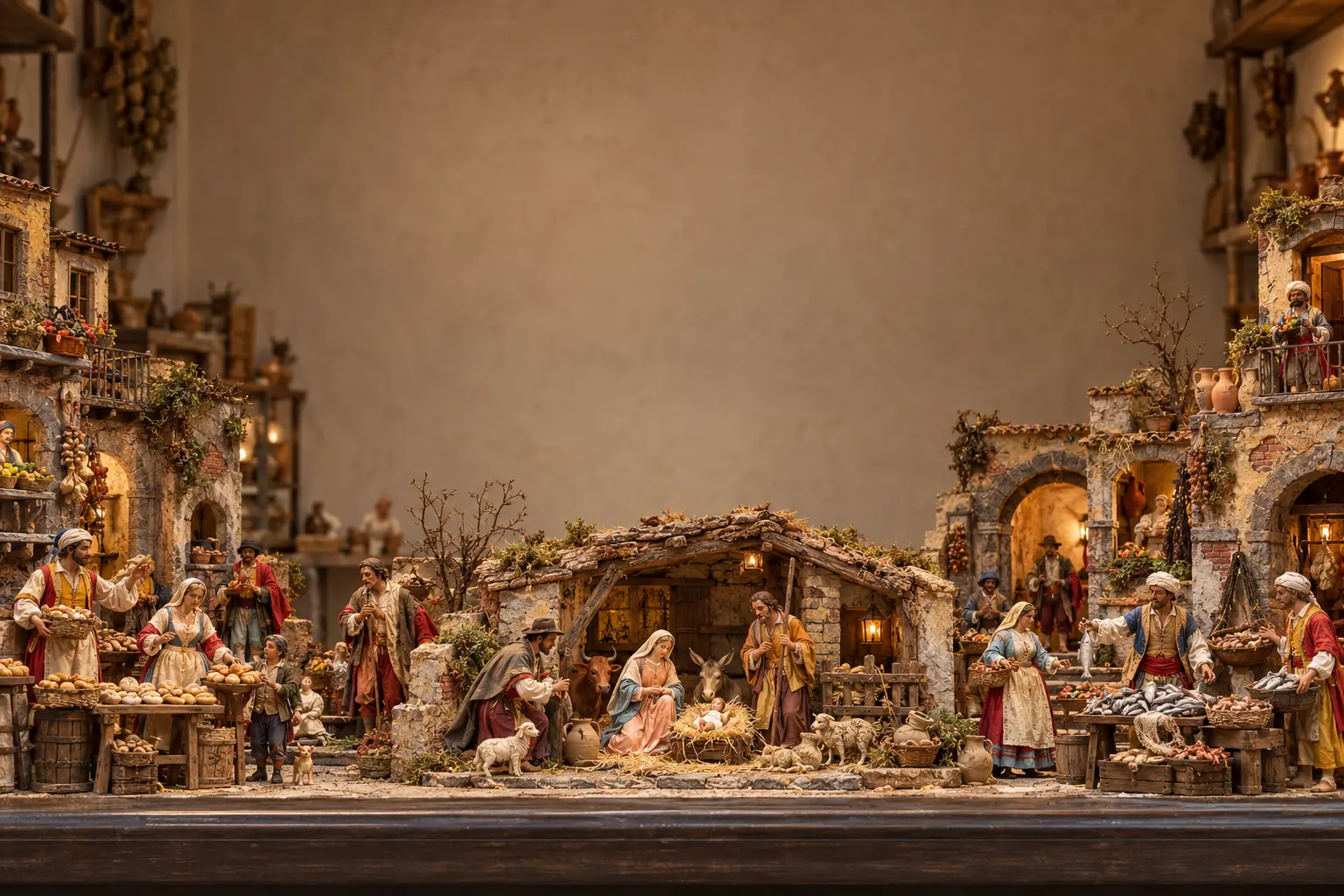
The municipal museum also contains a permanent Neapolitan nativity scene. That makes a natural connection with the Italian presepe, where the Christmas story is given a setting of figures, buildings and everyday life. Leave room to look closely instead of treating the instruments and the nativity as a single quick stop.
The work behind the sound
Scapoli’s Fontecostanza district is associated with workshops making zampogne and ciaramelle. Olive and cherry are among the woods used, and the turned pipes, bells and reeds form parts of a carefully fitted instrument. Keyed and unkeyed forms have different constructions. Size, tuning and the companion instrument matter when musicians choose a set.
If you would like to visit a workshop, ask in advance whether the maker can receive visitors. Let them choose what can be handled or demonstrated. A useful question is how the instrument works with its ciaramella; another is which details distinguish the model in front of you. Buying, lessons and demonstrations need their own arrangements rather than an assumption that every workshop visit includes a performance.
Make room for a live performance
For a December trip, look for an announced local concert, novena or other public performance. Confirm the place and time with its organiser before travelling; a town’s musical tradition does not promise players on a particular street on the day you arrive. A museum visit gives you another way to explore when no performance fits your dates.
When music begins, leave a clear space around the players and keep doorways and paths open. Ask before making a close recording, and respect the setting if the music forms part of a devotional occasion. Staying for a complete piece gives you more time to hear how the two voices work together than moving straight to a photograph.
Carry the interest into the rest of your holiday. Explore Naples at Christmas, make a small presepe at home, or use the Christmas in Italy guide to connect music with the next meal or visit. Let the people, instruments and places you encounter give the season its particular sound.
Sources and citations (7)
- Scapoli: museo multimediale e collezioni | Museo Internazionale della Zampogna
- La zampogna scapolese: tipi, materiali e abbinamento | Museo Internazionale della Zampogna
- La ciaramella scapolese | Museo Internazionale della Zampogna
- Le botteghe artigiane di Fontecostanza | Museo Internazionale della Zampogna
- Cornamusa di ambito abruzzese, scheda 1300026484 | Catalogo generale dei Beni Culturali
- La Mostra Permanente | Circolo della Zampogna
- Sonata con zampogna e ciaramella, Viggiano | Catalogo generale dei Beni Culturali