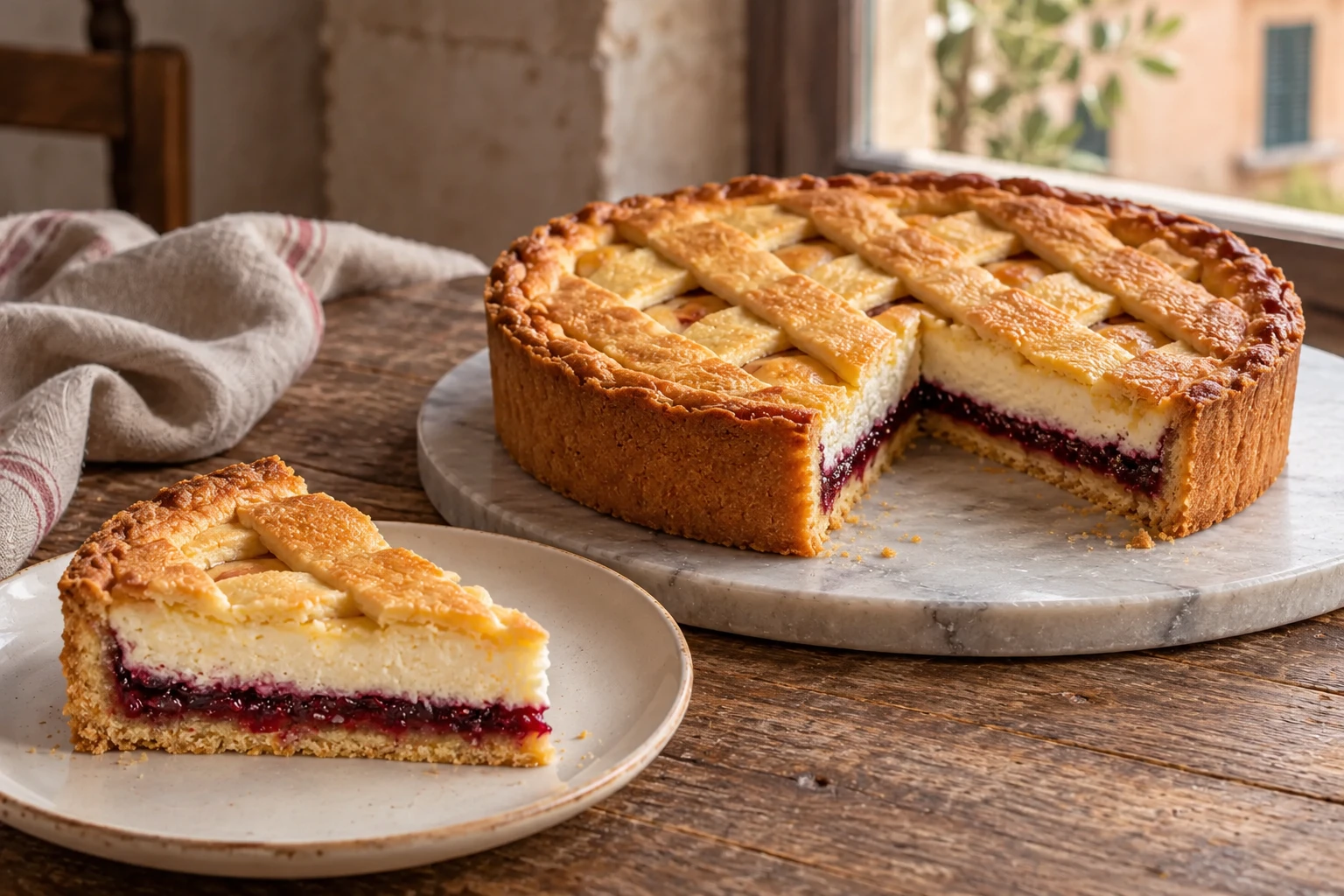
Choose a deep enough tin for both layers and let the tart chill fully before slicing.
Make ahead Bake early enough to cool and refrigerate thoroughly; keep chilled until serving.
Ricotta and visciole tart
Prep 35 min · Cook 1 hr · Rest 4 hr · Yield 1 tart (24 cm tin; about 10 slices per tart.) · Difficulty Medium
Method
Combine the pastry flour and sugar on the worktop. Work in the softened butter, yolks and lemon zest quickly, just until a smooth dough forms. Flatten, wrap and refrigerate for at least 30 minutes.Combine the pastry flour and sugar on the worktop. Work in the softened butter, yolks and lemon zest quickly, just until a smooth dough forms. Flatten, wrap and refrigerate for at least 30 minutes.
Heat a conventional oven to 180°C. Grease and flour a 24 cm tart tin 4 cm deep, tapping out excess flour. Keep roughly one-third of the pastry chilled for the lattice. Press or roll the rest into a 6–7 mm base with a rim about 3 cm high, repairing any cracks.Heat a conventional oven to 350°F. Grease and flour a 9½ in tart tin 1½ in deep, tapping out excess flour. Keep roughly one-third of the pastry chilled for the lattice. Press or roll the rest into a ¼–¼ in base with a rim about 1¼ in high, repairing any cracks.
Spread the visciole jam over the raw pastry base. In a bowl stir the drained ricotta with the filling sugar, whole egg and sambuca until even. Spoon over the jam and level gently without mixing the layers.Spread the visciole jam over the raw pastry base. In a bowl stir the drained ricotta with the filling sugar, whole egg and sambuca until even. Spoon over the jam and level gently without mixing the layers.
Roll the reserved pastry about 5 mm thick, cut into strips about 2 cm wide and arrange a lattice over the filling. Join the ends to the rim. Bake at 180°C for about 1 hour, checking from 45 minutes. The pastry should be golden and the center set; check that the filling reaches 75°C for 30 seconds with a clean food thermometer, extending baking if needed.Roll the reserved pastry about ¼ in thick, cut into strips about ¾ in wide and arrange a lattice over the filling. Join the ends to the rim. Bake at 350°F for about 1 hour, checking from 45 minutes. The pastry should be golden and the center set; check that the filling reaches 167°F for 30 seconds with a clean food thermometer, extending baking if needed.
Cool the tart in its tin, allowing about 90 minutes, then refrigerate for at least 2 hours and until completely cold. Remove from the tin carefully and cut into slices. Keep refrigerated until serving; allow more cooling time if the center remains warm.Cool the tart in its tin, allowing about 90 minutes, then refrigerate for at least 2 hours and until completely cold. Remove from the tin carefully and cut into slices. Keep refrigerated until serving; allow more cooling time if the center remains warm.