Roman Origin
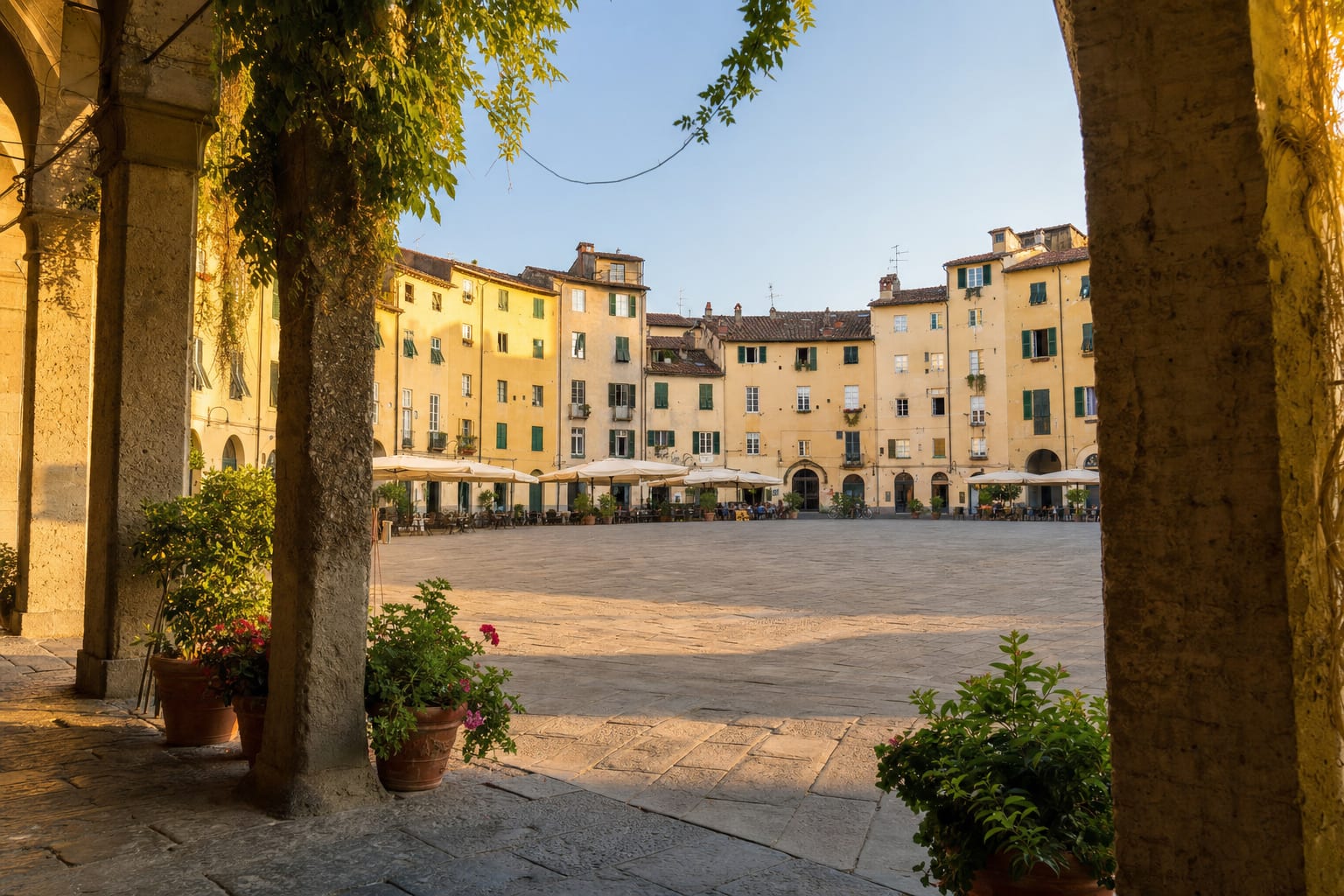
The oval is the ancient amphitheatre speaking
The present piazza keeps the footprint of a Roman amphitheatre built in the 1st or 2nd century AD, even though the ancient structure is largely buried.1
Lucca
An oval piazza built over Lucca's Roman amphitheatre, curved house fronts, four entrances, cafes, and a perfect lesson in urban reuse.
Photograph · Piazza dell'Anfiteatro
At a glance
Names, makers, dates, and context before the story opens up.
| What it is | Square |
|---|---|
| Where | Lucca, Tuscany |
| Known for | An oval piazza built over Lucca's Roman amphitheatre, curved house fronts, four entrances, cafes, and a perfect lesson in urban reuse. |
The story
The Roman amphitheatre was built outside Lucca’s walls in the first or second century CE, later fell into ruin and was absorbed into later buildings. The present square was reshaped through Lorenzo Nottolini’s intervention from 1830; current access requires verification.
The site records the layered transformation of a Roman amphitheatre into later urban fabric and a nineteenth-century piazza. The former amphitheatre, later buildings and current square require separate source-backed relationships.
Look closer
The details our editors pull from official records, archives, guides, and local sources.
Roman Origin
The present piazza keeps the footprint of a Roman amphitheatre built in the 1st or 2nd century AD, even though the ancient structure is largely buried.1
Scale
Lucca Tourism describes an ancient arena with two orders of arches and capacity for about ten thousand spectators, a scale now hidden inside the city's domestic fabric.1
Reuse
The piazza does not present Rome as a ruin. It shows how ancient form can become housing, passage, cafes, and public life.2
Visit
The square's narrow entrances make the oval more dramatic. Step in from the surrounding lanes and the curve suddenly closes around you.1
Each statement below is linked to the record or institution that supports it.
The present piazza keeps the footprint of a Roman amphitheatre built in the 1st or 2nd century AD, even though the ancient structure is largely buried.1
Piazza dell'Anfiteatro is a present-day square in Lucca whose shape preserves the footprint of a distinct Roman amphitheatre; it is not itself an intact exposed amphitheatre.3
Lucca Tourism describes an ancient arena with two orders of arches and capacity for about ten thousand spectators, a scale now hidden inside the city's domestic fabric.1
According to the Comune di Lucca, the Roman amphitheatre was built outside the city walls in the first or second century CE and is now buried by about three metres.3
The piazza does not present Rome as a ruin. It shows how ancient form can become housing, passage, cafes, and public life.2
The municipal description records an elliptical amphitheatre with two superimposed exterior orders of 55 arches, a 20-step cavea, and a stated capacity of 10,000 spectators.3
Plan your visit
Book a visit
Compared by our editors, across providers.
Booking through these links may earn Italia Magnifica a commission, at no cost to you.
Nearby
Worth folding into the same day.
Reading
Long reads from our writers on the ground.