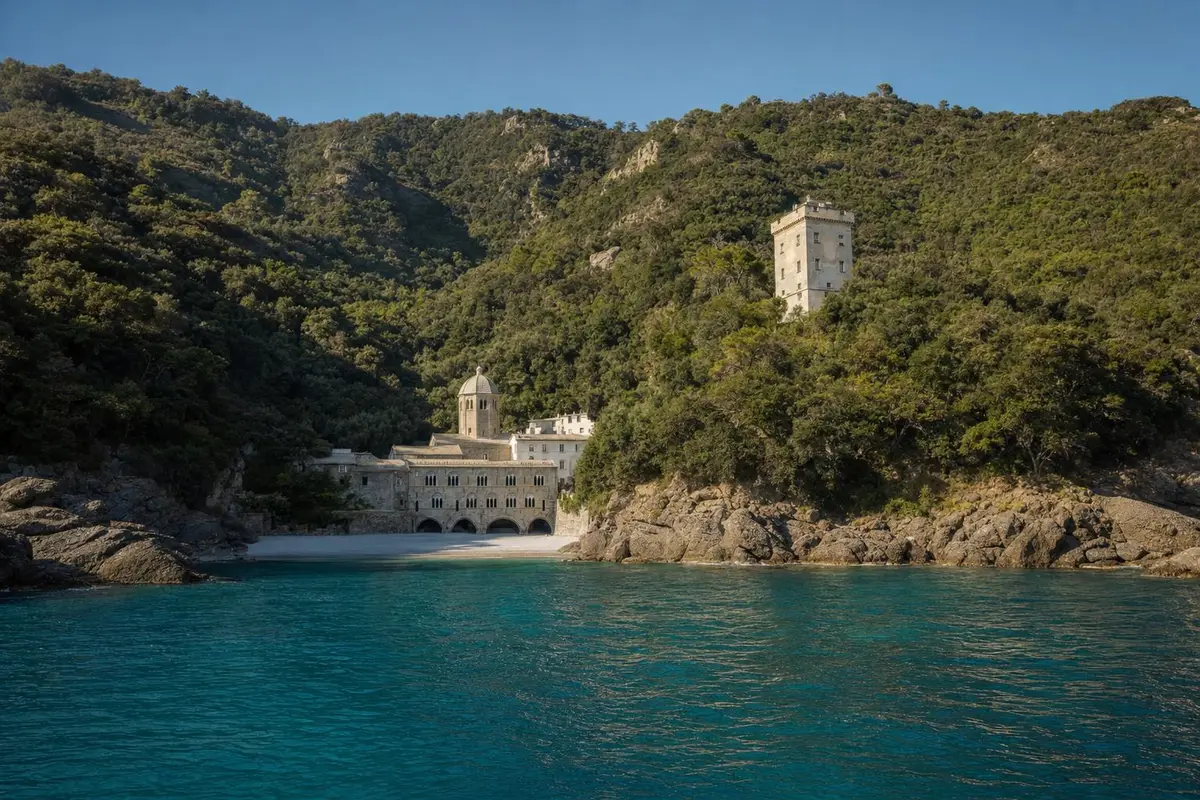
Fresh water runs beneath the arcades of San Fruttuoso, where the wooded Portofino headland meets a small Ligurian cove. The spring emerges at the base of the church tower and reaches the sea through a vaulted passage. Its presence helped make this isolated shore a place for a church long before the abbey acquired its present appearance.
From the spring to the Doria tombs
The complex was rebuilt as a Benedictine monastery in the tenth century and became linked to the Doria family in the thirteenth. Their burial chamber contains medieval tombs in white marble and grey stone, with inscriptions and two-tone arches. The abbey later became a residence and, in the nineteenth century, the parish church of the fishing hamlet of San Fruttuoso.
Two towers above one cove
The dome-capped church tower and Torre Doria belong to different parts of that history. The defensive tower above the cove was completed by Andrea Doria’s heirs in 1562, following the patronage granted to the admiral in 1551 and plans to defend the coast against pirate raids. Boats connect the cove with Camogli and, seasonally, Portofino. Paths through the park provide the approach on foot.
On arrival, take a moment at the edge of the beach to read the building from the outside. The broad arches face the cove, and the dark opening at the base hints at the water running underneath. Inside, allow time for the spring rooms and the upper cloister before you descend to the shore. In the short winter opening, work back from both the last entry and the last boat so you have time for the rooms rather than just a look from the beach.
The beach is part of that history too. A flood in 1915 brought down the front section of the church and helped form the present beach; the church facade was rebuilt in 1922. Frank and Orietta Pogson Doria Pamphilj donated the abbey to FAI in 1983. After restoration, the spring beneath the complex reopened to visitors in 2017.