

Skip to content
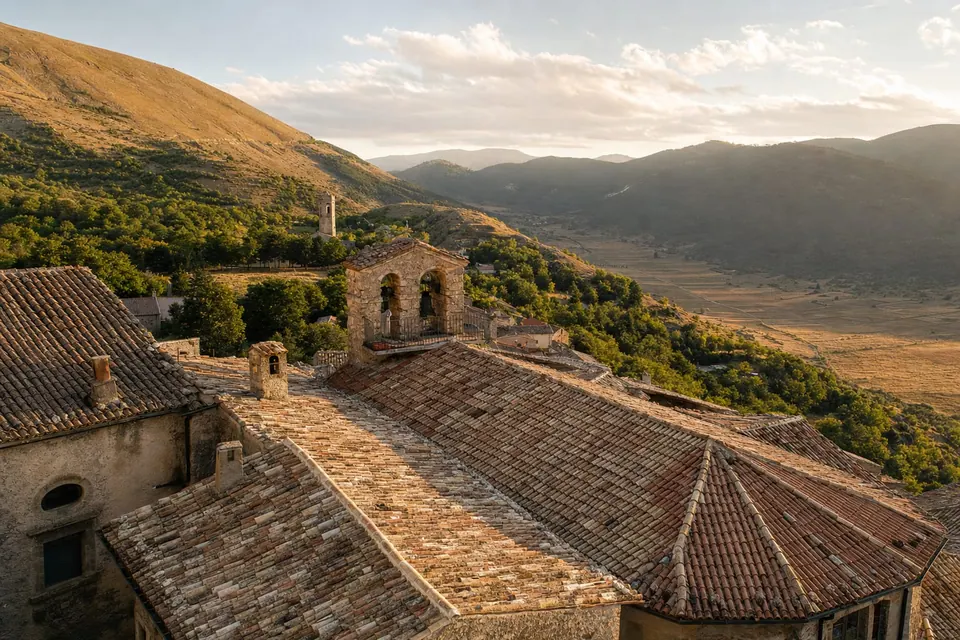
The stone rooftops of Santo Stefano di Sessanio on Gran Sasso's slopes

Santo Stefano di Sessanio

Follow the stone lanes of Santo Stefano di Sessanio to its round tower, then trace the village’s wool trade and taste its tiny mountain lentils.

  • Santo Stefano di Sessanio
  • District
Where
Santo Stefano di Sessanio
Best for
Medici mountain borgo
Allow
1 hr 30 min
Tickets
Free

Read the village from the outside in

Start at the edge of the old village and walk towards Piazza Medicea. Where the houses meet the slope, their outer walls run together into a defensive line. Inside, covered passages give way to steps, arched doorways and small openings in the stone. Look back through one of the passages towards the fields. From there you can see how tightly the houses cluster around the tower while the landscape opens out almost at once.

The tower and the wool money

The round tower is known as the Torre Medicea, even though its origins lie in the fourteenth century, before the Florentine family took control. Its name recalls the importance of the wool trade under Medici rule. The surrounding district drew wealth from sheep rearing and the seasonal movements that connected mountain pasture with the plains. The tower you see today was reconstructed after its collapse in the 2009 earthquake.

A lentil shaped by altitude

The local lentil is tiny, dark and thin skinned. It grows above 1,000 metres on this side of the Gran Sasso. Look for it dried at a producer’s shop or cooked simply in soup with garlic, bay leaf and olive oil. The growers’ area takes in several neighbouring villages, so ask where the lentils were grown if you are buying a bag to bring home.

Porta Medicea's stone arch and Medici crest above the sloping paved lane in Santo Stefano di Sessanio
The stone arch and Medici crest of Porta Medicea in Santo Stefano di Sessanio.

Three things worth finding

If you see nothing else, see these.

  1. The houses at the edge of the village

    Their tightly joined walls make the shape of the fortified settlement easier to see.

  2. Torre Medicea

    The round tower predates the Medici and was rebuilt after the 2009 earthquake.

  3. The lentil

    The small dark grain cooks without soaking and keeps its character in a simple soup.

Plan your visit

Tickets
Free
Booking
Check booking requirements
Time needed
1 hr 30 min
Best time
In daylight, with time for the lanes and a stop with a local grower.
Getting there
Approach by road from the L’Aquila side of the Gran Sasso and park outside the tight historic lanes. Check local bus connections if travelling without a car.
Accessibility
The historic centre has steep cobbles, uneven paving and steps. Ask the visitor centre about a drop-off and the easiest approach to the square.

Free to walk through the village. Confirm guided tower visits and any fee with the visitor centre.

Walk the village before lunch and ask a producer about the different growing areas. If heading on to the ridge, check the forecast and return route.

Directions to Santo Stefano di Sessanio, pedestrian approach at Porta MediceaGoogle MapsApple Maps

Good to know

Is the village free to visit?

The streets and squares are public. Ask the visitor centre about tower tours, which have their own access arrangements.

How long should I allow?

Allow around an hour for the lanes and tower exterior. Add time for a booked tour, lunch or a stop with a producer.

Can I combine it with Rocca Calascio?

Yes. You can drive to Calascio and approach the fortress from there, or plan a separate ridge walk using the park route in settled weather.

A letter from Italy, once a month.

Each month: one story, two recipes, an ingredient and a wine of the month, places worth the trip, and the month’s calendar.

One letter a month. Unsubscribe at any time. We never share your address. Choose your desks