

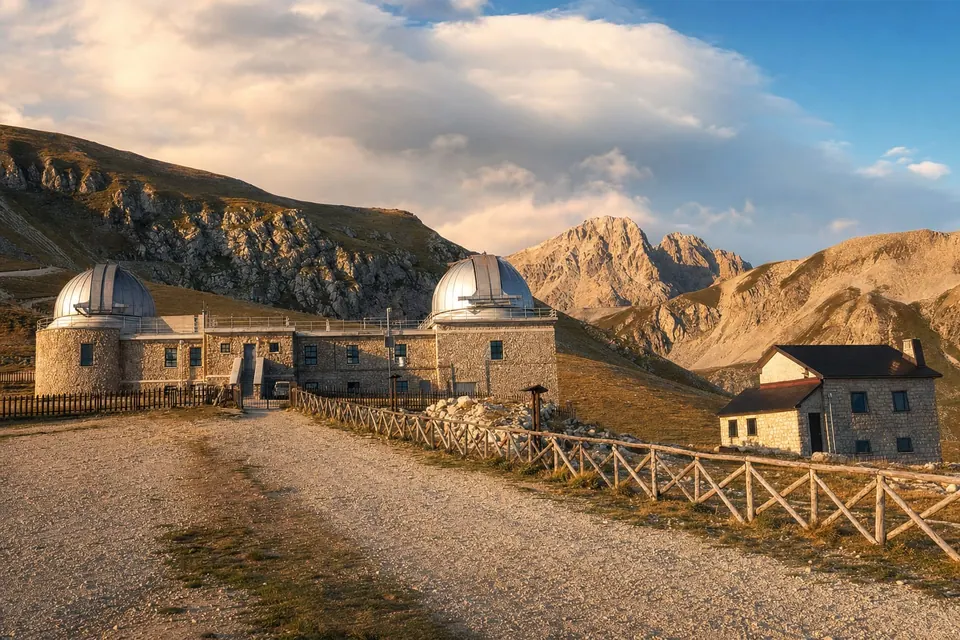
Campo Imperatore opens into high grassland beneath the Gran Sasso. Summer grazing gives these pastures a working rhythm, with herds and flocks using the open plateau. The sheep tracks known as tratturi linked these summer pastures with winter grazing on the Tavoliere plain and sustained pastoral communities such as Castel del Monte.
The approach through Fonte Cerreto leads to the cableway’s upper station and historic hotel. This is also a starting area for hiking, mountaineering and ski-mountaineering routes, each requiring its own plan. Check road conditions and the cableway’s current service before deciding how to reach it.
The Giardino Alpino Vincenzo Rivera adds a quieter scientific story. Rare and endemic alpine plants, glacial relicts and the propagation of threatened species shape its research with the University of L’Aquila. Confirm current garden access before making it part of your visit. For a wider journey through this mountain landscape, continue with our guides to L’Aquila and Abruzzo.

A working high pasture
Steppe-like grasslands stretch across Campo Imperatore, used for summer grazing by herds and flocks. The broad sweep of pasture is central to both the scenery and the plateau’s use.1
The routes of transhumance
The tratturi linked the flocks’ summer pastures on Campo Imperatore with winter grazing on the Tavoliere plain. Castel del Monte was part of that pastoral network, which tied the high grassland to distant lowlands.2
The traditional southward journey began in September, after the feast of the Madonna dei Pastori on 8 September. The flocks returned by the first half of June. That seasonal rhythm helps explain why so much open land was needed at different altitudes.2
Alpine plant research
Vulnerable alpine flora shapes the garden’s research: rare and endemic species and glacial relicts. Research themes also include in-vitro propagation of rare or threatened plants and conservation outside their natural habitat.3,4
Dried specimens of the cultivated species are collected in the Herbarium Aquilanum. This scientific collection adds another way of studying the plants beyond the living garden. Confirm current public access to the garden before travelling.3,4
A wartime film record
Istituto Luce catalogues a silent, black-and-white German compilation dated 1943–1944. Its sequence descriptions place Mussolini at Campo Imperatore, include a Gran Sasso cableway panorama and later describe Mussolini and Skorzeny boarding an aircraft. The record preserves a distinct wartime association with this mountain setting.5


