

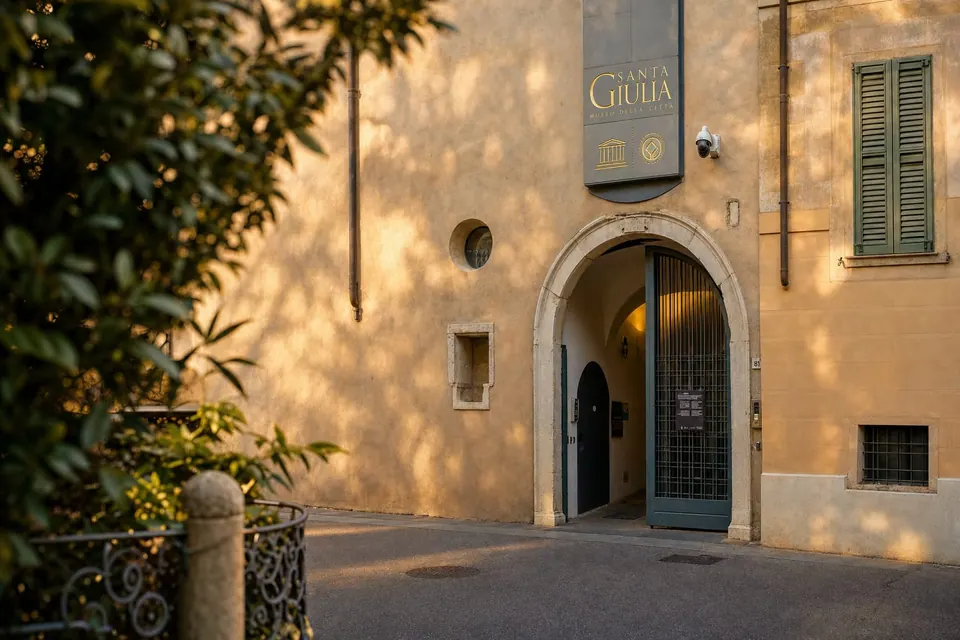
At Santa Giulia, some of the most important things in the museum are the rooms themselves. The former monastery stands over Roman houses and contains a Lombard basilica, a frescoed nuns’ choir and a Romanesque oratory. Leave time to look at the architecture between exhibits. A painted wall or an old floor can tell you as much about Brescia as the objects in a case.
From Roman homes to the monastic church
Begin at the Domus dell’Ortaglia and look beyond the best-preserved mosaic. Doorways and the outlines of adjoining rooms help you imagine a household moving through the building. The nearby Capitolium was the public face of the same city. Here the scale changes from the temple platform to the dimensions of a home.
The Benedictine monastery was founded in the eighth century under the Lombard king Desiderius and Queen Ansa. At San Salvatore, compare the older basilica with the richly decorated choir used by the nuns centuries later. They belonged to a single religious community’s history, yet they speak very different architectural languages.
Leave time for the Cross of Desiderius
In Santa Maria in Solario the cross stands beneath a blue ceiling scattered with stars. Look at the individual stones and settings, including the ancient gems incorporated into the work. Set aside a couple of hours for a selective visit. Consult the museum’s route and tickets and the accessible visitor options, including digital views of spaces with stairs.


