

Skip to content
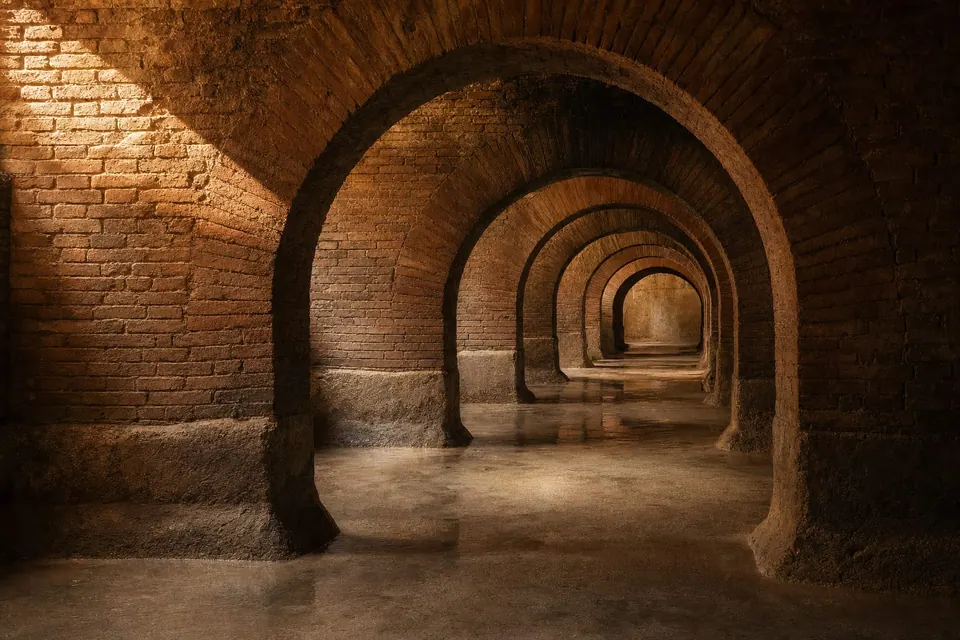
Brick vaults of the Roman Cisterns of Fermo, intact underground for 2000 years

Roman Cisterns of Fermo

Descend under Fermo to thirty vaulted cistern chambers. Find Roman waterproofing, a wine press and traces of a wartime refuge.

  • Fermo
  • Archaeological site
Where
Fermo
Best for
Thirty communicating rooms in three rows

Below Fermo’s hilltop centre, Roman waterworks extend beneath buildings on the eastern side of Piazza del Popolo. The large cistern dates from between the first century BC and the first century AD. Its thirty communicating chambers lie in three parallel rows across about 2,200 square metres, perimeter walls included. The system collected rainwater and supplied drinking water to the city; water from springs or groundwater on Girfalco hill may also have fed it.

The cistern is a sequence of connected rooms, not one open hall. Each chamber measures about nine by six metres; barrel vaults span the rooms, and rounded arches connect them. Collection wells and channels carried water between chambers along the sloping floor. Roman concrete forms the structure. The original waterproof cocciopesto coating, made with crushed brick, covered the floor and lower walls; on the internal walls it reached about 60–70 centimetres. Later waterproofing in six chambers belongs to a different phase of the cistern’s working life.

Those differences tell part of the site’s later story. Room 2 contains a Dominican palmento for wine production, with two fermentation basins and the base of a wooden press. Room 3’s vaults received modern-cement repairs in 1964–65. Rooms 11–16 were separated from the others and reused as a modern aqueduct reservoir from 1896 to 1980; their later waterproof coating rose to the three-metre water level.

The site’s later uses extended beyond water storage. Some rooms served as prisons between the sixteenth and nineteenth centuries. During Second World War bombing, the complex became a shelter. The words “Calma, uscita” (stay calm, exit) are a trace of that use. Today, visitors enter through the Museo Civico Archeologico at Via Paccarone 36.

Built between the 1st century BC and the 1st century AD to supply drinking water, the cisterns later served as cellars and, in six rooms, as a modern aqueduct reservoir from 1896 to 1980. Some rooms were later used as prisons, and the complex was a Second World War shelter.

Three things worth finding

If you see nothing else, see these.

  1. Thirty chambers in three rows

    The large reservoir covers about 2,200 square metres, perimeter walls included, and its thirty communicating chambers form three parallel rows.The large cistern beneath the eastern side of Piazza del Popolo

  2. Barrel vaults and rounded arches

    The barrel-vaulted rooms connect through rounded arches; collection wells and channels carried water between chambers along the sloped floor.Across the communicating chambers

  3. Original lining and later waterproofing

    The original cocciopesto lining rose about 60–70 centimetres on internal walls. In rooms 11–16, reused for the modern aqueduct from 1896 to 1980, later waterproof coating reached three metres; room 3’s vaults were repaired with modern cement in 1964–65.Lower internal walls; rooms 11–16

Plan your visit

Booking
Check booking requirements
Best time
Plan around Fermo Musei’s current seasonal schedule; guided-entry times vary by period. Dress for the humid interior and check the operator’s latest notice before travelling.
Getting there
Enter through the Civic Archaeological Museum at Via Paccarone 36. From Porto San Giorgio-Fermo station, take the STEAT bus towards Fermo Terminal and check the onward walk or connection to the museum.
Accessibility
The cistern route is currently closed to wheelchairs while work is under way. The Civic Archaeological Museum remains accessible. Check for updates at +39 0734 340383.

Outside the summer timetable, visit on a guided departure at 11 am or 4 pm Tuesday to Friday. Regular weekend hours are 10:30 am to 1 pm and 3:30 to 7 pm. Monday is normally closed. The single-site ticket is €4 and the full circuit pass is €10.

Check your date for timed guided slots and book ahead if visiting as a group. Bring a layer for the humid underground rooms.

Directions to Roman Cisterns, entry through the Civic Archaeological MuseumGoogle MapsApple Maps

Good to know

What did the cisterns supply to Fermo?

They stored drinking water for the city. Rainwater was collected and redistributed; water from springs or groundwater on Girfalco hill may also have fed the system.

How large is the main cistern?

It covers about 2,200 square metres, perimeter walls included, and contains thirty communicating rooms in three parallel rows. The overall dimensions are approximately 65 by 30 metres.

What later features are identified in room 2?

Room 2 contains a Dominican palmento for wine production, with two fermentation basins and the base of a wooden press.

Where do visitors enter the cisterns?

Visitors enter through the Museo Civico Archeologico at Via Paccarone 36. Call +39 0734 340383 to confirm the arrangement for your visit.

Do I need to reserve?

Guided visits are offered by reservation, and the museum recommends advance booking for groups. Contact Fermo Musei to confirm the entry arrangement for your date.

Is the full cistern route accessible?

The cistern route is currently closed to wheelchairs while work is under way. The Civic Archaeological Museum remains accessible. Check for updates at +39 0734 340383.

A letter from Italy, once a month.

Each month: one story, two recipes, an ingredient and a wine of the month, places worth the trip, and the month’s calendar.

One letter a month. Unsubscribe at any time. We never share your address. Choose your desks