

Skip to content
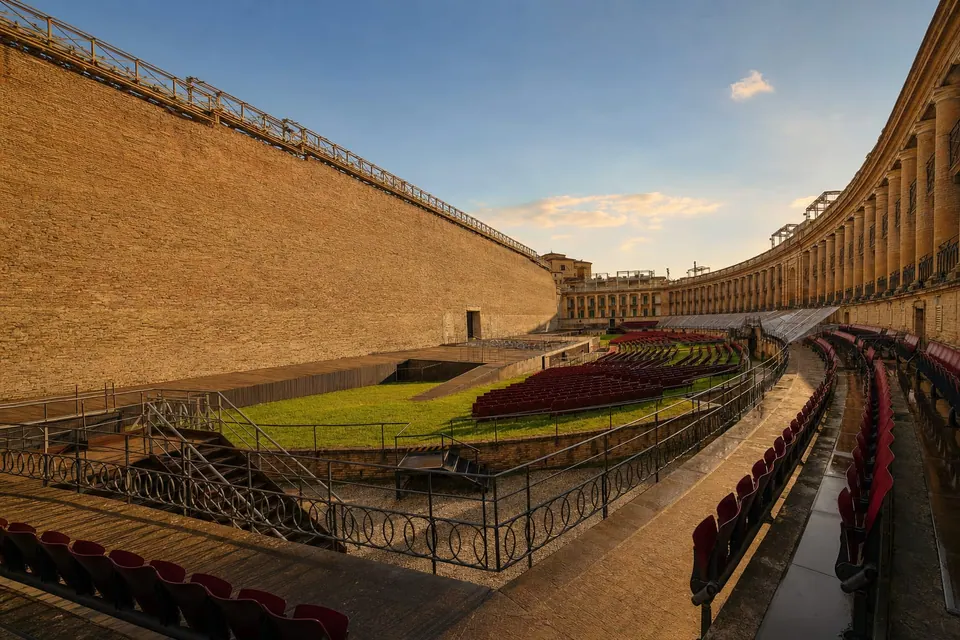
The hundred-meter wall and arena of the Sferisterio of Macerata

Sferisterio of Macerata

Read Macerata’s Sferisterio from the long wall to the curve of its boxes, where a nineteenth-century ball court became an open-air opera stage.

  • Macerata
  • Theatre
Where
Macerata
Best for
Neoclassical arena
Allow
45 minutes
Best time
A daytime session for the architecture

The wall tells you what the arena was for

Stand where you can see the long, straight wall and the curve of seats opposite. Their shapes make sense once you picture the original game: two teams striking a leather ball with a heavy wooden brace around the hand and forearm. The long court gave the players room; the broad curve gave the crowd a view. The inscription on the façade honours the one hundred subscribers who paid for the arena, built between 1823 and 1829 to a design by Ireneo Aleandri.

When the field became a stage

Verdi’s Aida was staged here in 1921. In a place so wide, opera could use distance and movement in ways an indoor theatre cannot. Look along the line of the boxes and then across to the height of the wall. Even on a daytime visit, that switch in viewpoint helps explain why the same building could serve a ball game and a large theatrical production. Modern summer performances are the other way to experience the space.

Choose the visit you want

By day there is time to notice the architecture and inscriptions. On an opera night, compare seat locations before buying: the angle to the stage depends on how far around the curve you sit. If you do both, see the building by day first. The performance gives the familiar wall a new scale.

Three things worth finding

If you see nothing else, see these.

  1. The inscription

    Look for the cento consorti on the façade before entering.

  2. The court wall

    Follow the straight wall from end to end to read the playing area.

  3. The curved boxes

    Follow the arc to see how the spectators’ view changes across the arena.

Plan your visit

Booking
Check booking requirements
Time needed
45 minutes
Best time
A daytime session for the architecture; a summer festival evening for opera.
Getting there
Find the arena on Piazza Nazario Sauro, at the edge of Macerata’s historic centre. The performance entrance depends on your seat sector.
Accessibility
Ask the museum about the daytime route and accessible entrances. For performances, arrange seating directly with the festival box office.

For a daytime visit, the arena normally opens Tuesday to Sunday from 10 am to 1 pm and 3 to 5:30 pm. The ticket desk closes 30 minutes early. Full admission is €6. Opera and concert tickets are separate.

Look at the façade before going in, then compare the long wall with the curved stands when you reach the arena.

Directions to Daytime visits and opera gates 1–2, Piazza Nazario SauroGoogle MapsApple Maps
Directions to Opera gates 4–6, Viale Diomede PantaleoniGoogle MapsApple Maps

Good to know

Do I need an opera ticket to see the arena?

No. The daytime monument visit has its own ticket, separate from performances.

How long is a daytime visit?

Allow around 30–45 minutes to see the arena and façade. The ticket desk closes half an hour before the end of a visiting session.

What else can I see on the same pass?

The Macerata tourist pass combines the Sferisterio with Palazzo Buonaccorsi and the Civic Tower. Check the separate opening hours.

A letter from Italy, once a month.

Each month: one story, two recipes, an ingredient and a wine of the month, places worth the trip, and the month’s calendar.

One letter a month. Unsubscribe at any time. We never share your address. Choose your desks