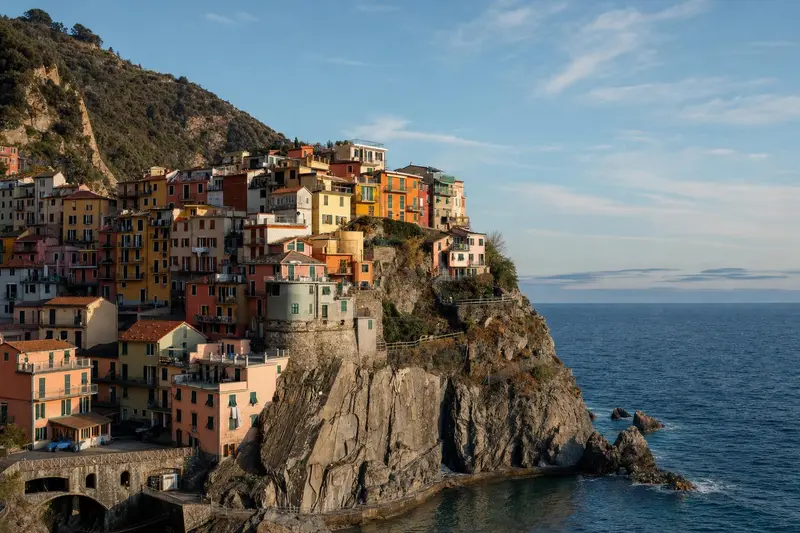
Riomaggiore is pressed between two steep, terraced hills, where tall painted houses seem to climb one above another toward the ridge. In the historic lanes, the tower houses follow the course of the Rio Maggiore; their unusual upper rear doors once offered another way into homes when storm waves could surge up the old harbour before the sea wall was built. From Piazza del Vignaiolo, the way to the old landing descends beneath the railway to the marina, where the village opens suddenly to the Ligurian light.
The coastal settlement grew from older hillside communities. Early records from the thirteenth century name Montenero, Cacinagora, Casale, Limen and Saricò among the upland settlements. An oath of allegiance to Genoa followed in 1251 and the territory passed to Genoa in 1276, before the settlement near the stream mouth took shape. The village’s name arrived in the records later than those of its hill communities; the coast and the inland slopes belong to one history.
Stone steps lead from the marina through the old quarters toward the thirteenth-century castle, once a defensive stronghold and later used as a cemetery. Nearby, the church of San Giovanni Battista was founded in 1340 and extended in the nineteenth century; Look for its side portal and medieval reliefs, as well as the small oratories of Santa Maria Assunta, Sant’Antonio Abate and San Rocco in the village. Take the climbs at your own pace: stairs are part of the town’s shape.
Riomaggiore is one of the five lived-in villages of the National Park, with terraces and dry-stone walls rising above the shore. The station is a practical arrival point: the main street runs uphill from its pedestrian tunnel, while the entrance to the Via dell’Amore is to the left as you leave the station. That one-way coastal route to Manarola is a separate, timed Park visit; the village itself needs no reservation. For a wider coast-to-mountain plan, continue with our Liguria guide.
Follow the old landing into the upper village
Start at Piazza del Vignaiolo. Look for a break in the line of houses where the railway passes below, then descend to the marina. The masonry on opposite sides of the landing belongs to its old defences. From the smaller bastion, the stairs through Sant’Antonio climb to the castle. Take them if the climb suits you. Allow about two hours with pauses, and check the Via dell’Amore access rules separately if you want to continue to Manarola.