

Start with the open arches of the Ospedale degli Innocenti, then look at how two Florentine families used stone to give their palaces weight. Finish across the square from Santa Maria Novella, where Alberti joined an existing medieval front to a Renaissance design. A few steps back from each building often reveal more than a look from the doorway.
The route
Ospedale degli Innocenti
Face the loggia from Piazza della Santissima Annunziata. The grey pietra serena of Brunelleschi’s columns and round arches stands out against the pale plaster. Follow one arch, then look along the row to see how the repeated openings set the rhythm of the square. The glazed terracotta roundels of infants were added later.
Palazzo Medici Riccardi
Look at the palace from the Via de’ Gori corner. Michelozzo’s façade goes from coarse projecting stone near the street to smoother courses above. The rows of paired windows and the deep roof cornice pull the long front together. Keep the change in stone finish in mind for Palazzo Strozzi.
Palazzo Strozzi
Start on Piazza Strozzi and look up the stone courses again. The rough surface softens higher on the wall, as at the Medici palace, and the rows of paired windows hold the façade in order. From a corner you can read the mass of the building and see how the projecting cornice turns around it.
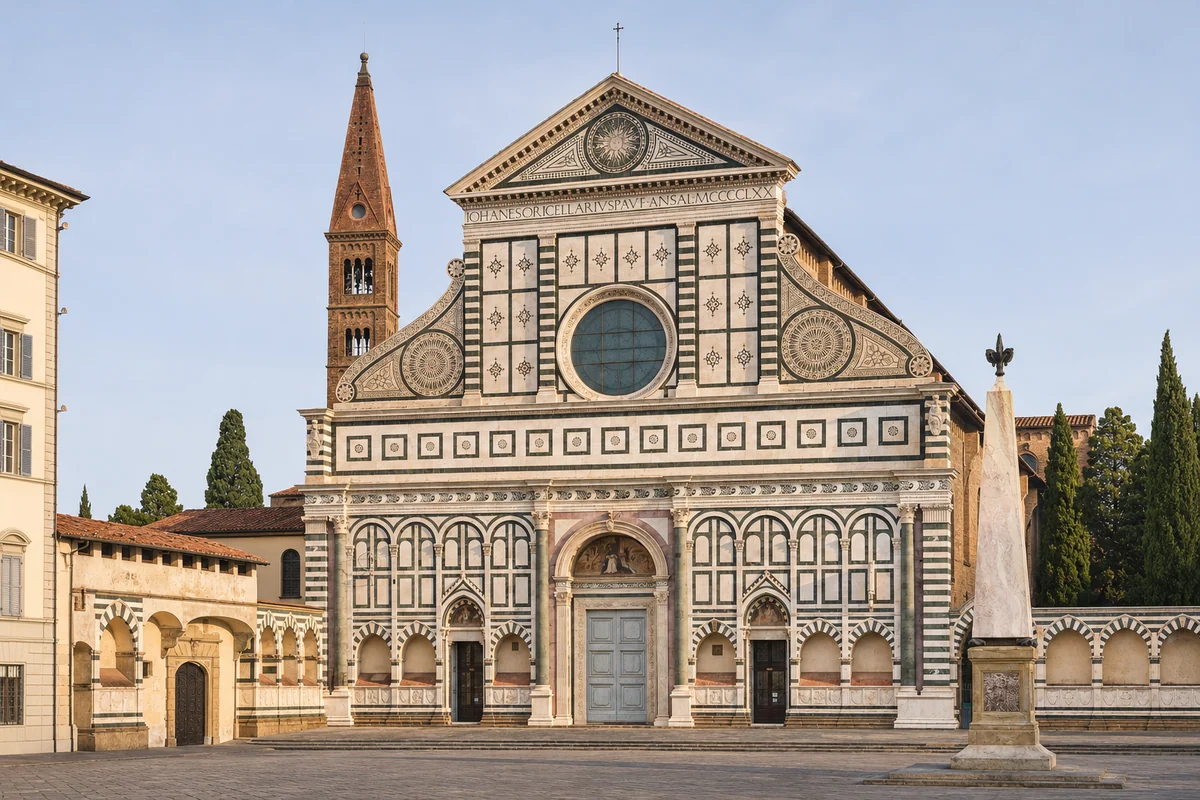
Santa Maria Novella
Step back across the square to see the whole marble front. The pointed arches over the older tombs sit low on the façade. Above them, Alberti used a band of squares and broad scrolls to join the wider base to the narrower wall of the nave. Look for the large round window already in place when he began.
Getting around
From Piazza della Santissima Annunziata take Via dei Servi towards the centre, then turn towards Via Cavour for Palazzo Medici Riccardi. Continue past San Lorenzo and through the centre to Piazza Strozzi. From there it is a short walk to Piazza di Santa Maria Novella.
