

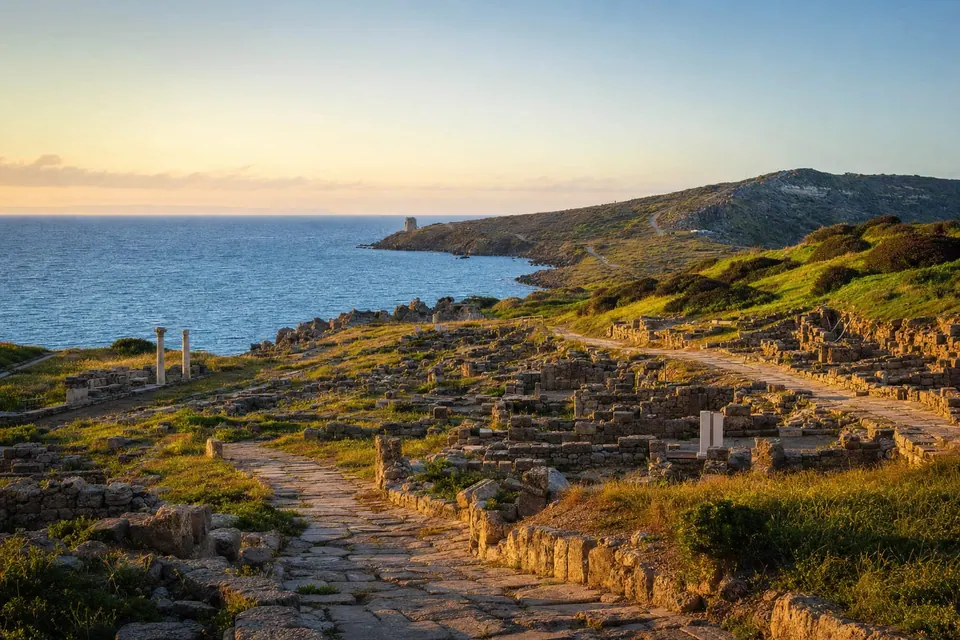
At the tip of the Sinis peninsula, Tharros occupies a strip of land between the Gulf of Oristano and open sea. Take a moment above the ruins to see the slope and the narrowness of the approach. Phoenician settlement, Punic rebuilding and Roman streets occupy some of the same ground. The view from above helps you read the city before you start looking at individual walls.
Follow the streets towards the baths
Start with the dark stone paving and look at how the streets bend across the hill. Compare their scale with the narrower spaces around the houses. Farther down, the Roman baths give an idea of the public buildings that served the town. Look out for the older carved bedrock and temple remains alongside the Roman work. The sequence of building matters here because so many phases survive side by side.
Allow a second stop on the Sinis
The Spanish tower above the site gives a different angle on the ruins and has its own opening hours. The Giovanni Marongiu Civic Museum is in Cabras itself. See the archaeological area first if you want to relate the museum’s finds to streets and buildings at Tharros. If the wind is strong on the headland, allow more time indoors in Cabras. Keep the winter last entry and the separate journey to the museum in mind.

