

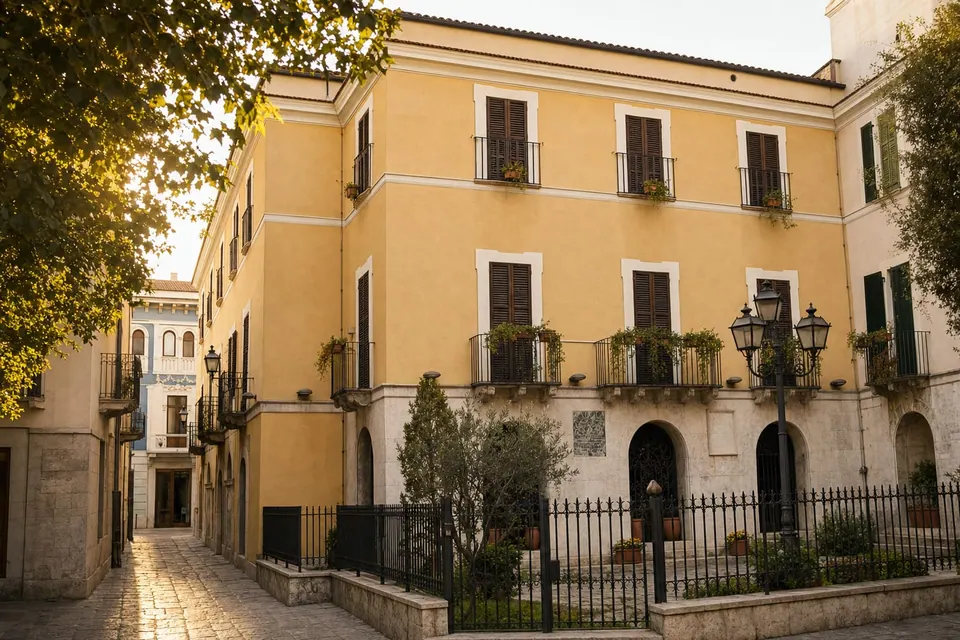
In the old town of Pescara, on the main street of a city once enclosed by a military fortress, Gabriele d’Annunzio’s birthplace retains the character of a nineteenth-century bourgeois home. He was born here on 12 March 1863 and spent his childhood here until, at eleven, he left for school in Prato. Several restoration and consolidation campaigns have preserved the building’s original domestic type.
Upstairs, the first five rooms bring together period furnishings, household objects and paintings. Panels draw on d’Annunzio’s Notturno, letting his own words accompany the rooms of his childhood. In the reception rooms, tempera paintings spread across the vaulted ceilings: vegetal candelabra, putti and fantastical animals follow neoclassical designs. At ground level, a small courtyard gathers around a brick well; nearby, the stable commemorates the poet’s first horses, Aquilino and Murgione, known as Silvano.
Other rooms shift from family memories to the public figure d’Annunzio fashioned. His wardrobe includes a red coat worn for hunting or equestrian events and gilded sandals for summer dress. First editions of his works retain their woodcut illustrations. A more intimate display preserves casts of his face and hand, taken from his body by sculptor Arrigo Minerbi on the night of 1 March 1938, just after his death. War relics, period photographs and a general’s uniforms complete the rooms devoted to the poet-soldier.
The house was declared a National Monument in 1927 by decree under Mussolini, at d’Annunzio’s request to secure state protection. It passed to state property in 1958 and later came under the Ministry of Culture. The rooms in Pescara recall his beginnings. From 1921, in Gardone Riviera on Lake Garda, he built the Vittoriale complex with architect Gian Carlo Maroni.
Born here in 1863, d’Annunzio spent his childhood in the house before leaving for school in Prato at eleven. Declared a National Monument in 1927 at his request, it passed to state property in 1958 and later came under Ministry protection. The house preserves the setting of his beginnings; the Vittoriale in Gardone Riviera belongs to a later chapter.


