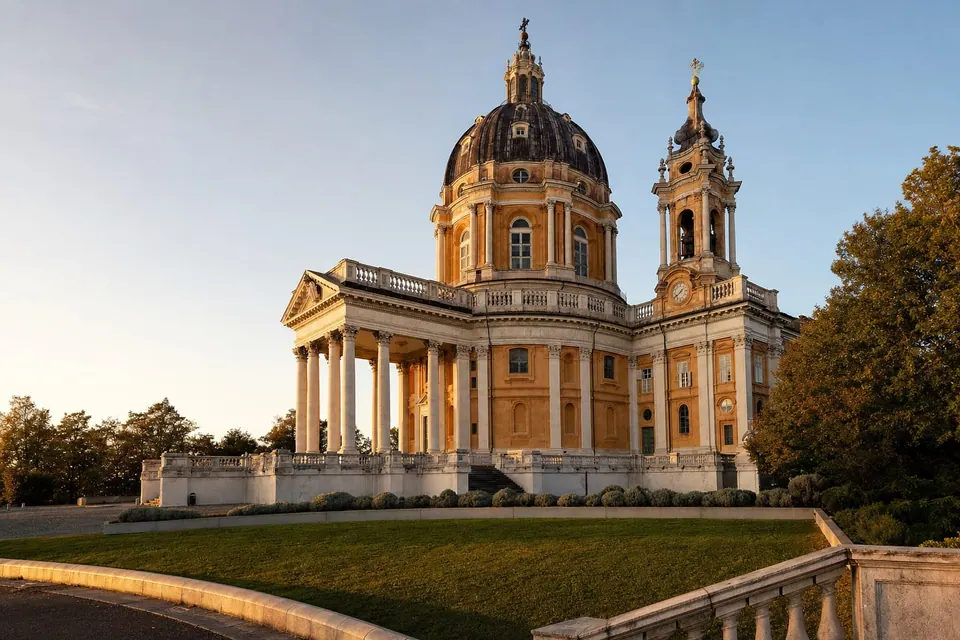
Filippo Juvarra set this domed basilica on Superga's summit between 1717 and 1731. Its origin is traditionally linked to a vow Victor Amadeus II made during the 1706 siege of Turin, promising a shrine to the Virgin if the city held. Juvarra's dome, recalling Michelangelo's project for Saint Peter's, has crowned the hill ever since.
The Savoys chose its crypt for their tombs: members of the dynasty, including kings of Sardinia, lie here. Italy's kings rest elsewhere. The hill carries a second, darker memory. On 4 May 1949, a plane carrying the Grande Torino football team home from Lisbon crashed into the basilica's rear retaining wall. All 31 people aboard died. The memorial behind the church remains a place of remembrance for supporters who return to Superga each May.
A vow and a royal project
The story begins with Turin’s siege in 1706 and the vow remembered by the sanctuary. The building took shape later: Antonio Bertola drew up an initial proposal in 1713, and Juvarra revised it in 1715. Work began in 1717; the basilica opened for worship in 1731.1,2,3,4,5
Look at the relationship between the columned portico, the central-plan church and the high drum carrying the dome. The double shell gives the dome its layered structure. Its Roman references, including Saint Peter’s, belong to Juvarra’s architectural language rather than to a copy of a single building.3,4,5
A dynasty beneath the church
The underground royal mausoleum belongs to a later phase, completed in the 1770s by Francesco Martinez and Carlo Amedeo Rana. It turns the hilltop sanctuary into a family burial place as well as a church commemorating victory.3,6
The distinction between the Savoy dynasty and the Kingdom of Italy matters here. Superga holds members of the House of Savoy, including Sardinian kings; the kings of unified Italy rest elsewhere. Allow time for the accompanied tomb visit if this dynastic history is part of what brings you to the hill.3,6,7,8,9
The memory of Grande Torino
Behind the church, the memorial plaque gives the visit a very different focus. On 4 May 1949, the plane bringing Torino’s team home from Lisbon struck the rear retaining wall. The 31 victims included players and other people travelling with them; the loss belongs to the history of the whole city.10,11,12,13
Supporters return to Superga each 4 May to remember Grande Torino. Leave a little time for the memorial rather than treating the hill only as a panorama stop. The royal crypt, the church and this place of remembrance tell different parts of Turin’s story within one visit.3,6,10,11,12,13
Choose the parts of your visit
The church and Chapel of the Vow are free; the dome, Royal Tombs and Royal Apartment have separate paid visits. The two royal-area tours are accompanied in Italian and last 45 minutes. The apartment has only two standard visits a day, so check availability before planning the rest of your day around it. The original apartment plan was never completed; some rooms now display Savoy furnishings and artworks, while the unfinished part is not open to visitors.7,8,9,14,15,16
Keep about two hours as a planning estimate for the ascent, church and panoramic part of the visit, adding time for royal-area tours and waiting between departures. Check both the Basilica’s current opening information and GTT’s timetable. Access arrangements vary by area.7,8,9,17,18