

Skip to content
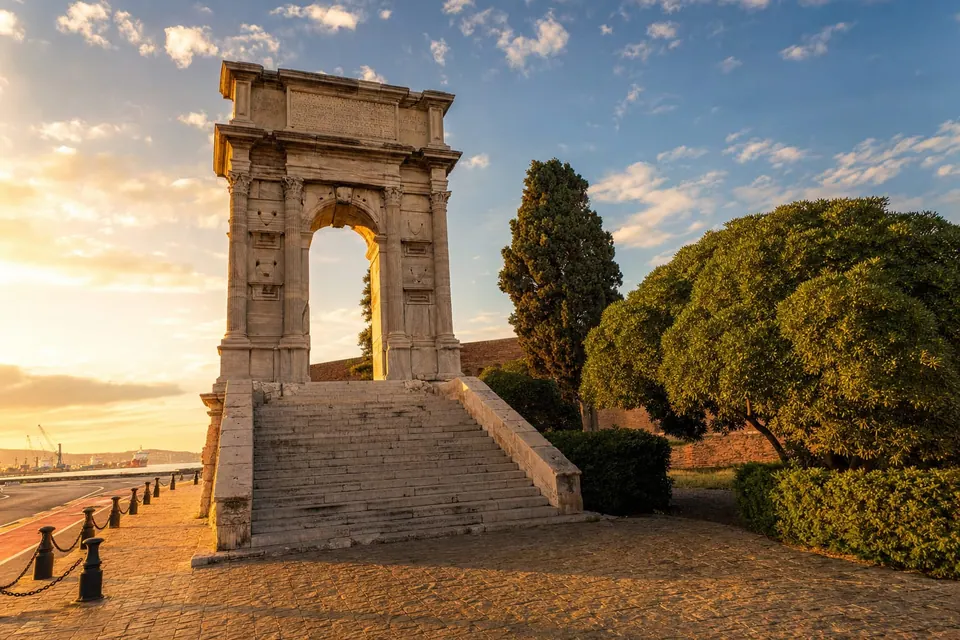
Trajan's slender Arch of Trajan of Ancona on the harbor mole at dusk

Arch of Trajan of Ancona

Walk Ancona’s old harbour mole to Trajan’s marble arch, read its Roman dedication and see how Vanvitelli framed the port seventeen centuries later.

  • Ancona
  • Monument
Where
Ancona
Best for
Harbor-mole arch of 115 AD
Allow
15 minutes
Tickets
Free

An arch built for sailors to see

Follow the old harbour towards the top of the mole. The arch stands above the quay, pale against a port that still receives ferries. In the early second century CE, the Romans put up this monument to honour Trajan for enlarging and securing Ancona’s harbour. It wasn’t a city gate. Its narrow opening, high base and tall Corinthian columns give it a profile you can pick out from a distance, the way an arriving sailor would have done.

Three names above the opening

Look at the high panel above the columns from the landward side. The central dedication is to Trajan; his wife Plotina and his sister Marciana are named on either side. The missing metal decoration is part of the building’s story: the marble gives a much plainer impression now than it would have when bronze ornament caught the light. The design is traditionally attributed to Apollodorus of Damascus.

Two arches, two ideas of a port

Continue as far as the public route permits towards the Arco Clementino, designed by Luigi Vanvitelli in the eighteenth century. Its opening frames the older arch and the cathedral on Guasco Hill. Compare the two: one marked imperial investment in a harbour, the other gave visitors a ceremonial gateway from the sea. For the reverse view, go up to Ancona Cathedral and look back down to the mole.

Fluted marble column bases at the Arch of Trajan of Ancona overlooking curved tracks, moored working boats and the harbour
The marble columns of Trajan’s Arch rise beside Ancona’s working quay on the old harbour mole.

Three things worth finding

If you see nothing else, see these.

  1. The dedication on the attic

    From the city side, trace the names of Trajan, Plotina and Marciana.

  2. The high base

    Look up from quay level to see how the base changes the proportions of the single opening.

  3. Vanvitelli’s frame

    Where the public route allows, look from the Arco Clementino towards the cathedral.

Plan your visit

Tickets
Free
Booking
Check booking requirements
Time needed
15 minutes
Best time
Late afternoon, when low sun catches the white marble against the water.
Getting there
Head to Lungomare Vanvitelli and follow the Porto Antico pedestrian route. Ferry vehicle lanes and restricted quays are separate.
Accessibility
Look from the public quayside if you need to avoid stairs. The raised passage through the monument itself is not wheelchair accessible.

Free outdoor monument. Follow public signs and any temporary restrictions at the working port.

Start from the city side for the inscription, then compare the two arches from farther back.

Get directionsGoogle MapsApple Maps

Good to know

Is there a ticket or interior to visit?

The Roman arch is an outdoor monument, with no ticket or interior galleries. Public access to specific parts of the quay can change with port operations.

Are the two arches from the same period?

No. Trajan’s arch is Roman; Vanvitelli’s Arco Clementino was built for Pope Clement XII in 1738, at the junction of the old and new moles.

How long should I allow?

About half an hour for the two arches and the quay. Allow extra time if you are walking uphill to San Ciriaco.

A letter from Italy, once a month.

Each month: one story, two recipes, an ingredient and a wine of the month, places worth the trip, and the month’s calendar.

One letter a month. Unsubscribe at any time. We never share your address. Choose your desks