

Skip to content
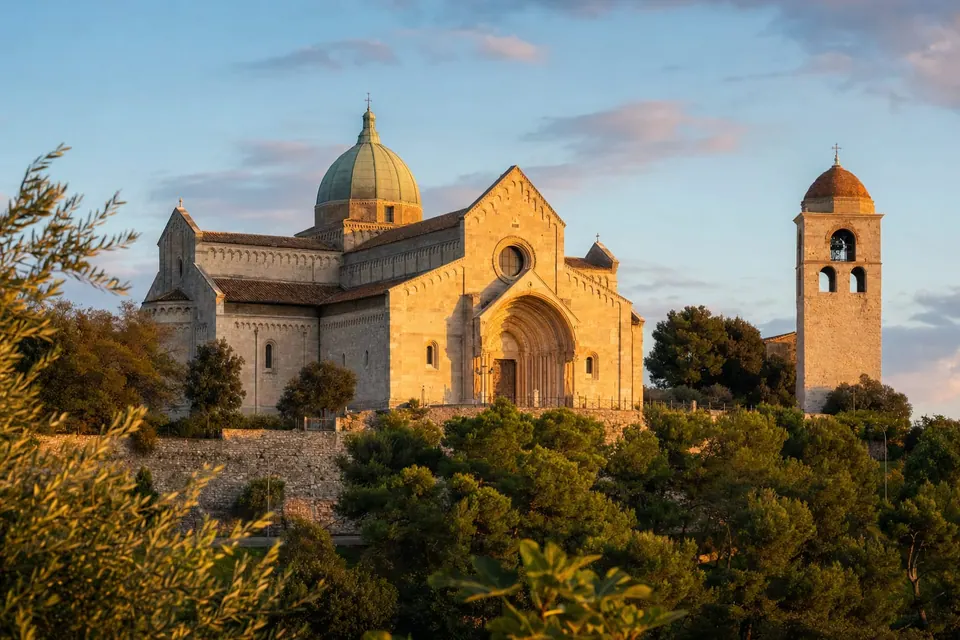
Ancona Cathedral, San Ciriaco, on its harbor hill above Ancona

Ancona Cathedral

Above Ancona’s harbour, look for the cathedral’s red marble lions, ship-hull ceilings, medieval dome and a shrine by Luigi Vanvitelli.

  • Ancona
  • Church
Where
Colle Guasco, Ancona
Best for
Its Greek-cross plan
Allow
30 minutes

San Ciriaco looks over Ancona and its gulf from Guasco Hill, the site of the ancient city’s acropolis. Local tradition places a Greek temple to Aphrodite beneath the cathedral, where the earlier building’s foundations were found. The seaward setting connects San Ciriaco, Ancona’s religious symbol, with the Arch of Trajan at the harbour, its secular counterpart. Together they give the city’s relationship with the sea an architectural form.

At the entrance, white stone from Monte Conero and pink Verona marble distinguish the medieval porch. Look down at the two red-marble lions at the portal’s base: one grips a serpent, the other a lamb. Their different carvings reward a pause before entering.

Inside, follow the arms of the Greek-cross plan and look up. The main naves have ceilings shaped like an upturned ship’s hull; the medieval dome is articulated by twelve ribs, with praying angels on its supporting pendentives. The building’s Romanesque and Byzantine elements become easier to read when you follow those lines from floor to roof.

The raised transepts sit over two crypts with different histories. The right was a lapidary space dedicated to the Madonna delle Lacrime; the left holds the remains of Ancona’s patron saints. Elsewhere in the church, Luigi Vanvitelli’s elliptical shrine of 1739 frames the image of the Madonna Regina di tutti i Santi, a later chapter within the medieval building. For the wider setting beyond the hill, continue with our Ancona guide.

The cathedral developed through distinct phases on Guasco Hill. A sixth-century basilica with three naves, dedicated to San Lorenzo, stood on the foundations of an earlier building. An addition at right angles around the tenth century produced the Greek-cross plan. The porch was added in the thirteenth century; later medieval work changed the choir and dome. The 1739 shrine by Luigi Vanvitelli adds another period to the interior.

Look closer

Low oblique detail of three pale stone steps, two fluted column bases and the recessed doorway of the side porch at Ancona Cathedral
Stone steps at the side entranceThree shallow steps lead to the platform beneath the side porch’s fluted columns. The low framing follows their relationship to the recessed doorway.
Two rose-colored stone lions on separate plinths beside the main portal of Ancona Cathedral
The portal lions at Ancona CathedralTwo carved stone lions support the porch columns at Ancona Cathedral.

Three things worth finding

If you see nothing else, see these.

  1. The acropolis and Aphrodite tradition

    Foundations of an earlier building survive beneath the cathedral, on a site traditionally associated with a Greek temple of Aphrodite.Guasco Hill, beneath the cathedral site

  2. The portal lions

    The two red-marble lions hold different creatures: one a serpent, the other a lamb. The porch combines white Conero stone and pink Verona marble.At the base of the white-stone entrance portal

  3. Greek-cross plan and medieval dome

    An orthogonal addition around the tenth century produced the Greek-cross plan. The medieval dome has twelve ribs, with praying angels on its pendentives.Interior, beneath the central dome

Plan your visit

Booking
Requirement is not stated; confirm with the museum before visiting
Time needed
30 minutes
Best time
Between services, on a clear day if you want to see both the harbour and the cathedral details.
Getting there
The cathedral stands on Guasco Hill above Ancona and its gulf. Plan your approach to the hill before setting out. If you need a step-free route or access to a particular part of the church, ask the Museo Diocesano about the approach and entrance in advance: +39 071 52688 or museo.ancona@diocesi.ancona.it.
Accessibility
Before travelling, ask the Museo Diocesano about a step-free approach, the route through the church and access to each crypt: +39 071 52688 or museo.ancona@diocesi.ancona.it. Agree a route suited to your needs; level access to all these spaces is not guaranteed.

Visit the cathedral outside services. For museum tickets, guided visits and crypt access, contact the Museo Diocesano separately at +39 071 52688.

As a planning estimate, allow about 30 minutes for a focused cathedral visit, with the approach up Guasco Hill planned separately. First compare the serpent and lamb on the entrance lions, then look for the ship-hull ceiling and the Vanvitelli shrine. Confirm whether the crypts are open before allowing time for them.

Directions to Cathedral forecourt on Piazza del DuomoGoogle MapsApple Maps

Colle Guasco, Ancona, Italy

Good to know

What stood on Guasco Hill before the cathedral?

Local tradition places a temple of Aphrodite on the acropolis. A sixth-century basilica dedicated to San Lorenzo rose over the earlier building, with three naves.

How does the Arch of Trajan relate to San Ciriaco?

Look down from Guasco Hill to trace the distance between them: the cathedral crowns the old acropolis while the Roman arch stands on the harbour’s ancient mole. You can visit both on the same walk.

What should I look for at the entrance?

White Conero stone and pink Verona marble frame the porch. Look below for the two red lions and follow their paws to find the serpent and lamb.

What architectural details are distinctive inside?

The Greek-cross plan, the nave ceiling shaped like an upturned ship’s hull, and the medieval dome with twelve ribs and praying angels on its pendentives. The choir and dome belong to a later phase than the early basilica and the tenth-century plan change.

Can visitors enter both crypts?

Two crypts lie beneath the transepts and contain different collections. Before planning to enter either, ask the Museo Diocesano which spaces are open and how to reach them: +39 071 52688 or museo.ancona@diocesi.ancona.it.

Is there an admission fee or do I need to book?

Plan your cathedral visit around services. For a guided itinerary, the neighbouring museum or a look into the crypts, check arrangements separately at +39 071 52688.

A letter from Italy, once a month.

Each month: one story, two recipes, an ingredient and a wine of the month, places worth the trip, and the month’s calendar.

One letter a month. Unsubscribe at any time. We never share your address. Choose your desks