

Start with the excavated ground
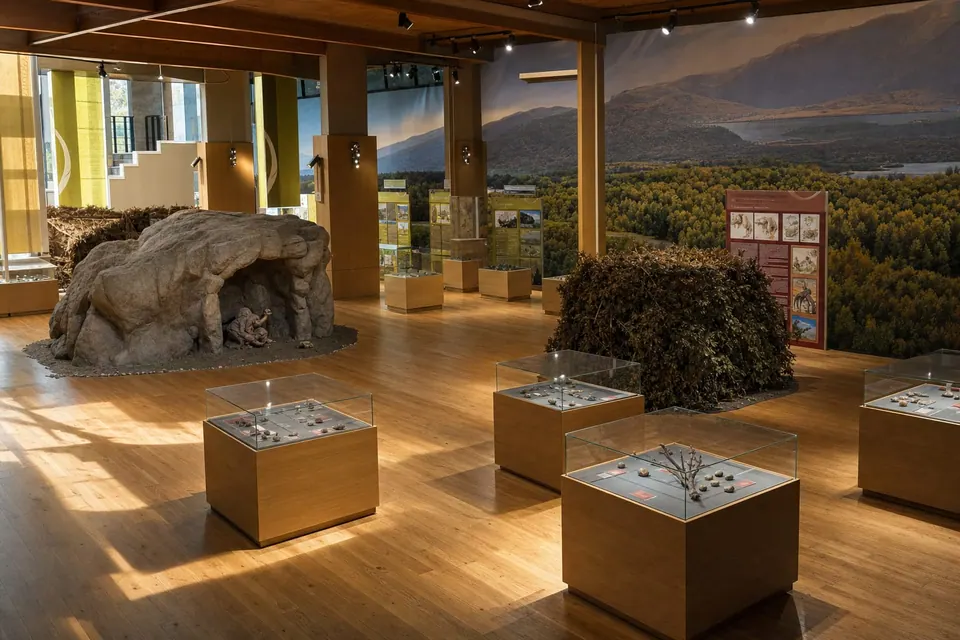
Work on a road brought La Pineta to light in 1978. The museum now stands beside the excavation at the eastern edge of Isernia. In the galleries, thousands of original finds lie in the positions where they were recorded on a reconstructed patch of the buried surface. Look for pieces of bone and stone close together. Their positions are part of the evidence, just as the objects themselves are. A covered pavilion protects the excavation nearby.
From a child’s tooth to a giant deer
The milk incisor is easy to miss among the larger finds. The layer in which it was found dates to roughly 583,000–561,000 years ago in the published study. Use the digital scan to examine the little tooth before moving to the life-size animals. Compare the model of the giant deer with its fossil antler and the straight-tusked elephant model with the tusk in the case. The displays let you move between the evidence and the animal it helps reconstruct.


